Examining the claims of Jonathan Neville and the Heartland movement

Showing posts sorted by relevance for query twocumorahfraud. Sort by date Show all posts

Friday, September 18, 2020

We get fan mail

I welcome all comments, especially ones that disagree with something I’ve written.

My only rule is that comments must be thoughtful. I don’t publish “drive-by” comments.

So, while I won’t be publishing the following comment, I do wish to demonstrate to “TwoCumorahFraud” that I don’t censor, obviously or otherwise:
Comment from TwoCumorahFraud on the Neville-Neville Land blog, 17 September 2020
Jonathan Neville insists that “those who accept the New York Cumorah are happy to discuss their reasoning and are confident, not defensive.”

TwoCumorahFraud’s comment doesn’t seem to be a good representative of his assertion.

—Peter Pan

Monday, March 14, 2022

Follow-up: The character of Stephen Reed (“TwoCumorahFraud”)

My last post was an open letter to Stephen Reed, a zealous Heartlander and conspiracy theorist (two things which often go hand-in-hand).

Mr. Reed regularly comment-bombs this blog with hateful, petty, immature remarks. I don’t usually approve his comments to be published; this only causes him to mock me for supposedly being afraid of the truth, yadda, yadda.

Here’s an example of one of his latest comments. I’m posting this only because I want my readers to know the kind of remarks that prompted my open letter to him. I don’t know Mr. Reed personally, but his comments clearly demonstrate that he’s obsessed and possibly somewhat unhinged.

Rod Meldrum’s FIRM Foundation has published Mr. Reed’s writings. Take that as you will.

—Peter Pan
 

Saturday, March 12, 2022

An open letter to Stephen Reed, aka “TwoCumorahFraud”


Mr. Reed,

Please stop leaving childish and insulting comments on this blog. I won’t approve them to be published, and I’m tempted to flag them as spam.

Regular readers of this blog are already acquainted with your claims and your insolent manner, so please find another blog to harass, if you would be so kind.

—Peter Pan
Golden retriever puppy running
Since I don’t have a photo to go with this post, here’s one of a Golden Retreiver puppy. Because everyone loves puppies. Even Stephen Reed, I’ll wager.

Friday, September 24, 2021

The latest Neville Land fan mail

Stephen Reed, who goes by the online pseudonym “TwoCumorahFraud,” is a belligerent Heartlander who regularly leaves comments on this blog. Some of his comments I’ve published; others I leave permanently in the moderation queue because they’re insulting or nasty.

He recently left this comment:
Peter Pan is one to believe in the Limited Mesoamerica geography theory, requiring the Prophet Moroni to wander for some 40 years and travel thousands of miles from Central America to present-day New York with the gold plates and the Urim and Thummim in his care for four decades. Then the Prophet Moroni carefully buried both objects in the ground with water-tight cement concealed under a stone. Then when Moroni reveals said objects to Joseph Smith, the boy-prophet needs neither to translate the plates, because he already had a rock and a hat. Then Peter Pan calls Jonathan Neville an idiot, while Pan can’t think logically for himself but has to rely on some idiot scholars to do the thinking for him.
I’m featuring this comment as its own blog post because I think it merits a response.

“Peter Pan is one to believe in the Limited Mesoamerica geography theory, requiring the Prophet Moroni to wander for some 40 years and travel thousands of miles from Central America to present-day New York with the gold plates and the Urim and Thummim in his care for four decades.”

I do think that Mesoamerica does present the strongest case, archaeologically and anthropologically, for being the area where the Book of Mormon took place. Why Stephen Reed is critical of the claim that Moroni traveled on foot from Mesoamerica to western New York is beyond me.

  • The Nephites made their last stand against Lamanites 384 years after the sign of the birth of Christ. (Mormon 6:5)
  • By the 400th year, the Lamanites had hunted down and killed all the Nephites, and the whole face of the land was covered by Lamantites and robbers. (Mormon 8:6–9)
  • Moroni was the only survivor among his people: “I make not myself known to the Lamanites lest they should destroy me.… Wherefore, I wander whithersoever I can for the safety of mine own life.” (Moroni 1:1, 3)
  • After more than 420 years since the sign of the birth of Christ, Moroni sealed up the records. (Moroni 10:1–2)

Google Maps directions from Veracruz, Mexico, to Palmyra, New York, United States Moroni had wandered away from the Lamanites for at least twenty-one years (421 − 400 = 21) and possibly as long as thirty-seven years (421 − 384 = 37). A direct journey from the area just north of the Isthmus of Tehuantepec to western New York would be a distance of just over 4,000 kilometers or about 2,500 miles. An individual could walk that in twenty-one years by traveling just .53 kilometers—one-third of a mile—per day. That gives Moroni more than enough time to make the journey, even allowing for an indirect route.

Heartlanders like Stephen Reed, on the other hand, would have us believe that Moroni “wander[ed] whithersoever I can for the safety of mine own life” for more than two decades by staying near the hill Cumorah, even though Lamanites covered “the whole face of the land.” This makes little sense from a rational standpoint and does not line up with Moroni’s account.

“Then the Prophet Moroni carefully buried both objects in the ground with water-tight cement concealed under a stone.”

Yes. Since ancient American cement has been found only in Mesoamerica, it makes sense that Moroni would have brought the knowledge of how to make limestone cement with him. No one in the American Midwest or Northeast ca. AD 400 would have known how to do this.

“Then when Moroni reveals said objects to Joseph Smith, the boy-prophet needs neither to translate the plates, because he already had a rock and a hat.”

This statement makes zero sense. Whether Joseph Smith used a stone in a hat or “two stones in silver bows” (or both) to translate the Book of Mormon, he still needed to translate it. Since he couldn’t read the language on the plates, the translation was accomplished through divine aid, “by the gift and power of God.”

“Then Peter Pan calls Jonathan Neville an idiot, while Pan can’t think logically for himself but has to rely on some idiot scholars to do the thinking for him.”

To the best of my knowledge, I have never called Jonathan Neville an “idiot.” There’s certainly nothing in the 275 published posts on this blog that shows I’ve ever used that word to refer to him. And not only have I not said or written it, I also do not believe it to be the case. Jonathan Neville is often mistaken and sometimes dishonest, but he is not of low intellect.

Stephen Reed, on the other hand, has explicitly stated in his comment that it’s his opinion that people who advocate for a Mesoamerican setting for the Book of Mormon are “idiot scholars.” If this is how he talks about fellow Latter-day Saints, then he sounds like a charming individual indeed.

—Peter Pan

Postscript: Stephen Reed left a comment on this blog post that you can read here. In it, he makes numerous historical claims without once providing evidence that Latter-day Saint scholarship is in any way derivative of the works he cites. I’m not going to publish his post because he repeatedly refers to me and everyone else who disagrees with him as “ignorant and an idiot.” Mr. Reed apparently does not know how to have anything approaching a civil conversation.
 

Wednesday, March 15, 2023

Why the Mesoamerican photos in the 1963–1981 Book of Mormon are important

In my last post, I shared a set of photographs that were published by The Church of Jesus Christ of Latter-day Saints in the 1963–1981 missionary edition of the Book of Mormon. These photos of of ancient sites, murals, textiles, and crafts from Mesoamerica are clear evidence that leaders of the Church since at least the early 1960s have considered Mesoamerica and South America to be potential locations for Book of Mormon events. (The publication of multiple articles in the Ensign magazine in the 1980s shows that belief persisted after the photographs were no longer included in the Church-published Book of Mormon.)

Our old fried “TwoCumorahFraud,” whose immature, mocking comments I no longer publish (see here), left a comment on that post that began with:
But The Church of Jesus of Christ of Latter-day Saints never taught the Two Cumorahs theory.
Heartlanders like Mr. Fraud and Jonathan Neville assert that mention in Church publications of connections between the Book of Mormon and Mesoamerican sites and artifacts is okay, as long as it doesn’t mean that the hill Cumorah itself was located in Mesoamerica. They insist—for reasons that still perplex me—that the hill Cumorah in western New York must be the one and only Cumorah and the place where the final battles of the Jaredites and the Nephites were fought because some leaders of the Church said it was.

The problem is that there’s no reasonable way to admit that at least some of the narrative of the Book of Mormon took place in Mesoamerica and also insist that the hill in New York was the hill Cumorah described in Mormon chapter 6.

The problem—which John Sorenson documented decades ago—has to do with travel distances. The Book of Mormon doesn’t measure the distances it took for people to travel from one place to another in miles or kilometers, but it does regularly mention how many days it took for people on foot to go from point A to point B.

For example, the book of Mosiah describes Ammon¹ and his party departing Zarahemla and going south, up to the land of Lehi-Nephi: “And now, they knew not the course they should travel in the wilderness to go up to the land of Lehi-Nephi; therefore they wandered many days in the wilderness, even forty days did they wander” (Mosiah 7:4) “Wandering” clearly indicates that they did not know the route, so that tells us that a person who did know the route could make the same trip in less time. And that’s exactly what we see when Alma¹’s group makes the same trip, only in reverse, in approximately 22 days. This translates to a maximum distance of between 225 and 260 miles between Lehi-Nephi and Zarahemla. (See Sorenson’s The Geography of Book of Mormon Events: A Source Book, p. 229.)

That distance is important because we also read about an earlier expedition sent by King Limhi from Lehi-Nephi to find Zarahemla:
And [King Limhi] said unto [Ammon¹]: Being grieved for the afflictions of my people, I caused that forty and three of my people should take a journey into the wilderness, that thereby they might find the land of Zarahemla, that we might appeal unto our brethren to deliver us out of bondage. And they were lost in the wilderness for the space of many days, yet they were diligent, and found not the land of Zarahemla but returned to this land, having traveled in a land among many waters, having discovered a land which was covered with bones of men, and of beasts, and was also covered with ruins of buildings of every kind, having discovered a land which had been peopled with a people who were as numerous as the hosts of Israel. (Mosiah 8:7–8)
Limhi’s expeditionary party did not know the way to Zarahemla; they only knew that it was in the lowlands to the north of the land of Nephi. This group was “lost in the wilderness for the space of many days,” but they eventually stumbled upon “a land among many waters” and discovered the ruins and remains of the Jaredite people. This land featured the hill Cumorah, which the Jaredites had called Ramah (Ether 15:11).

From this narrative, we can logically infer that the men of Limhi’s expedition knew the basic direction in which they needed to travel to get to Zarahemla; they just didn’t know the exact way to get there. They were only two generations removed from when their ancestor, Zeniff, had come from the land of Zarahemla to settle in Lehi-Nephi. They missed Zarahemla, overshot it by some distance, and stumbled upon the land where the hill Cumorah was. They believed they had found Zarahemla and that it had been destroyed (Mosiah 21:26).

If they hadn’t found the remains of the Jaredites, how far would Limhi’s party have traveled before realizing they were lost and turned back? We can’t answer this question definitively from the scriptural record, but it seems implausible that they would have traveled more than twice the distance that we know it to be. Let’s be generous and give them three times the distance—750 miles.
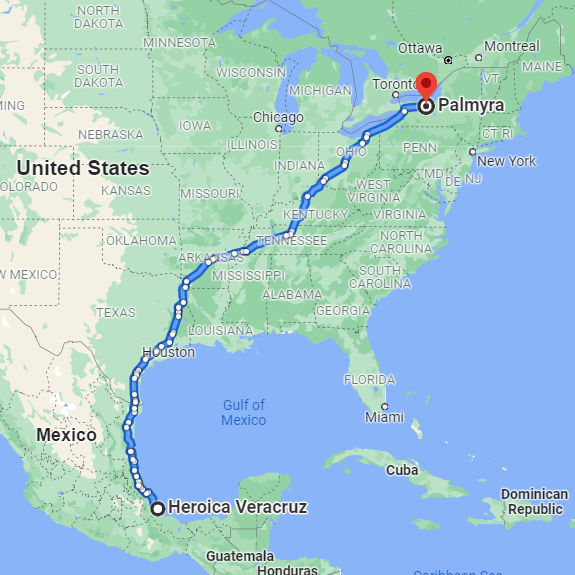
Google Maps directions from Veracruz, Mexico, to Palmyra, New York, United States And this is where we get to the important part: If at least parts of the Book of Mormon took place in Mesoamerica, as Church leaders seem to have acknowledged by using photographs of that area in the missionary edition of the Book of Mormon published in the 1960s and 1970s, then it would have been impossible for Limhi’s expeditionary group to have traveled from there to western New York, a journey on foot of about 2,500 miles.

So it’s extremely unlikely—and I would argue impossible—for any part of the Book of Mormon to have taken place in Mesoamerica and still have the hill Cumorah of Mormon chapter 6 be in western New York. The distances just don’t work out.

Therefore, according to Heartlanders, the leaders of the Church must have been mistaken to include photographs of Mesoamerican and South American sites and artifacts in the 1963–1981 missionary edition of the Book of Mormon. Those were in no way connected to the peoples and civilizations of the Book of Mormon.

That’s not any different than Mesoamericanists claiming that leaders of the Church who have insisted on a single location for Cumorah—in the absence of any revelation on the subject, I wish to point out—were also mistaken.

Both theories require that one explain contrary statements and publications by Church leaders. It’s not nearly as cut-and-dried as the Heartlanders’ “scholars vs. prophets” claim would have us believe.

—Peter Pan
 

Saturday, December 31, 2022

Neville-Neville Land 2022 year in review

2022 M2C NPCsThe end of 2022 brings to a close the fourth year I’ve been publishing this blog. What started as something of a lark has developed into a full-blown escapade.

This year I published 48 posts examining the iconoclastic beliefs and assertions of Jonathan Neville and his associates in the so-called “Heartland” Book of Mormon movement. That’s down from 72 in 2021 and 74 in 2020. The reduced number of posts this year has been due mostly to (a) my increasingly busy schedule and (b) Jonathan Neville’s regular routine of regurgitating the same content over and over again, only using just ever-so-slightly different words. There’s only so many times that I can write about (to use just one example) his repeated fatuous assertion that people who don’t agree with him are “rejecting the teachings of the prophets.”

Among the significant developments this year in Neville-Neville Land, I would include the following:


Finally, here are the top ten Neville-Neville Land posts for 2022 by number of reads:

  1. The First Presidency reviewed Saints before publication (July 27, 2022).
  2. Jonathan Neville reacts to Spencer Kraus’s reviews (June 30, 2022).
  3. President Nelson and the attention to detail in Saints (August 4, 2022).
  4. Follow-up: The character of Stephen Reed (“TwoCumorahFraud”) (March 14, 2022).
  5. “Doctor Scratch,” perpetual gadfly and blowhard (July 23, 2022).
  6. Recommended watching: Spencer Kraus’s interview with Robert Boylan (July 19, 2022).
  7. Peter’s hiatus and three brief notices (March 6, 2022).
  8. Jonathan Neville’s latest folly: The Kinderhook Plates (March 30, 2022).
  9. Spencer Kraus’s devastating review of Jonathan Neville’s A Man that Can Translate (June 17, 2022).
  10. Rian Nelson pulls a Michael Scott (April 11, 2022).

Last year at this time, I wrote, “I see little evidence that Jonathan Neville will retreat from his extremist views in the coming year and bring himself more in line with the teachings of the prophets regarding the Book of Mormon and how the Prophet Joseph Smith translated it.” I’m saddened to report that I was right. However, 2023 brings a new year and new opportunities, so here’s hoping that more people will see through the transparent falsehoods of the Heartland movement in the coming year.

Happy new year!

—Peter Pan
 

Popular Posts

Search This Blog