Examining the claims of Jonathan Neville and the Heartland movement

Showing posts with label Archeology. Show all posts

Wednesday, March 30, 2022

Jonathan Neville’s latest folly: The Kinderhook Plates

Heartlanders have a tendency to accept archaeological hoaxes as genuine artifacts. The Michigan Relics (which James E. Talmage debunked over 100 years ago), the Newark Holy Stones and the Los Lunas Decalogue Stone (see here), and the Tucson Lead Artifacts (see here) have all been exposed as modern frauds, yet Heartlanders claim they are legitimate evidence of ancient Book of Mormon peoples in North America.

(This very day, in fact, The Salt Lake Tribune published an article about the Heartland movement. The article quotes Kenneth Feder, who holds a Ph.D. in anthropology and has taught that subject at Central Connecticut State University since 1977. Regarding the Newark Holy Stones, Feder says, “Archaeologists are certain it’s a hoax. Case closed.”)

Recently, Jonathan Neville sat for a half-hour interview on YouTube in which he described the history of the Kinderhook Plates and the supposed evidence for their authenticity:
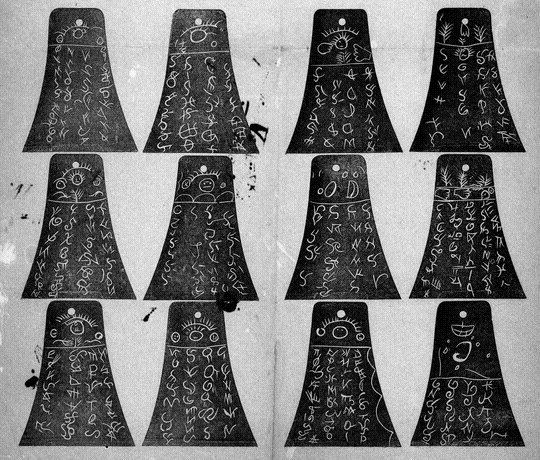
Facsimile of the Kinderhook Plates, Times and Seasons 4/12, May 1843
A facsimile of the Kinderhook Plates, published by John Taylor in the Times and Seasons, May 1, 1843. (Click to enlarge.)
The Kinderhook Plates were an attempted hoax perpetrated on the Prophet Joseph Smith. As the Church’s article about the plates explains, a group of men brought the six small, engraved, bell-shaped plates to Joseph in 1843. Joseph initially showed some interest in the plates, but he never produced a revealed translation of them.

In 1878, Wilburn Fugate claimed that he and two other men created the plates “simply for a joke.” Questions about the authenticity of the plates persisted until 1980, when Stanley B. Kimball secured permission from the Chicago Historical Society to have Northwestern University perform destructive tests on the one extant plate from the set. The findings of those tests were published in the August 1981 edition of Ensign magazine. Kimball wrote:
The extreme depth of focus and resolution of the scanning electron microscope (SEM) at high magnification make it possible to clearly distinguish between etching or engraving on metal surfaces. If a character were cut or scratched into the surface, the groove would contain secondary grooves and ridges running lengthwise within it where the engraving instrument forced a flow of metal. This would be especially noticeable at groove intersections, where metal would be pushed from the second groove into the first. On the other hand, etched lines would show no metal flows or secondary grooves; instead, a roughened, pock-marked etching would be seen.… The irregular, grainy texture characteristic of acid etching is evident, not a striated surface that would have been produced by an engraving tool.…

The X-ray fluorescence test indicated that the plate was made of a true brass alloy of approximately 73 percent copper, 24 percent zinc, and lesser amounts of other metals. In addition, an examination of the small area of the plate that was ground and polished revealed a basically “clean” alloy—that is, there were very few visible traces of impurities such as particles of slag and other debris that one might expect to find in metal of ancient manufacture.

As a result of these tests, we concluded that the plate owned by the Chicago Historical Society is not of ancient origin. We concluded that the plate was etched with acid; and as Paul Cheesman and other scholars have pointed out, ancient inhabitants would probably have engraved the plates rather than etched them with acid. Secondly, we concluded that the plate was made from a true brass alloy (copper and zinc) typical of the mid-nineteenth century; whereas the “brass” of ancient times was actually bronze, an alloy of copper and tin. Furthermore, one would expect an ancient alloy to contain larger amounts of impurities and inclusions than did the alloy tested.
Kimball’s findings match those of a non-destructive examination of the plate performed in 1966 by Latter-day Saint physicist George M. Lawrence, who concluded:
The metal of the plate is fine grained and homogeneous as are modern metals. It has no spring when flexed, like annealed copper. Except for scratches, the surface is smooth as if the plate had been rolled or ground rather than hammered or cast.…

The [plate’s] dimensions, tolerances, composition and workmanship are consistent with the facilities of an 1843 blacksmith shop and with the fraud stories of the original participants.
Despite the confession of Wilburn Fugate, the overwhelming scientific evidence, and the stated position of The Church of Jesus Christ of Latter-day Saints, Neville in his interview repeatedly claimed that the Kinderhook Plates were more likely to be authentic ancient relics than 19th-century forgeries.

With regard to the scientific tests that have been performed on the plates, Neville specifically said (beginning at 9:16):
Well, Edward [sic] Kimball did an analysis. They took—there was one plate found—all the plates were lost, but as you [the interviewer] mentioned, the one plate had been discovered, and they knew it was the same one because there was the same etching and there was a nick on one of the corners. And so they did a metallurgical analysis and determined that it was an alloy that was common in the 1800s. And so, therefore, they assumed that it really was.

And they looked at the engravings, and the guy—sorry I’m not using their names, but people who don’t care [sic] what their names are, they can look it up in Wikipedia—but the guy who claimed it was a fraud [i.e., Wilburn Fugate] said that they etched it with acid, wax and acid. And, according to this metallurgical analysis, it was etched with acid, these things [points to the engravings on his replica of the Kinderhook plates]. But, at the same time, the original story was that they [the people who discovered the plates] washed it with acid. So, if they had washed it with acid, it could have caused the same kind of indication on the marks as being etched by acid. So, there’s a little bit of ambivalence.
Not only has Neville misrepresented the scientific analyses performed on the plates, it’s not even clear that he has more than a cursory understanding of the evidence and the arguments involved.

  • The individual who arranged for the tests to be performed in 1980 was Stanley Kimball, not Edward Kimball.
  • The metallurgical tests done didn’t just determine that the plate was made from “an alloy that was common in the 1800s.” It determined that it was impossible for that alloy to be ancient, due to its high zinc content. Ancient copper–zinc alloys were composed of, at most, 15% zinc (Craddock & Lang, p. 217), while the Kinderhook plate analyzed by Northwestern University was made of 24% zinc, a percentage common for brass made in the 1800s.
  • Likewise, the purity of the tested plate’s alloy—meaning its low amount impurities and debris—is what one would find in a brass alloy of modern manufacture. Ancient alloys, created by hand with rudimentary tools and equipment, had much higher amounts of slag than what we find in the plate tested in 1980.
  • Furthermore, as George Lawrence’s analysis revealed, the surface of the plate is “smooth as if the plate had been rolled or ground rather than hammered or cast,” as it would have been if it were created anciently.
  • Neville is also incorrect in claiming that washing the plate with acid could make it appear as if it were engraved with acid. As the scanning electron microscope analysis revealed, the engravings do not show any evidence of having been cut or scratched into the plate with a tool; rather, their texture is characteristic of acid etching.

So, contrary to Neville’s glib claim that Stanley Kimball just “assumed” that the plate was made in the 1800s because of the composition of the alloy, the tests performed at Northwestern University in 1980 provided practically incontrovertible evidence that the Kinderhook Plates could not have been made anciently. There is no “ambivalence,” as Neville claims.

This yet another example of Neville misrepresenting the evidence so that it fits his predetermined beliefs. It’s to Neville’s advantage if the Kinderhook Plates are genuine, because that would mean they were discovered in the American Midwest and are of Jaredite origin, therefore proving the Heartland theory. He’s content to overlook historical and scientific evidence just to reinforce his personal beliefs.

—Peter Pan
 

Tuesday, October 26, 2021

Another excellent review from Spencer Kraus & recent finds in Mesoamerica

I’ve been preoccupied with some family matters recently, so this blog has been quiet for a few weeks. Here are two new developments my readers may be interested in:

The erudite Spencer Kraus writes:
You…may be interested in a recent review I did of Jonathan Neville’s latest interview with Mormon Book Reviews. In Part One I respond mostly to assertions made by the host, and focus more on claims made by Neville in Parts Two and Three. Neville, for instance, tries to discredit the seer stone translation [of the Book of Mormon] because the four authors of the Gospels of the New Testament didn’t use a seer stone—which is a ridiculous assertion for more than one reason. Or he claims it is a lost cause to expect to find any writing whatsoever in Book of Mormon lands—even though the Book of Mormon describes at least a semi-literate Lamanite nation.

Here are the links to all three parts for any [who are] interested:

Part One: https://latterdaylightandtruth.blogspot.com/2021/10/misrepresentation-and-miscellaneous.html

Part Two (Regarding Jonathan Edwards and the Book of Mormon): https://latterdaylightandtruth.blogspot.com/2021/10/jonathan-edwardss-purported-influence.html

Part Three (regarding baseless attacks, general misrepresentations, etc.): https://latterdaylightandtruth.blogspot.com/2021/10/misrepresenting-mesoamerica-book-of.html
Spencer’s three-part series is solid, and I recommend it to those interested in all things Neville.

In other news, the venerable publication Science posted a news article on their website on October 25, 2021, about a large number of Mesoamerican monuments that have been revealed by laser mapping:
Scientists have uncovered nearly 500 Mesoamerican monuments in southern Mexico using an airborne laser mapping technology called lidar. Dating as far back as 3000 years ago, the structures—still buried beneath vegetation—include huge artificial plateaus that may have been used for ceremonial gatherings and other religious events.…

The analysis resulted in the discovery of 478 formal complexes—many new to science—the team reports today in [the journal] Nature Human Behaviour. Several of these monuments had the same layout as Aguada Fénix, including an even more ancient Olmec site in San Lorenzo. Researchers continue to argue over whether the Olmec, which predate the Maya, are more of a mother or sister culture to them. The researchers estimate these Olmec and Maya complexes were built between 1100 and 400 B.C.E., and would have been used for ceremonial gatherings.
These findings are right in the middle of where most educated, competent Book of Mormon geographers place the events of the Book of Mormon. While the structures discovered by the lidar survey are too old to be connected to the peoples of the Book of Mormon, they are examples of the complex, developed societies that were found in ancient Mesoamerica—a striking difference from the simple Hopewell cultures in the American Midwest that had no written languages, large cities, or other features described by the Nephite authors.

After reading John L. Stephens’s 1841 book, Incidents of Travel in Central America, Chiapas, and Yucatan, Joseph Smith (with editorial assistance from John Taylor) wrote in 1842:
Mr. Stephens’ great developements of antiquities are made bare to the eyes of all the people by reading the history of the Nephites in the Book of Mormon. They lived about the narrow neck of land, which now embraces Central America, with all the cities that can be found.… Who could have dreamed that twelve years would have developed such incontrovertible testimony to the Book of Mormon? surely the Lord worketh and none can hinder.
These hundreds of new discoveries in Central America continue to show us how little we know of the ancient civilizations that inhabited that region. If twelve years (1830–1842) were enough for Joseph Smith to claim that “incontrovertible testimony” of the Book of Mormon had been found, how much more will its historicity be established as evidence continues to be uncoverered in Mesoamerica?

—Peter Pan
 

Saturday, September 4, 2021

Brigham Young, M2C intellectual

President Brigham Young made the following statement a letter written in 1876 dealing with the issue of missions and the Mormon settlements in Arizona. He wrote:
Nor do I expect we shall stop at Arizona, but I look forward to the time when the settlements of the Church of Jesus Christ of Latter day Saints will extend right through to the City of Old Mexico, and from thence on through Central America to the land where the Nephites flourished in the Golden era of their history, and this great backbone of the American Continent be filled, north and south, with the cities and temples of the people of God. In this great work I anticipate the children of Nephi, of Laman and Lemuel will take no small part.

—Brigham Young to William C. Staines, 11 January 1876, Letterbook 14:124–26 [Church catalog linkdownload image]
Brigham’s expectation could well be considered a prophecy: Church membership in Mexico has grown from just 2,314 in 1920 to 1,481,530 in 2020. In Mexico, there are thirteen operating temples, one under construction, and two more have been announced. The first convert in Guatemala wasn’t baptized until 1947; now there are 281,465 members there, plus two operating temples, one under construction, and one more announced. Truly “this great backbone of the American Continent” has been “filled, north and south, with the cities and temples of the people of God,” and the descendants of Lehi in those countries have taken “no small part” in that growth.

Yet, Heartlanders would have us believe that the Nephites flourished in their Golden era across the Mississippi River from Nauvoo. Jonathan Neville wrote an entire book about this, and his flagship website that bears the same name is subtitled “The North American Setting for the Book of Mormon.” But the Heartlanders’ evidence for Nephites in the Midwest rests almost entirely with forged and unprovenanced artifacts, the Hopewell people that Heartlanders claim were the Nephites “left no written language or recorded histories,” and no complex ancient civilizations or structures have been discovered there. All the Heartlanders have so far is a few fire pits where clams—a food forbidden by the law of Moses—were cooked.

Meanwhile, the list of prophets and Church leaders who believe that the Book of Mormon took place in Mesoamerica grows longer. —Peter Pan
 

Saturday, October 24, 2020

Those who live in glass houses, pt. 8

(Part eight of a series.)

Jonathan Neville writes:
In Joseph Smith’s translation of the Book of Mormon, there are zero accounts of people building massive stone temple, pyramids, or other structures. Yet the M2C* citation cartel has retranslated the text to describe these and other features of Mayan culture.
Setting aside his misrepresentations of Mesoamericanist arguments for a moment, Neville is in no position to criticize “M2C” Book of Mormon believers on this matter when his own writings on the Book of Mormon are filled with conjecture and downright fantasy about the Nephites and Lamanites.

Here are just a few examples from his book Moroni’s America. (Page numbers here refer to the Moroni’s America – Maps Edition volume he edited.)
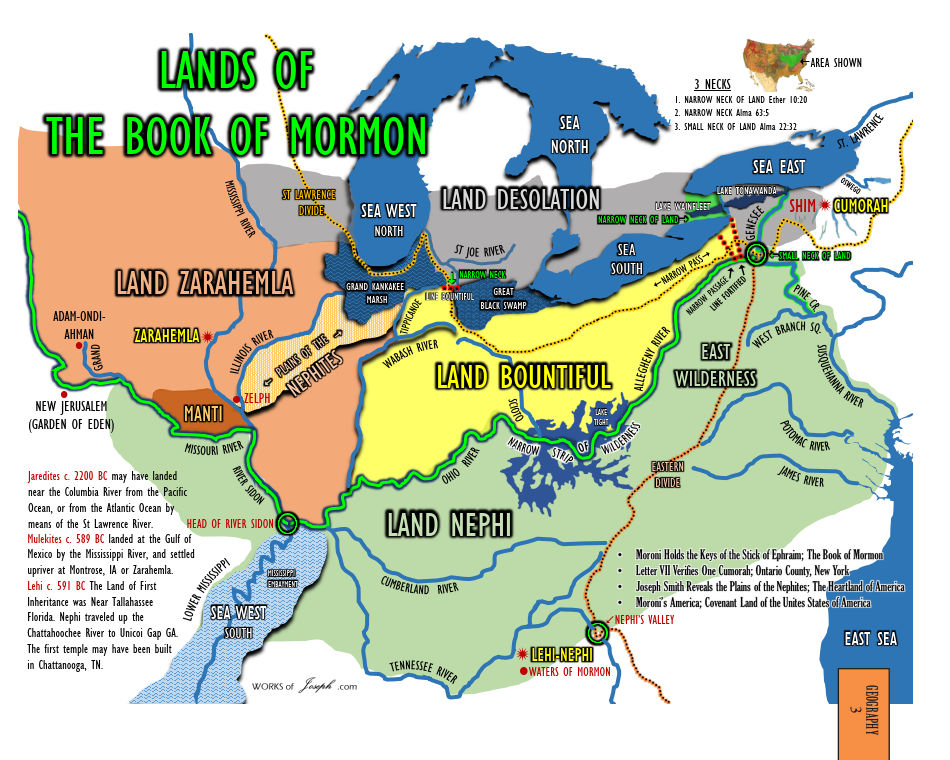
Jonathan Neville's Lands of the Book of Mormon fantasy map
Jonathan Neville’s fantasy map of the Book of Mormon
  • According to Neville, the term “wilderness” means “river,” and the “narrow strip of wilderness” was “a water barrier that acted as a border—effectively a fence.” (pp. 2, 9)
  • According to Neville, the Book of Mormon’s references to the “narrow pass,” “narrow passage,” “narrow neck,” “narrow neck of land,” and “small neck of land” were not references to a single, narrow passage in a narrow neck of land, but five different passes, passages, and necks spread out across a distance of nearly 500 miles. (p. 4)
  • According to Neville, the sea west was actually two seas, one south of Nephite lands (the Mississippi River delta) and one northeast of Nephite lands (Lake Michigan). (pp. 12–13)
  • According to Neville, the narrow neck between the land Bountiful and the land of Desolation was a passage between the Grand Kankakee Marsh and the Great Black Swamp. Neither the terms marsh nor swamp appear anywhere in the Book of Mormon. (p. 16)
  • According to Neville, Lehi’s prophecy that the Lord “will take away from [the descendants of the Lamanites] the lands of their possessions, and he will cause them to be scattered and smitten” (2 Nephi 1:10–11) was fulfilled “at the beginning of the 1830s, [when] nearly 125,000 Native Americans” were forced the by federal government of the United States to relocate to modern-day Oklahoma, Kansas, and Nebraska. (p. 29–30) Neville ignores the important context of Lehi’s prophecy, written by Nephi in the preceding chapter: “The Lord God will raise up a mighty nation among the Gentiles, yea, even upon the face of this land; and by them shall our seed be scattered. And after our seed is scattered the Lord God will proceed to do a marvelous work among the Gentiles, which shall be of great worth unto our seed.” (1 Nephi 22:7–8; emphasis added). Nephi informs us that the scattering of the descendants of the Lamanites will take place before the Lord’s “marvelous work” in restoring the gospel to the earth—in other words, prior to the 1830s. Lehi’s prophecy, therefore, cannot refer to the Trail of Tears.
  • According to Neville, the peoples of the Book of Mormon used rivers (which are wildernesses?) to travel extensively throughout their lands. (pp. 37, 38, 40, 88, 89) There is not a single account in the Book of Mormon of anyone traveling by boat using rivers.
  • According to Neville, Hagoth the shipbuilder sailed his “exceedingly large ship” (Alma 63:5) between the Great Lakes and eventually out the St. Lawrence River to the Atlantic Ocean. (p. 73) Before the modern invention of locks, neither the rivers and rapids that connect the Great Lakes nor the St. Lawrence River could not be navigated by boats of any size.
  • According to Neville, the Nephites fortified Bountiful (Helaman 4:7) by building a massive earth-and-wood wall from Lake Michigan, down into southern Ohio,and then up to western New York. (p. 75) This wall would have been nearly 600 miles long. Needless to say, there is absolutely zero archaeological evidence of such an enormous structure.
  • According to Neville, the Nephites had “lambs, sheep, [and] rams,” which they sacrificied according to the law of Moses. (p. 85) Sheep—domesticated or wild—did not exist anciently in the eastern part of North America; they were introduced to the continent by the Spaniards. Sheep are mentioned twenty-five times in the Book of Mormon, all but once in a metaphorical context. The single passage that refers to the existence of sheep was during Jaredite times (Ether 9:18); the Nephites are never described as possessing sheep, nor using them for sacrifice.

Despite these and many other inaccuracies in Neville’s Book of Mormon claims, he feels free to criticize believers in a Mesoamerican setting for the Book of Mormon for things they never claimed in the first place.

Glass houses, indeed.

—Peter Pan

* “M2C” is Jonathan Neville’s acronym for the theory that the Book of Mormon took place in Mesoamerica and that the hill Cumorah in the Book of Mormon is not the same hill in New York where Joseph Smith received the plates of Mormon.

Sunday, July 26, 2020

A response to Opie regarding Wayne May

My recent blog post about Wayne May’s charming video prompted a comment from Opie. I thought his comment raised enough points that it would be best if I responded in a separate post.

Here’s a link to his original comment, which I’ll also reprint here:
I work closely with the LDS members you are judging and you are bearing false witness.

I followed the Mesoamerican Book of Mormon archaeology for 45 years and grew tired of the lack of results that confirmed the Book of Mormon geography. The Heartland model does not demand that we throw Joseph Smith and many others church leaders under the bus.

I do not know of anyone who has lost their testimony because of the Heartland Model, but one of the very prominent believers in Mesoamerica left the church and called the Book of Mormon a fraud (see attached article). Notice in the article in table 1 that the timeline for the Mayan culture does not fit at all within the Book of Mormon timeline. The picture of Christ walking down the stairs of a pagan Mayan temple is impossible since the Mayan buildings were not built until ~800 years after the resurrection of Jesus Christ. If you do not believe in the revelation recorded in D&C 125:3, please tells us why the Lord gave Joseph Smith this revelation? Also, please enlighten us as to what you know about Mesoamerican Book of Mormon archaeological findings that Brother Thomas Stuart Ferguson did not know that would have kept him from leaving the church. There is nothing phony here except the millions of dollars Mesoamerican Book of Mormon hoaxers has taken from the church and its members. The events recorded in the Book of Mormon took place in the eastern US and not in Southern Mexico or Guatemala. https://www.sciencemag.org/news/2018/01/how-mormon-lawyer-transformed-archaeology-mexico-and-ended-losing-his-faith
I’m grateful that Opie felt comfortable leaving a comment criticizing my post, and I’m happy to publish it and so other readers can read and engage with it.

In response to the points he raised:

“I work closely with the LDS members you are judging and you are bearing false witness.‘

I am not “judging” anyone, at least not in the soteriological sense. Rather, I’m evaluating their words and their claims.

Wayne May published a video on YouTube that accuses The Church of Jesus Christ of Latter-day Saints of hypocrisy and teaching falsehoods. He is criticizing the Church; doing so makes him a critic of the Church. Anyone who openly criticizes the Church in such a blatant way is, at the very least, flirting with apostasy.

If you’re a faithful, believing member of the Church, Opie, then I don’t understand why you believe May’s comments attacking the Church are justifiable.

“I followed the Mesoamerican Book of Mormon archaeology for 45 years and grew tired of the lack of results that confirmed the Book of Mormon geography.”

Clearly you and I have a different perspective on the results of Book of Mormon research in Mesoamerica. The case for a Mesoamerican setting for the Book of Mormon has never been stronger, thanks to the diligent efforts of credible, trained scholars like John L. Sorenson, Brant A. Gardner, Mark Alan Wright, and others.

“The Heartland model does not demand that we throw Joseph Smith and many others church leaders under the bus.”

Well, it does demand that you throw modern prophets and apostles under the bus.

Believing the Heartland model also requires one to elevate every statement made by Joseph Smith about Book of Mormon geography to the level of revelation—unless, of course, what he said or wrote contradicts the Heartland theory, in which case one must then throw him under the bus by claiming that he didn’t know what was being published in his name.

“I do not know of anyone who has lost their testimony because of the Heartland Model…”

Your anecdotal evidence tells us nothing. Certainly there must be individuals who once believed the Heartland theory who are now non-believing, non-practicing, or former members of the Church.

Of greater concern to me, though, is the current trajectory the Heartland movement. Its leaders have been making statements critical of the Church for years; more recently, these comments have even been critical of living prophets and apostles. (For just one example, see here.) If they continue on their current path, they will inevitably come to believe that the the Church is “out of the way” and form their own fundamentalist splinter group.

Mark my words. It’s happened before, and it will happen again.

“…but one of the very prominent believers in Mesoamerica left the church and called the Book of Mormon a fraud (see attached article [from ScienceMag.org]).”

“Also, please enlighten us as to what you know about Mesoamerican Book of Mormon archaeological findings that Brother Thomas Stuart Ferguson did not know that would have kept him from leaving the church.

It’s curious, Opie, that you would join with critics of the Church in singling out Thomas Ferguson as evidence of the failure of the Mesoamerican theory of Book of Mormon geography. For decades, anti-Mormons and ex-Mormons have claimed that Ferguson’s inability to find evidence of his predetermined beliefs shows how weak the claims for the authenticity of the Book of Mormon are.

The article you linked from ScienceMag.org shares all the weaknesses of those criticisms of the Church—it emphasizes Ferguson’s efforts and ignores all the research that’s been done since his time. (It likewise attacks the authenticity of the Book of Abraham, something I hope you, Opie, would disagree with.)

Ferguson wasn’t an archaeologist or an anthropologist; he was a lawyer who started a private foundation to advance his amateur archaeological interests. He came to his conclusions, then failed to find evidence to support them—backwards from how real science is done.

Numerous Latter-day Saint scholars have tried to correct the record with regard to Ferguson’s activities, but critics of the Church (including Heartlanders) have simply been ignorant of what’s been written or have refused to read what’s available. Here are a few suggested articles, Opie, that will set you straight about Ferguson:


“Notice in the [ScienceMag.org] article in table 1 that the timeline for the Mayan culture does not fit at all within the Book of Mormon timeline.”

It doesn’t? Are we looking at the same article?
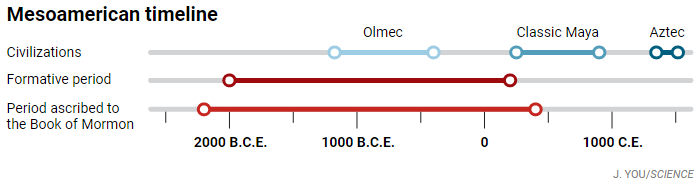
Mesoamerican timeline from ScienceMag.org
According to the article’s timeline, the Book of Mormon’s timeline fits very neatly with the Formative period of the Preclassic Maya. Now, I’m not claiming that the Nephites were the Preclassic Maya, but the timelines and general historical arc of the Preclassic Period seem to track very closely with the narrative of the Book of Mormon.

“The picture of Christ walking down the stairs of a pagan Mayan temple is impossible since the Mayan buildings were not built until ~800 years after the resurrection of Jesus Christ.‘

I freely and cheerfully admit that some Latter-day Saint artwork produced for the Church has been ahistorical. Artists frequently take license in their works in ways which strict historians and other scholars would take issue with. Your criticism of Church artwork, however, isn’t a valid criticism of a Mesoamerican setting for the Book of Mormon.

“If you do not believe in the revelation recorded in D&C 125:3, please tells us why the Lord gave Joseph Smith this revelation?”

I’ll answer your question with a question: If D&C 125:3 is to be interpreted as a revelation about the ancient location of the Book of Mormon city of Zarahemla, why has no other Latter-day Saint interpreted it that way before Rodney Meldrum and the Heartlanders appeared on the scene just over a decade ago?

Neither Joseph Smith nor any of his contemporaries said anything on record about D&C 125:3 revealing the true location of the ancient city of Zarahemla. There is also not a single reference to D&C 125 in general conference or any other published sermon of a general authority of the Church.

Likewise, not a single mainstream Latter-day Saint commentary on the Doctrine and Covenants has made this connection. I happen to have these four commentaries in my personal library; none of them make the connection that Heartlanders have:

  • Hyrum M. Smith and Janne M. Sjödahl, A Commentary on the Doctrine and Covenants (1919). They say nothing about any connection between the Zarahemla in Iowa and the Zarahemla of the Book of Mormon.
  • Boyd W. Brewster Jr., Doctrine and Covenants Encyclopedia (Bookcraft, 1988). He has an entry for “Zarahemla” on page 656, but says nothing about it being the same city as the one in the Book of Mormon.
  • Stephen E. Robinson and H. Dean Garrett, A Commentary on the Doctrine and Covenants, volume 4 (Deseret Book, 2005). These authors explicitly state on page 200, “Why the Lord chose Zarahemla, a Book of Mormon name, for the area is unknown.”
  • Glen M. Leonard, “Zarahemla,” in Doctrine and Covenants Reference Companion (Deseret Book, 2012), 740. He writes, “The name refers to the ‘great city Zarahemla’ (Hel. 1:18) and to the Mulekite leader Zarahemla named in the Book of Mormon (Omni 1:13–18; Mosiah 25:2).” See also, in the same book, Alexander L. Baugh, “Historical context and overview of Doctrine and Covenants 125,”840–41. This author says nothing about any connection between the ancient city and the one in Joseph Smith’s time.

Like so many other heterodox Heartlander claims, their strained interpretation of D&C 125:3 is yet another example of “They were all out of step but Jim!

“There is nothing phony here except the millions of dollars Mesoamerican Book of Mormon hoaxers has taken from the church and its members.”

What “millions of dollars” are you referring to, Opie? Who is forking over this money and who is raking it in? Which Mesoamerican Book of Mormon scholar is living the high life, sitting on a fat stack of cash?

(Compare this to Rod Meldrum’s semiannual Book of Mormon Expos: The amount of money changing hands there for Heartlander products borders on the obscene.)

“The events recorded in the Book of Mormon took place in the eastern US and not in Southern Mexico or Guatemala.‘

You’re certainly free to believe that, as long as you follow the counsel of the First Presidency and the Quorum of the Twelve “not to advocate those personal theories in any setting or manner that would imply either prophetic or Church support for those theories.” Heartlanders have continually violated that counsel, though, and I don’t expect them to stop any time soon.

—Peter Pan

Sunday, June 7, 2020

Neville’s Book of Mormon geography makes no sense, part 1

For some time I’ve wanted to critique Jonathan Neville’s proposed geography of the Book of Mormon. This is the first in what I expect will be a series that will demonstrate his proposed geography is fundamentally at odds with the descriptions given in the text of the book itself.

The problem with Neville’s geographic theory, of course, is that he’s put the cart before the horse: He presumes that the Book of Mormon took place in the “heartland” of the United States, based on his (undemonstrated) belief that the statements of prophets and apostles about the location of Cumorah were revealed by God and based on a strained interpretation of D&C 125:3 that claims it reveals the location of the Book of Mormon city of Zarahemla. These two references are what Neville calls “two pins on the map” in his books, Moroni’s America and Moroni’s America – Maps Edition:
Map 1 from Moroni's America - Maps Edition (Two Pins in a Map)
Because of these two incorrect starting points, Neville has to twist himself into knots to force the geography described in the Book of Mormon to align with his “pins.”

One particular failure of his geography came to me suddenly today while I was reading Helaman 1:14–34. This passage describes the Lamanite invasion of Nephite lands that took place ten years after the end of the end of the great war with the Lamanites (Alma 62:39). Under the command of the Mulekite dissenter Coriantumr, the Lamanite army “came down” (Helaman 1:15) from the land of Nephi into the land of Zarahemla. The Nephites, torn apart by “so much contention and so much difficulty in the government,” were unprepared for the Lamanites’ attack, and Coriantumr easily took the Nephite capital city of Zarahemla (Helaman 1:18–20).

Overconfident because of his easy victory over the Nephite capital, Coriantumr
did not tarry in the land of Zarahemla, but he did march forth with a large army, even towards the city of Bountiful; for it was his determination to go forth and cut his way through with the sword, that he might obtain the north parts of the land. And, supposing that their greatest strength was in the center of the land, therefore he did march forth, giving them no time to assemble themselves together save it were in small bodies; and in this manner they did fall upon them and cut them down to the earth. (Helaman 1:23–24)
Four times the text of Helaman 1 explains that Coriantumr and his Lamanite army marched through “the center of the land” from their homelands in the land of Nephi, then to Zarahemla, then to Bountiful (1:24, 25, 26, 27). Coriantumr’s objective was to “obtain the north parts of the land” (1:23), which is a reference to the former Jaredite lands that the Nephites called Desolation.

Mormon had previously described the Nephites’ precarious position and their desperate need to keep the Lamanites from taking the lands in the north:
Now, the more idle part of the Lamanites lived in the wilderness, and dwelt in tents; and they were spread through the wilderness on the west, in the land of Nephi; yea, and also on the west of the land of Zarahemla, in the borders by the seashore, and on the west in the land of Nephi, in the place of their fathers’ first inheritance, and thus bordering along by the seashore. And also there were many Lamanites on the east by the seashore, whither the Nephites had driven them. And thus the Nephites were nearly surrounded by the Lamanites.

Nevertheless the Nephites had taken possession of all the northern parts of the land bordering on the wilderness, at the head of the river Sidon, from the east to the west, round about on the wilderness side; on the north, even until they came to the land which they called Bountiful. And it bordered upon the land which they called Desolation, it being so far northward that it came into the land which had been peopled and been destroyed, of whose bones we have spoken, which was discovered by the people of Zarahemla, it being the place of their first landing. (Alma 22:28–30)
At the time of Alma 22, the Lamanites occupied the land of Nephi, south of the land of Zarahemla (Alma 16:6; 50:7), and many Lamanites also lived “on the west of the land of Zarahemla, in the borders by the seashore” (Alma 22:28) and “on the east by the seashore.” “And thus,” Mormon explained, “the Nephites were nearly surrounded by the Lamanites” (Alma 22:29). The Nephites occupied the center of the land of Zarahemla and held the strategic land of Bountiful, which was at the head of a “narrow pass” (Alma 52:9) or “narrow neck” (Alma 63:5) that led to the land northward. If the Lamanites had obtained the narrow pass, they would have had the Nephites surrounded, and would “have [had] power to harass them on every side” (Alma 52:9).

Prior to the great Lamanite war, Nephite captain Moroni drove the Lamanites out of the the wilderness areas on the west and the east of Zarahemla (Alma 50:7–12), giving the Nephites total control of the land of Zarahemla, from the sea west to the sea east. Ten years after the war, Nephite captain Moronihah “had supposed that the Lamanites durst not come into the center of the land, but that they would attack the cities round about in the borders as they had hitherto done” in the great Lamanite war (see Alma 51:22–28), “therefore Moronihah had caused that their strong armies should maintain those parts round about by the borders” (Helaman 1:26). In other words, Moronihah’s armies were in the west and east wilderness areas, along the west and east seashores. Because of this, captain Lehi was able to bring his army out of the wilderness and meet Coriantumr’s army in the center of the land before the Lamanites reached Bountiful, while Moronihah’s army also came out of the wilderness behind Coriantumr, surrounding the Lamanite army and defeating them (Helaman 1:28–31). Moronihah “took possession of the city of Zarahemla again, and caused that the Lamanites who had been taken prisoners should depart out of the land in peace” (Helaman 1:33).

Mormon’s descriptions of Nephite lands in the passages I’ve cited are clear and unambiguous. They were arranged something like this:
General arrangement of Nephite lands, created by Peter Pan for the Neville-Neville Land blog
Jonathan Neville will certainly object that my general map looks a lot like all the other “fantasy maps” of the Book of Mormon that he rejects. But this arrangement is the only way to logically arrange Nephite lands so that they meet all the requirements of the passages cited above. Any proposed Book of Mormon map must depict Nephite lands in such a way that that they meet four criteria:

  1. There were wilderness areas on the west and the east of the land of Zarahemla, the Nephite core.
  2. Beyond the west and east wilderness areas were seashores.
  3. The land of Bountiful was north of the land of Zarahemla.
  4. The land of Bountiful was a defensive point before the “narrow pass” or “narrow neck” that led to the land northward (Desolation).

That’s the only way that Mormon could describe the Nephites as being “nearly surrounded by the Lamanites” (Alma 22:29), as well as “nearly surrounded by water” (Alma 22:32). There was no other avenue of escape for the Nephites—they had to hold the land of Bountiful, or else the Lamanites would have had them completely hemmed in with no means of escape.

Now let’s look at Jonathan Neville’s map of Coriantumr’s invasion in Helaman 1:
Map 74 from Moroni's America - Maps Edition (Coriantumr and Moronihah)
Neville’s map—which mistakenly identifies itself as describing the action in Helaman 2fails all four criteria.

There is no way, in Neville’s map, for the Nephites to be “nearly surrounded by the Lamanites,” as Mormon described them. Even if one grants all the lands south of the Missouri and Ohio Rivers were Lamanite territory, that would only box in the Nephites on two sides. The Nephites would have had numerous ways to escape invading Lamanite armies, including through modern-day Iowa, Wisconsin, and Minnesota, with another escape route through Michigan.

In Neville’s map, Bountiful is of no strategic value in keeping the Lamanites from getting to the north parts of the land (or Desolation). The Lamanites could easily have done an end-run around Nephite lands through modern Pennsylvania, or crossed directly through Nephite lands in modern Indiana and Ohio and made their way north through Michigan, or traveled upriver along the Missouri to get north of the Nephites in Zarahemla, Iowa.

Neville tries to fix one of those three problems in his next map, number 75, in which he imagines that there was one continuous wood-and-earth fortification—a “Great Wall of Nephi,” if you will—between Lake Michigan (the “sea west”) and Lake Ontario (the “sea east”). This fantastic feat of construction—for which there is no archaeological evidence whatsoever—would have been over 600 miles long. (And Neville complains that BYU’s Virtual Book of Mormon is a “fantasy map”!)
Map 75 (detail) from Moroni's America - Maps Edition (Nephites Fortify Bountiful)

Finally, there is the problem of the west wilderness and the east wilderness on either side of the land of Zarahemla, with each each wilderness bordering a seashore. There’s simply no way that can work in Neville’s geography. In order to fit his geographical square peg into the round hole of the American Midwest, Neville has to distort the meanings of basic words multiple times. Sometimes he expects us to believe that these wilderness areas were rivers (see map 9), even though the Book of Mormon tells us that people “lived in the wilderness” (Alma 22:28). Other times he expects us to believe that rivers were seas (see map 13, where he claims the lower Mississippi River was the sea west), except when he needs them to be rivers (see map 12, where he claims the Mississippi River is the river Sidon). And as for Nephite and Lamanite lands being “nearly surrounded by water” (Alma 22:32), he expects us to believe that means the Missouri and Ohio Rivers (see map 14), which were also wildernesses (per map 9).

Neville’s fantastic Book of Mormon geography is, in short, a mess. It makes no sense, doesn’t align with the book’s own descriptions of the lands, and requires us to define words in whatever way is convenient to Neville in an given passage.

—Peter Pan

Monday, October 21, 2019

The willful ignorance of Jonathan Neville

On Monday, October 28, 2019, Dr. Stephen D. Houston, Dupee Family Professor of Social Sciences at Brown University, will be giving a free public lecture at Brigham Young University on “Recovering a Lost World: The LiDAR Revolution and Ancient Maya Warfare.”

Today (October 21, 2019) Jonathan Neville expressed his disdain for any mention of Mayan warfare at BYU:
bookofmormonwars.blogspot.com/2019/10/mayan-warfare-at-byu.html
Based on that comment, it’s clear that Neville has no idea who Houston is, doesn’t know he is not a Latter-day Saint, and doesn’t know that he won’t be speaking about the Book of Mormon.

But this would hardly be the first time that Jonathan Neville and the facts have been in opposition to one another.

—Peter Pan

Monday, September 30, 2019

The mark of the fraudster

Jonathan Neville published a blog post today (September 30, 2019) that points out the Mayan glyph in Book of Mormon Central’s logo. He calls this “The mark of M2C”* and helpfully informs us:
The mark of M2C is identifiable by the Mayan icon in the upper right. It is used to let people know that anything published under or by this mark will promote M2C (the Mesoamerican/two-Cumorahs theory).
In the spirit of recompense, I’ll help our readers identify the mark of the gullible, otherwise known as “the sign-manual of the forger.”

The following image is from a blog post by Wayne May, long-time purveyor of fraudulent artifacts that he claims are evidence of the Book of Mormon:
The Mystic Symbol of the fraudulent Michigan Relics
The glyph is from the Michigan Relics, a forged set of tablets that were “discovered” in the late 19th century. May and other Heartlanders, of course, try to pass these fraudulent artifacts off as not only genuine but connected to the Book of Mormon. Heartlander artist Ken Corbett has even painted this glyph onto the breastplate supposedly worn by Zelph, the white Lamanite:
Detail from Zelph a Man of God by Ken Corbett
(The Zelph account has reached almost mythic proportions within the Heartlander community. He’s so central to their beliefs that Jonathan Neville has an entire page on one of his 67 blogs, entitled “Testimony,” that bears witness of Zelph.)

The “Mystic Symbol” is the mark of a fraud. James E. Talmage exposed the fraud over 100 years ago in the Improvement Era, the Church’s official magazine:
James E. Talmage called the Mystic Symbol of the Michigan Relics 'the sign-manual of the forger
The pitchmen who sell Heartlander materials to gullible Latter-day Saints continue to insist that the Michigan Relics are genuine, despite what has been published by the Church and responsible archeologists.

Jonathan Neville is worried about the wrong symbol.

—Peter Pan

* “M2C” is Jonathan Neville’s acronym for the theory that the Book of Mormon took place in Mesoamerica and that the hill Cumorah in the Book of Mormon is not the same hill in New York where Joseph Smith received the plates of Mormon.

Thursday, July 18, 2019

Those who live in glass houses…

On July 18, 2019, Jonathan Neville blogged about the Mayan glyph that was in the old FARMS logo that is now the logo used by Book of Mormon Central:
Logo of the Foundation for Ancient Research and Mormon Studies and Book of Mormon Central
Book of Mormon Central is doing a great job telling the world that the Book of Mormon is a Mayan codex. They've got their Mayan logo everywhere.…

Of course, the Mayan logo directly contradicts the Church's policy of neutrality regarding Book of Mormon Geography. It also makes the Book of Mormon look ridiculous to non-LDS experts on the Mayans.

Many believers in the Book of Mormon still accept the teachings of the prophets about the New York Cumorah. That does not exclude Central America as a possible site for some Book of Mormon events, but Book of Mormon Central excludes the New York Cumorah as a possibility for Cumorah!
Oh, my dear Brother Neville. Let’s put the shoe on the other foot for a moment, shall we?
Heartlanders are doing a great job telling the world that the Book of Mormon is connected to the Michigan Relics. They’ve got the “Mystic Symbol” logo everywhere, including on the breastplate supposedly worn by Zelph:
The Mystic Symbol of the forged Michigan Relics painted on Zelph's breastplate by Ken Corbett
Left: The “Mystic Symbol” on the Michigan Relics, also called “the sign manual of the forger.” Right: The “Mystic Symbol” imagined on Zelph’s breastplate by artist and Heartlander Ken Corbett; image retrieved from Jonathan Neville’s blog. (Click to enlarge.)
Of course, the Mystic Symbol directly contradicts the Church’s (supposed) policy of neutrality regarding Book of Mormon geography. It also contradicts James E. Talmage’s conclusion, published in the Church’s official magazine, that he was “thoroughly convinced that the alleged ‘relics’ are forgeries and that they [were] made and buried to be dug up on command.” It also makes the Heartland movement look ridiculous to many Latter-day Saints and it makes the Book of Mormon look ridiculous to non-Latter-day Saints who think it has ties to fraudulent relics.

Many believers in the Book of Mormon accept the declaration of living prophets and apostles that “the Church does not take a position on the specific geographic locations of Book of Mormon events in the ancient Americas.” That does not exclude the American Midwest as a possible site for some Book of Mormon events, but Heartlanders exclude anywhere but New York as a possibility for Cumorah because they selectively interpret specific dead prophets.
Who looks worse here, Brother Neville?

—Peter Pan

* “M2C” is Jonathan Neville’s acronym for the theory that the Book of Mormon took place in Mesoamerica and that the hill Cumorah in the Book of Mormon is not the same hill in New York where Joseph Smith received the plates of Mormon.

Thursday, June 27, 2019

Jonathan Neville doesn’t understand the “M2C” position at all

One of the most challenging things Captain Hook and I have had to deal with on this blog is that Jonathan Neville simply does not understand the views that he criticizes. Because he misunderstands the beliefs of those who believe the Book of Mormon took place in Mesoamerica—what he calls “M2C”*—he frequently misrepresents them. An example of this is found in his June 26, 2019, blog post, “The article you’ve never seen.”

We’ll get to Neville’s blog post in a moment. First, some background:

Joseph Smith stated in November 1841 that recently-published descriptions of the ruins in Mesoamerica “unfolds & developes many things that are of great importance to this generation & corresponds with & supports the testimony of the Book of Mormon.” He was also editor of the Times and Seasons when it published a series of articles about Mesoamerica that concluded that the Nephite city of Zarahemla once “stood upon [the] land” of “Central America, or Guatimala.” (Neville does not believe that Joseph had anything to do with the Times and Seasons articles, despite the solid scholarly evidence against his opinion.)

Regardless of what he wrote or believed in 1841/1842, those who believe in a Mesoamerican Book of Mormon geography do not argue that Joseph Smith ever believed or taught that the Book of Mormon took place exclusively in Mesoamerica. Rather, like all of Joseph’s contemporaries of whom we are aware, Joseph believed in a hemispheric Book of Mormon geography—that is, he believed that the Book of Mormon took place across the North and South American continents, that South America was the “land southward,” the isthmus of Panama was the “narrow neck of land,” and North America was the “land northward” where the Jaredites lived and met their end and the Nephites fought their final battles. It’s virtually certain that Joseph believed that the hill in New York where he received the plates of Mormon was the hill Cumorah described in the Book of Mormon.

So Jonathan Neville demonostrates his ignorance of what Mesoamericanists actually are claiming when he publishes things like this:
Our M2C intellectuals like to emphasize the anonymous editorials in the 1842 Times and Seasons that mention Central America. They claim Joseph Smith wrote, edited, or approved of these editorials.…

Here’s an article from the 1842 Times and Seasons you’ve never read before. When you read it, you’ll see why our M2C citation cartel doesn’t emphasize this one.
Following this, Neville reprints, in its entirety, the January 1, 1842, Times and Seasons article, “Evidences in Proof of the Book of Mormon.” It contains excerpts from Charles Thompson’s 1841 book of the same name. Thompson, a Latter-day Saint, believed that the ancient Native American earthworks in Ohio and its environs were evidence of that the Nephites lived in that land. The Times and Seasons article quotes from Thompson’s book and the Book of Mormon.

First, I should note that the “Evidences in Proof of the Book of Mormon” article was published a full two-and-a-half months before Joseph Smith became editor of the Times and Seasons. (Joseph became editor starting with the March 15, 1842, issue of the paper.) Why didn’t Neville mention this important fact? Was he perhaps censoring what his readers see in order to mislead them? If so, that would be both ironic and hypocritical.

But let’s grant that Joseph did approve of Thompson’s book and the excerpts of it that were published in the Times and Seasons. So what? As I explained above, Mesoamericanists fully accept that Joseph believed the Book of Mormon peoples lived all over the North and South American continents, and so any evidence of ancient civilizations anywhere in the Americas were of interest to him.

So, to answer Neville’s challenge: Why don’t Mesoamericanist Book of Mormon believers “emphasize” the January 1, 1842, article in the Time and Seasons? Because there’s no evidence Joseph had anything to do with it and because we already accept that Joseph would have agreed with it anyway.

The fault isn’t in us for not emphasizing something Joseph didn’t write; the fault is in Jonathan Neville for disputing what Joseph clearly approved of as editor of the paper.

—Peter Pan

* “M2C” is Jonathan Neville’s acronym for the theory that the Book of Mormon took place in Mesoamerica and that the hill Cumorah in the Book of Mormon is not the same hill in New York where Joseph Smith received the plates of Mormon.

Friday, March 29, 2019

Jonathan Neville cements his ignorance of ancient America

One of the evidences for placing the Book of Mormon in a Mesoamerican context cited by proponents of that theory is its mention of cement as a building material:
And there being but little timber upon the face of the land, nevertheless the people who went forth became exceedingly expert in the working of cement; therefore they did build houses of cement, in the which they did dwell. . . . And the people who were in the land northward did dwell in tents, and in houses of cement, and they did suffer whatsoever tree should spring up upon the face of the land that it should grow up, that in time they might have timber to build their houses, yea, their cities, and their temples, and their synagogues, and their sanctuaries, and all manner of their buildings. . . . And thus they did enable the people in the land northward that they might build many cities, both of wood and of cement.
(Helaman 3:7, 9, 11, emphasis added)

Cement was actually once considered an anachronism in the Book of Mormon but has since been shown by archaeologists to have been a building material used by the ancient Maya. (Book of Mormon Central has a KnoWhy that provides a useful overview on this topic.)

Jonathan Neville, predictably, is not impressed with this argument, as he makes clear in his March 29, 2019, post “The M2C hoax - part 6 - cement.” He writes:
Naturally, the Mayans built with stone and cement. In a jungle, wood structures don’t last long. Which explains how we know the Nephites did not live in a jungle. The Nephites built with wood and cement, not stone and cement.
In fact, the ancient and modern Maya in fact did (and still do) use wood as a building material. Here are just a few citations from the same Mesoamerican archaeologists Neville praises in his post:
From representations in the arts we can see that the wooden, thatched-roof houses of the Maya have changed very little in the past two millennia. Maya families in the country-side continue to live in houses with a skeleton framework of lashed and notched tree trunks and limbs supporting steeply pitched roofs covered with many layers of palm thatch to shed the heavy tropical rains.
(Michael Edwin Kampen, The Religion of the Maya [Leiden: Brill, 1981], 8.)
Above all, the trees provided construction materials, including the frames for Maya houses, lintels for palaces and temples, and the thatches for their roofs.… The hardest woods of the rain forest, especially the rock-hard sapodilla wood and beautiful mahogany and cedars, were used for carving works of art that are sometimes still preserved in tombs or other buried contexts. Elaborately carved sapodilla lintels with long hieroglyphic texts have been found in outstanding condition in the doorways of temples, giving us histories and insights into Maya temple rituals and concepts.
(Arthur Demarest, Ancient Maya: The Rise and Fall of a Rainforest Civilization [Cambridge: Cambridge University Press, 2004], 144.)

It wasn’t just simple countryside homes that used timber as a building material either:
The largest cities served as the capitals of independent kingdoms, containing the most elaborate temples, palaces, markets, causeways, reservoirs, and plazas. Lowland cities were mostly constructed of masonry; highland cities favored adobe and timber. In all Maya cities, hundreds to thousands of houses of the common people were constructed of adobe or pole and thatch.
(Robert Sharer, "Who Were the Maya?" Expedition 54, no. 1 [2012]: 15.)

Neville is correct that wood and other organic structures do not easily survive in a jungle environment. But he is wrong in claiming that the ancient Maya did not use wood. Although the archaeological evidence for such is scarce, it has in fact been identified.

Of course, a simple Google search would have revealed this to Neville. Or he could have read the godfather of “M2C*,” John Sorenson, in his discussion in his magnum opus:
After disembarking from their ship, the Lehite colonists found themselves in a tropical area (very likely Pacific coastal Guatemala) that was heavily forested (1 Nephi 18:25). Later areas they inhabited also included forested territories (e.g. Alma 2:37). This would account for the occasions when, throughout the land southward, parties found themselves lost or able to hunt or hide in the wilderness (Enos 1:3; Mosiah 8:8; 20:8; 21:25; 22:16; 23:30). No doubt trees of these forests provided timber as prime building material.
(John L. Sorenson, Mormon’s Codex: An Ancient American Book [Provo, UT: Neal A. Maxwell Institute, 2013], 321–22.) 

This reading is very plausible given what we know about ancient Mesoamerica. In fact, the mention of Book of Mormon peoples “work[ing] in all manner of wood” (2 Nephi 5:15; cf. Jarom 1:8; Mosiah 11:8) in various contexts fits nicely in ancient Mesoamerica, since ancient woodworking is attested in that region in both surviving artifacts and iconographic representations.

So much for Neville’s claim that woodworking in the Book of Mormon precludes a Mesoamerican setting. But what about cement? Neville claims:
The only known Nephite cement was the cement Moroni used when we built the stone box for the plates, as described by Joseph and Oliver.

This claim is so bizarre and so flagrantly erroneous that I have a hard time understanding how Neville could possibly write it with a straight face. As seen above, the citation in Helaman 3 is explicit that “Nephite cement” included “houses of cement” and “cities, both of wood and of cement.” This is exactly what we encounter in ancient Mesoamerica, as discussed in the Book of Mormon Central KnoWhy.

But this doesn’t stop Neville from attempting to poison the well against those he pejoratively calls “Mesomaniacs” with this line:
Unless by now the Mesomaniacs have talked themselves into disbelieving what Joseph and Oliver said about the box, even they have to admit that Moroni used Nephite cement in New York.… [Cement in Mesoamerica is] another illusory correspondence, designing to support the rejection of what Joseph and Oliver taught about Cumorah in New York.

Perhaps Neville is unaware of (or is deliberately ignoring) the fact that what he considers the censorious “M2C” journal Interpreter: A Journal of Latter-day Saint Faith and Scholarship has actually published an article arguing for the authenticity of Joseph Smith’s description of the cement box that contained the plates. From the paper’s abstract:
The story of Joseph Smith retrieving gold plates from a stone box on a hillside in upstate New York and translating them into the foundational text of the Restoration is well known among Latter-day Saints. While countless retellings have examined these events in considerable detail, very few have explored the geological aspects involved in this story. In particular, none have discussed in detail the geological materials that would have been required by the Nephite prophet Moroni ca. AD 421 to construct a sealed container able to protect the gold plates from the elements and from premature discovery for some fourteen centuries. This paper reports the outcomes from a field investigation into what resources would have been available to Moroni in the Palmyra area. It was conducted by the authors in New York state in October 2017.
Neville is so wrapped up in his anti-“M2C” derangement—I’ll even call it prejudice—that he can’t or won’t even acknowledge when “M2C intellectuals” actually agree with him! Moroni’s construction of a cement box in upstate New York is actually geologically plausible.

But this raises the question of where Moroni learned this technological ability. To answer that, Neville claims the following:
You can see archaeological reconstructions of ancient wood and cement structures at museums in Ohio.… [T]here is abundant evidence of the North American Indians using cement. Some of the mounds were covered with cement, to the point that they were difficult for farmers to tear down. People used jackhammers to break up the cement. Even today, at Cahokia, archaeologists have recreated a portion of the ancient wall around the city to show what it looked like anciently. It consists of tall timbers, covered with cement.
As is his wont, Neville provides precisely zero citations to archaeological field reports or scientific journals to back up this claim. But he does mention one site that we can investigate: Cahokia. In fact, the “cement” Neville talks about isn’t actually cement (limestone mortar)—it’s hardened clay. Even worse for him, the walls weren’t constructed until “A.D. 1100 and then rebuilt three times over a period of 200 years.” So not only is the evidence Neville used not contemporary to Book of Mormon times, it isn’t even “cement” as he claims.

Contrast this with the genuine, verified limestone cement of Mesoamerica that was known to be used during Book of Mormon times (again, as discussed in the Book of Mormon Central KnoWhy). The best scholarship from actual credential archaeologists reveals the following:
Lime cement came into use as building material in central Mexico as well as in southern Mesoamerica in the centuries just before and after the time of Christ. Archaeology has revealed the degree of sophistication those artisans achieved. Margain commented on "the abundance of flat surfaces made of concrete" in central Mexico. At El Tajín in Veracruze, roofs were formed of slabs of concrete that covered up to 246 square feet (23 sq m). The cement was poured into prepared wooden forms. Sometime the builders filled the space for a planned room with stones and mud, smoothed the surface on top, and then poured a concrete mix thereon. Once the roof dried, they removed the fill beneath. The first century-BC appearance of cement in the Book of Mormon agrees strikingly with the archaeology of central Mexico.
(Sorenson, Mormon’s Codex, 322.)

In practically every single detail on this subject, Neville is wrong. He is wrong about ancient Mayan building materials. He is wrong about what “M2C intellectuals” actually believe. He is wrong about the “evidence” he uses for the Heartland hoax. And yet Neville wants us to trust him when he claims, “In my opinion, these cement references in the text exclude Mesoamerica as a potential location described by the text.”

Neville is free to hold his opinions, but why on earth should anyone take his ignorant and prejudiced opinions seriously?

—Captain Hook

* “M2C” is Jonathan Neville’s acronym for the theory that the Book of Mormon took place in Mesoamerica and that the hill Cumorah in the Book of Mormon is not the same hill in New York where Joseph Smith received the plates of Mormon.

Tuesday, March 5, 2019

One Cumorah, Two Cumorah, Hill Cumorah, Blue Cumorah

Not content with literally just making up numbers out of thin air, Jonathan Neville is now manufacturing archaeological evidence out of thin air to fit his obsessive assertion that the Hill Cumorah of the Book of Mormon is in New York state.

In his March 5, 2019, blog post, “The 4 Cumorahs,” Neville repeats his absurd claim that “M2C*” will eventually cause widespread abandonment in a historical Book of Mormon among members of The Church of Jesus Christ of Latter-day Saints. Since he provides not one shred of evidence for this prediction, I won’t bother responding to it here; rather, I’ll focus on the ludicrous comments he made in defense of this claim:
I think the descriptions in the text [of the Book of Mormon] and related scientific evidence (archaeology, anthropology, etc.) supports the traditional teachings about the New York Cumorah.
[Emphasis mine.]

Unlike genuine archaeologists—including faithful Latter-day Saint archaeologists who assure us that “the archaeology of New York is persuasive evidence that Book of Mormon peoples did not live in that region”—Neville asserts that the location of the Hill Cumorah in New York is supported by archaeology and anthropology. Unlike his fantasy charts where he make-believes data into existence, this is a testable, potentially falsifiable claim. Let’s take a look and see what evidence Neville might have to offer.

Neville insists that “the New York hill remains the best real-world candidate for the Cumorah of Mormon 6:6.” As evidence for this, he offers the following:
When he joined the Church, Heber C. Kimball visited the hill and observed the embankments around it. The area has since been plowed for decades, but detailed topographical maps suggest there may be one residual feature from the ancient embankment left.
Neville offers no citation for this claim. Perhaps he’s referring to this line from the August 20, 1864, installment of the “History of Brigham Young,” in The Latter-day Saints’ Millennial Star:
The hill Cumorah is a high hill for that country, and had the appearance of a fortification or entrenchment around it. In the state of New York, probably, there are hundreds of those fortifications which are now visible and I have seen them in many other parts of the United States.
This statement seems to settle the matter in the minds of Neville and many other Heartlanders. It should be remembered, however, that Heber C. Kimball had absolutely no archaeological expertise through which he could determine anything about the provenance of these “entrenchments,” beyond their simple existence. There was no way for Kimball to have known if these “entrenchments” dated to Book of Mormon times, much less if they were directly built and used during the final Nephite battles.

So Neville’s first piece of evidence, which he is very fond of citing, is a non-starter. What other evidence does he have?
Archaeologists and anthropologists have reported that around 300 A.D., the Hopewell civilization in Ohio ceased building sophisticated earthworks and instead built a series of defensive structures. This was about the time when Mormon traveled to Zarahemla and became the military leader of the Nephites. He led them on their wars with the Lamanites, which eventually ended in retreat to Cumorah. Archaeologists say there was a general Hopewell movement toward western New York. Defensive structures similar to those in Ohio, although rapidly constructed, appear throughout western New York.
It would be nice to know which “archaeologists and anthropologists” Neville is relying on here but, since he provides no citations whatsoever, it’s impossible to verify any of his claims. For all we know, he is relying on the bogus pseudoscience of Wayne May or Rodney Meldrum or other Heartlander “scholars.” Until Neville cites specific scholars with published research that we can cross-reference, he is making nothing more than a bald assertion, not offering any sort of evidence.

Besides not offering any evidence, Neville also misreads the Book of Mormon in order to shoehorn in his theory about the New York location of Cumorah. He writes:
[The prophet] Mormon expressed his idea of a “great number of men,” when he added “even to exceed the number of thirty thousand” (Mormon 1:11). The largest enumerated Nephite army was only 42,000 men (Morm. 2:9), assembled after gathering in their people (2:7), while the largest enumerated Lamanite army was only 50,000 men (2:25). This was around 346 AD, only about 40 years before the final conflict at Cumorah. After years of slaughter and retreat, the Nephites assembled at Cumorah. My reading of Mormon 6 tells me Mormon and Moroni could see the bodies of their 20,000 people lying in the Cumorah valley. The other 21 leaders of their respective ten thousand each were killed elsewhere, either in the wars immediately leading up to the battle at Cumorah or the wars throughout Mormon’s military career. This is also how I read Letter VII.
The Book of Mormon text simply does not support Neville’s reading.

Mormon 6:6 specifically says that the slaying of the Nephites in the final battle was in the “land of Cumorah” after the Nephites had “gathered in all our people in one.” After the Nephites “with their wives and their children” had gathered in the land of Cumorah, they did “behold the armies of the Lamanites marching towards them; and with that awful fear of death which fills the breasts of all the wicked, did they await to receive them” (Mormon 6:7).

After this, the Lamanites “came to battle against” the assembled Nephites (Mormon 6:8). Mormon gave a tally of how many Nephites he personally “beheld” were slain in “the land of Cumorah” (Mormon 6:11–15):
  • “[T]he ten thousand of my people who were hewn down.”
  • “[T]he ten thousand of my people who were led by my son Moroni.”
  • “[T]he ten thousand of Gidgiddonah.”
  • “Lamah…with his ten thousand”
  • “Gilgal…with his ten thousand”
  • “Limhah…with his ten thousand
  • “Jeneum…with his ten thousand”
  • “Cumenihah, and Moronihah, and Antionum, and Shiblom, and Shem, and Josh,…with their ten thousand each” (=60,000).
  • “[T]en more…with their ten thousand each" (=100,000)
Neville comments that his reading these verses “tells me Mormon and Moroni could see the bodies of their 20,000 people lying in the Cumorah valley.” But this is directly contradicted by the text! Mormon beheld no less than 230,000 slain Nephites after the final battle of Cumorah. There is nothing in the text to suggest, as Neville reads it, that these additional 210,000 Nephites had been slain “either in the wars immediately leading up to the battle at Cumorah or the wars throughout Mormon’s military career.”

Despite these problems with his interpretation of the text, Neville astonishingly insists that “the physical evidence at Cumorah accommodates these numbers, both in terms of logistics and in terms of the number of arrowheads and other weapons found in the area over the years.” Once again, however, he provides absolutely no citations for this claim. What arrowheads? What weapons? Who found them? When? Were they uncovered in a controlled archaeological dig, by grave-robbers, by farmers, or by amateur treasure hunters? What is their provenance? Have they been authenticated? Have they been archaeologically dated to fit the time period of the Book of Mormon? Can they be determined to have been used in battle (via signs of battle-wear, for instance)? Neville must answer these fundamentally important questions before he can use any supposed “arrowheads and other weapons” found at the New York Cumorah as evidence for his claims. Instead, he completely fails to notice or respond to them.

Like his use of fantasy charts in his previous post, his use of fantasy archaeological evidence in his latest post shows that Jonathan Neville is not a serious scholar. He is, rather, an ideologue, pure and simple.

—Captain Hook

* “M2C” is Jonathan Neville’s acronym for the theory that the Book of Mormon took place in Mesoamerica and that the hill Cumorah in the Book of Mormon is not the same hill in New York where Joseph Smith received the plates of Mormon.

Popular Posts

Search This Blog