Examining the claims of Jonathan Neville and the Heartland movement

Showing posts sorted by relevance for query Kraus. Sort by date Show all posts

Thursday, June 30, 2022

Jonathan Neville reacts to Spencer Kraus’s reviews

In the wake of Spencer Kraus’s reviews of A Man that Can Translate and Infinite Goodness, Jonathan Neville has been flailing about, vainly hoping to land a blow against Kraus, or me, or Book of Mormon Central, or Daniel Peterson, or Jack Welch, or apparently anyone who opposes him.

Neville has begun a series of responses to Kraus that he runs under the noisome title “Under the Banner of the Interpreter,” apparently in a feeble attempt to connect anyone and anything that’s critical of his work to the loathesome anti-Mormon book and streaming television series Under the Banner of Heaven. That’s par for the course for Neville, who for years has implied that anyone who doesn’t agree with his eccentric views—including general authorities—is leading the Church and its members astray.

Meanwhile, beneath the title “Under the Banner of the Interpreter,” Neville obtusely protests that none of what he writes “is an ‘ad hominem’ argument” for “we focus on the merits” of his opponents’ arguments. Let’s see how well he lives up to that claim, shall we?

Neville writes:
Most Latter-day Saints ignore these foolish antics of the apologists in the citation cartel. We go about our business, helping our fellow Latter-day Saints and our local communities, attending the temple, teaching classes and serving missions, and generally rejoicing in living the gospel on a daily basis. We support our Church leaders and still believe what Joseph Smith and Oliver Cowdery said.
That’s only the second paragraph after Neville promised to “focus on the merits,” and he’s already descended into ad hominem and appealed to the self-righteousness fallacy: People who disagree with Neville are guilty of “foolish antics,” while sincere, righteous Heartlanders help others, attend the temple, teach and serve, live the gospel, and support Church leaders.

I’m sure that there are many Heartlanders who are sincere and righteous. That does not, however, make Neville’s views correct or immune from critical review.
In their view, if you disagree with them (especially if you offer a faithful interpretation of Church history that supports and corroborates what Joseph and Oliver taught instead of M2C and SITH), you are an apostate—according to them.
This is a strawman argument: Spencer Kraus wrote a critical analysis of Neville’s use of history and historical sources. Neither he nor the Interpreter Foundation accused Neville of apostasy.

As far as I’m aware, I’m the only “apologist” who has accused Neville of flirting with apostasy. My basis for this claim has nothing to do with Neville’s interpretations or views and everything to do with the way he continually implies—or sometimes even states outright—that today’s leaders of The Church of Jesus Christ of Latter-day Saints are ignorant, are leading the Saints astray, are covering up historical facts, and are not teaching the truth.

Later in his blog post, Neville asserts that “the citation cartel aggressively attacks faithful Latter-day Saints who don’t accept either their style or their substance.” But the real issue here isn’t about “style” or “substance”; it’s about how Neville is guilty of evil-speaking of the Lord’s anointed leaders. He should repent and change his approach.
Since the inception of the Interpreter and Book of Mormon Central, the growth of the Church has steadily declined. Correlation is not necessarily causation, of course, and there are many factors involved with Church growth, but anyone who is active on social media (particularly English-language social media) knows that LDS apologists are flailing in comparison to the critics.
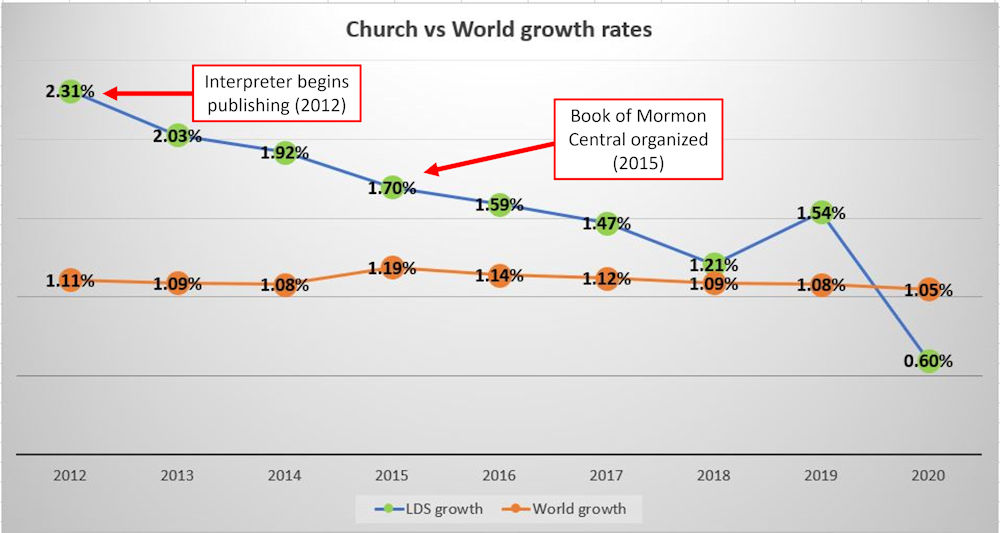
Neville has a penchant for using meaningless charts like this, then denying that correlation equals causation while simultaneously implying via his charts that correlation really does equal causation. One could just as easily claim that the declining growth rate of the Church correlates to the rise of Heartlanderism. (And I have, tongue firmly in cheek, of course.)

Apparently it has not occurred to Neville that the decline in Church growth rates would have been greater if it were not for the efforts of Book of Mormon Central, the Interpreter Foundation, and other organizations that stand up for modern leaders of the Church instead of disparaging them and spreading pernicious conspiracy theories about them.
Undoubtedly, Brother [Spencer] Kraus…is a fine, devout, committed Latter-day Saint, a great person, etc. Nevertheless, as a research associate with Book of Mormon Central, Brother Kraus naturally (and necessarily) follows the direction of his leaders in the organization, as is evident from his articles. His bio doesn’t reveal whether he is a volunteer or paid employee, but either way, he has to toe the party line or he couldn’t work there.
Statements like this make me wonder if Jonathan Neville really understands what an ad hominem argument is, because he just crafted a perfect example of such: According to Neville, Kraus has only been critical of Neville’s writings because Kraus’s job depends on it. If Kraus didn’t “toe the party line” at Book of Mormon Central, Neville claims, then Kraus “couldn’t work there.”

Nowhere does Neville grant that Kraus may have written his reviews of A Man that Can Translate and Infinite Goodness merely because Kraus himself disagrees with Neville’s methods and conclusions. Nowhere does he grant that Kraus may have written his review without the knowledge or approval of those who manage Book of Mormon Central. According to Neville, Kraus cannot possibly be anything more than an errand-boy for the Powers that Be at the M2C Citation Cartel.

Ad hominem itself blushes in the face of Jonathan Neville.
I’m hearing complaints about Brother Kraus, but we can’t blame him.
This is perhaps the strangest statement of all in Neville’s blog post. Complaints? Complaints about what? And from whom? Neville doesn’t tell us, but that’s because he doesn’t really have anything on Spencer Kraus; instead, he’s simply trying to poison the well against a good young scholar who has obviously struck a nerve.

Being that Neville was once a lawyer, it’s a shame that he doesn’t seems to understand the legal concept of libel.
Peter Pan is a good example of the worst of LDS apologetics, which may explain why he’s also a favorite of Dan Peterson’s. He’s basically Dan’s alter ego, given how frequently Dan refers his readers to Peter’s work.

I’ve had people tell me Peter Pan’s identity, but I respect his wish to remain anonymous because what better better [sic] epitome could there be of the worst of LDS apologetics than an individual (or group) so ashamed by his (their) work that he (they) remains anonymous while publishing a blog named after their chosen nemesis? Even better, that blog is a tutorial on logical and factual fallacies.
It’s not often the Jonathan Neville acknowledges my existence, so I suppose I should be flattered just to be mentioned.

Neville claims that “people” (plural) have told him my identity. I have very good reasons to doubt that he’s telling the truth. (Among them is the fact that he can’t make his mind if I’m one person or multiple people.) Unless he’s willing to go public with my identity—and please, Brother Neville, you have my permission to do so, so go right ahead—I think he’s “blowing smoke,” as they say.

The disappointing thing here is that Neville didn’t even make an attempt to respond to anything I’ve written. He simply accused me of using “logical and factual fallacies” (something he’s claimed repeatedly) without bothering to tell his readers where and how I’ve done so. Meanwhile, this is this blog’s 308th published post that has quoted what he’s written and provided evidence of why he’s wrong. His accusation against me isn’t exactly a textbook example of ad hominem, but it’s certainly avoiding the argument.

Finally, Neville incorrectly assumes that I operate under a pseudonym because I’m deeply “ashamed” of my work. I confess that I laughed out loud at this. The truth is that I operate under the pseudonyum “Peter Pan” for three reasons:

  1. I want to avoid being personally attacked by Jonathan Neville. (Seeing his attempt to start a whisper campaign concerning supposed “complaints” about Spencer Kraus, I think this has been a wise move.)
  2. It’s in keeping with the playful name of the blog to use the names of characters from J.M. Barrie’s children’s books.
  3. It annoys Jonathan Neville, and I take a small amount of perverse pleasure in that.

At least Neville seems to have given up on the (incorrect) belief that I’m secretly Daniel Peterson.

Second star to the right and straight on ’til morning!

—Peter Pan

 

Friday, July 16, 2021

Spencer Kraus challenges Neville’s translation theories

At the end of 2020 I became acquainted with Spencer Kraus and his excellent blog. (I’ve mentioned both of them before—see here, here, and here.) I’m grateful that he has joined the ranks of Latter-day Saints who are pushing back against Jonathan Neville’s devisive and unorthodox beliefs.

This week, Kraus published a review of three of Neville’s assertions, namely:

  1. That Joseph Smith was always separated from his scribes by a curtain, with Oliver Cowdery being the exception to this practice.
  2. That Joseph only used a seer stone as a “demonstration” of the translation process.
  3. That Oliver Cowdery wrote his series of letters in 1834 to show that Joseph Smith did not use a seer stone to translate the Book of Mormon.

In response to Neville’s claims, Kraus ably shows that:

  1. The eyewitness evidence indicates that Joseph and his scribes were separated from other people in the same room by a curtain, and that Joseph was only veiled from his scribes when he used the Urim and Thummim, not when he used his seer stone.
  2. Neville’s “demonostration hypothesis” fails because the source Neville relies on—David Whitmer—explictly said that, at that the event, Joseph was using the Urim and Thummim, not a seer stone.
  3. Rather than rejecting Joseph’s use of a seer stone, Oliver Cowdery’s 1834 letters are best interpreted as “reclaiming the narrative” from the anti-Mormon book, Mormonism Unvailed, by using the term “Urim and Thummim” as a term for all translation instruments.

Bilbo's pocket Throughout his blog post, Kraus identifies how Neville “misquotes and misuses historical sources to attempt to paint a history that exists only in his imagination.” Just one example of this is how Neville has claimed that Oliver Cowdery “had [Joseph’s] little seer stone, the brown seer stone we see pictures of, in his pocket when he rejoined the Church.” Kraus hasn’t found a single source for this claim; he therefore concludes that “this detail comes directly from Neville’s imagination.”

I warmly recommend Kraus’s recent review to all readers of this blog.

—Peter Pan
 

Saturday, December 31, 2022

Neville-Neville Land 2022 year in review

2022 M2C NPCsThe end of 2022 brings to a close the fourth year I’ve been publishing this blog. What started as something of a lark has developed into a full-blown escapade.

This year I published 48 posts examining the iconoclastic beliefs and assertions of Jonathan Neville and his associates in the so-called “Heartland” Book of Mormon movement. That’s down from 72 in 2021 and 74 in 2020. The reduced number of posts this year has been due mostly to (a) my increasingly busy schedule and (b) Jonathan Neville’s regular routine of regurgitating the same content over and over again, only using just ever-so-slightly different words. There’s only so many times that I can write about (to use just one example) his repeated fatuous assertion that people who don’t agree with him are “rejecting the teachings of the prophets.”

Among the significant developments this year in Neville-Neville Land, I would include the following:


Finally, here are the top ten Neville-Neville Land posts for 2022 by number of reads:

  1. The First Presidency reviewed Saints before publication (July 27, 2022).
  2. Jonathan Neville reacts to Spencer Kraus’s reviews (June 30, 2022).
  3. President Nelson and the attention to detail in Saints (August 4, 2022).
  4. Follow-up: The character of Stephen Reed (“TwoCumorahFraud”) (March 14, 2022).
  5. “Doctor Scratch,” perpetual gadfly and blowhard (July 23, 2022).
  6. Recommended watching: Spencer Kraus’s interview with Robert Boylan (July 19, 2022).
  7. Peter’s hiatus and three brief notices (March 6, 2022).
  8. Jonathan Neville’s latest folly: The Kinderhook Plates (March 30, 2022).
  9. Spencer Kraus’s devastating review of Jonathan Neville’s A Man that Can Translate (June 17, 2022).
  10. Rian Nelson pulls a Michael Scott (April 11, 2022).

Last year at this time, I wrote, “I see little evidence that Jonathan Neville will retreat from his extremist views in the coming year and bring himself more in line with the teachings of the prophets regarding the Book of Mormon and how the Prophet Joseph Smith translated it.” I’m saddened to report that I was right. However, 2023 brings a new year and new opportunities, so here’s hoping that more people will see through the transparent falsehoods of the Heartland movement in the coming year.

Happy new year!

—Peter Pan
 

Friday, June 24, 2022

Spencer Kraus’s trenchant review of Jonathan Neville’s Infinite Goodness

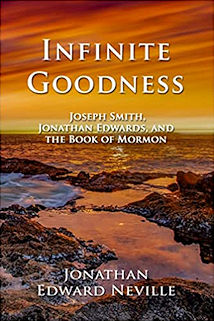
cover of Infinite Goodness: Joseph Smith, Jonathan Edwards, and the Book of Mormon by Jonathan Neville Following on the heels of last week’s review of A Man that Can Translate, Spencer Kraus has delivered his second knockout blow, this time to Neville’s most recent book, Infinite Goodness: Joseph Smith, Jonathan Edwards, and the Book of Mormon.

You can read his review, “Jonathan Edwards’s Unique Role in an Imagined Church History,” on the website of The Interpreter Foundation. Here is the abstract:
In Infinite Goodness, Neville claims that Joseph Smith’s vocabulary and translation of the Book of Mormon were deeply influenced by the famous Protestant minister Jonathan Edwards. Neville cites various words or ideas that he believes originate with Edwards as the original source for the Book of Mormon’s language. However, most of Neville’s findings regarding Edwards and other non-biblical sources are superficial and weak, and many of his findings have a more plausible common source: the language used by the King James Bible. Neville attempts to make Joseph a literary prodigy, able to read and reformulate eight volumes of Edwards’s sermons — with enough genius to do so, but not enough genius to learn the words without Edwards’s help. This scenario contradicts the historical record, and Neville uses sources disingenuously to impose his idiosyncratic and wholly modern worldview onto Joseph Smith and his contemporaries.
Kraus also recently published a blog post that’s a companion to his two reviews: “Joseph in the Hands of an Angry Pseudo-scholar,” which I enthusiastically recommend to all my readers.

Kraus has truly done yeoman’s work in the field of Neville Studies. His reviews are what I myself would have written, if I had the time and the patience to do so.

Meanwhile, Jonathan Neville has fired back at Kraus’s first review, delivering little gems like this nonsensical strawman argument:
According to the Interpreter, because I still believe Joseph translated the plates, I’m the one who “fails to deal with the historical record seriously or faithfully.”
What Neville’s personal beliefs have to do with his inability to engage in responsible scholarship is beyond me. Apparently, it’s beyond him as well.

—Peter Pan
 

Monday, April 3, 2023

The “Richard Nygren” affair and some vile accusations against me

It has sadly become necessary for me to publish the following.

Recently, some thoroughly despicable—and borderline unhinged—individuals on the internet have been accusing me of being some sort of racist for purportedly pretending to be an African-American man by the name of Richard Nygren. (You can read one example of such an accusation in this screenshot from a Facebook post.)

Here is the truth about these claims:

  • On July 9, 2022, Robert Boylan, who runs the blog and YouTube channel Scriptural Mormonism, interviewed Spencer Kraus about Kraus’s then-recently published reviews of Jonathan Neville’s books A Man that Can Translate and Infinite Goodness.
  • At about the 5:20 mark in the interview, Boylan plugged Kraus’s blog, along with “Richard Nygren’s blog, Neville-Neville Land, a blog critiquing Jonathan Neville mainly but also other Heartland proponents, where he posts on the nickname ‘Peter Pan.’ Richard is one of only [a] few African-American apologists in the Church at the moment, and he lives in Birmingham, Alabama, so be sure to check those out.”
  • At the time of the interview, Robert Boylan knew my real identity. I asked him about the “Richard Nygren” comment, and he told me that he made it up as “a little joke to tweak Heartlanders” because of some racist remarks that had published on the FIRM Foundation’s website. “Richard Nygren” is a fictional character.
  • On July 19, 2022, I posted a link to the Boylan/Kraus interview. At that time, my real identity was not known publicly, so any attempt on my part to address Boylan’s “Richard Nygren” comment would have been untrue (if I confirmed it) or confusing (if I denied it). Instead, I simply wrote that the interview “goes into more detail about this blog than I’m comfortable with.”

Regarding recent claims that have been made about me, I unconditionally state:

  • I have never claimed to be nor impersonated someone named Richard Nygren, neither openly nor as a “lurker” on the internet.
  • I have never claimed to be nor impersonated an African-American or any other person of color.
  • I have never used a profile or avatar of an African-American nor a person of color on any website or social media site. Any social media profiles of a Richard Nygren are either real people who coincidentally have the same name or fake profiles made by anti-Mormon critics to smear me.
  • I have not attempted to shield myself from criticism or to prevent others from learning my true identity by doing anything above.

This affair merely demonstrates how gullible some anti-Mormons are, how incapable they are of assessing evidence, and how quick they are to libel people with whom they disagree based upon nothing more than rumors and gossip. This was one of the primary reasons that I chose for so long to use a pseudonym on this blog. I have little doubt that, after reading this, my very online critics will claim that I’m still covering up the real story.

I have spoken with two attorneys about the defamatory claims made about me. They both agreed that what these individuals have written is repulsive, but they also both independently counseled me against taking legal action due to the difficulties of proving libel in Utah courts and the foreseeable expenses of protracted litigation.

My decision at this point is to simply try harder to understand and live the Savior’s teaching in Matthew 5:43–45.

This will be my only statement about this matter. [On , I was interviewed by Robert Boylan about this blog. We discussed the Richard Nygren affair starting at 1:07:56.] I [usually] have more productive and interesting things to do than to battle with internet trolls.

—Peter Pan (Mike Parker)

Afterword: Immediately after publishing this post, a friend shared with me another Facebook post by Bill Reel (one of my accusers) in which he claims to have “reached out” to me, Stephen Smoot, and others “to see if any of them wished to speak to us,” but, according to Reel, “all have seemingly instead gone silent on the matter.”

Reel’s claims are completely false. I was the one who first reached out to him by Facebook Messenger, voicemail, and SMS text message, telling him in all three messages that what he had written about me was false and asking him to take it down and issue a retraction. He responded and we exchanged several messages. He ignored my repeated requests for a retraction. It is completely and wholly untrue that I “went silent.”

I have asked Stephen Smoot if Reel has tried to contact him, and he has told me that he’s received no communication from him.

Feel free to assess Reel’s honesty and good character for yourself.
 

Tuesday, August 9, 2022

Spencer Kraus: “A swing and a miss from Jonathan Neville”

Jonathan Neville has continued his critique “peer review” of Spencer Kraus’s review of his book, A Man that Can Translate.

In his latest blog post, Neville makes some fundamental errors because he misreads both the original sources and Kraus’s review. (For a former lawyer, he has a surprisingly poor ability to understand what he reads.)

On his own blog, Spencer Kraus has replied to Neville’s misfire:

https://latterdaylightandtruth.blogspot.com/2022/08/a-swing-and-miss-from-jonathan-neville.html —Peter Pan
 

Tuesday, May 18, 2021

Follow-up to Spencer Kraus’s response to Jonathan Neville

In my last post, I shared an excellent response by Spencer Kraus to Jonathan Neville’s recent video interview.

Kraus has written a follow-up review in which he tackles this curious statement Neville made in the interview around the 21-minute mark:
Jonathan Neville interview on Book of Mormon Reviews https://www.youtube.com/watch?v=5hHY6oNM_ckFor Christians in general they’ve kind of tended to see the Book of Mormon as separate from the Bible… I see it as sort of a fulfillment of the Bible, and something that was anticipated actually by people such as Jonathan Edwards, who talked about the future, glorious state of the Church, and he talked about how the word of the Lord would be prevailed [sic] throughout the world… The problem is, I think… it’s devolved to the point today where we use the Book of Mormon as a missionary tool, and that turns Christians off. Because if you go to a Christian and say “If you read this book and believe it’s true, you have to join our church,” they’re not going to read the book, or they’re going to look for ways to attack it.

I had an experience with a Christian, really great guy, we’ve become really good friends, and he said, “Yeah, I know the missionaries always told me to pray about this, and I’d get a good feeling about it, but of course I would because it contains so much of the Bible!” [chuckles]. He says, “That tells me that the Bible parts of the Book of Mormon are true, I have a spiritual witness of that, but it doesn’t say anything about the rest of the Book of Mormon.”

And then, so that’s an example of poor apologetics, I think, this whole idea that if you pray about the Book of Mormon, and you get a strong feeling that it’s true, you have to join the Church. I don’t think that was ever the intent. In fact, even in the Title Page it doesn’t say that. It says nothing about joining any church, it says to bring people to Christ.
Read Spencer Kraus’s dissection of Neville’s statement here: —Peter Pan
 

Thursday, March 16, 2023

Jonathan Neville’s incredible self-own

In internet parlance, a self-own is when someone inadvertently embarrasses themselves by doing something that backfires on them. Today, Jonathan Neville owned himself. From this post that appeared on his Interpreter Peer Reviews blog:
As an optimist, I would like to see the Interpreter change its name and become a serious academic resource that respectfully considers multiple faithful points of view. I don’t think that’s possible so long as it’s under Dan’s thumb.
If I may blunt, Jonathan Neville wouldn’t know a “serious academic resource” if it hit him head-on on Interstate 15. The lack of serious academic rigor in his publications—as demonstrated by Spencer Kraus’s two reviews of his works, as well as comments he makes in the very blog post I’m reviewing (see below)—amply demonstrate this. He is in no position to criticize others in this area.
The other day on his blog, Dan Peterson (aka Slander Dan) was complaining again. He wrote, “For an unpleasant few days recently, a zealous and pseudonymous advocate of the ‘Heartland’ model for the geography of the Book of Mormon was active in the comments section…”

This is the same Dan who for years on his same blog has eagerly promoted a blog by “a zealous and pseudonymous advocate” of Dan’s theories. The blogger there goes by the name of Tinker Bell, or Peter Pan, or some such. He named his blog using my name, which should be enough of a clue that what he writes is full of logical fallacies.

One time I looked at that blog and it was so ridiculous that I’ve ignored it, but sometimes people send me excerpts. The person(s) who writes there chose an apt pseudonym because the arguments and claims are childish and foolish. Delusional, really. That author(s) writes so poorly and angrily that it’s no wonder he/they uses a pseudonym. And he’s even a contributor to the Interpreter.

Which is actually not surprising.
So, so much to unpack here.

First, Daniel Peterson’s “complaint” wasn’t that the individual who commented on this blog was “zealous and pseudonymous.” There is nothing untoward about being zealous; neither, I would assert, is there anything by nature improper about being pseudonymous. Peterson’s “complaint”—if it even rises to such a level—was that this Heartlander’s “not particularly convincing approach was to call me stupid and incompetent, to insult many of my best friends, to predict that I will be severely punished in the next life for my failure to share his geographical ideas, and to accuse me of having stolen my own views on the topic from a former mid-level leader of what was once called the Reorganized Church of Jesus Christ of Latter Day Saints.” He we see that Jonathan Neville either fails to understand what he reads or feels inclined to misrepresent others by giving a partial quotation so as to misconstrue the intended message.

Next, Neville is perturbed that I named this blog by making use of a pun at his expense, yet he himself has no compunction about doing this and more. In the very blog post I’m reviewing, he referred to Daniel Peterson as “Slander Dan” (which he has now done at least twice). He also invented and continually uses the term “SITH” to refer to the historical fact that Joseph Smith used a seer stone to translate the Book of Mormon, knowing full well that word also has a dark meaning and using it intentionally so. He also has used puns in the names of his own blogs, including “Book of Mormon Central America” (a play on Book of Mormon Central), “Scripture Central America” (a play on Scripture Central), and “Fairly Mormon” (play on FairMormon, the former name of FAIR). If naming this blog after his name is “enough of a clue” that what I write “is full of logical fallacies,” then what can be said of him and his many, many blogs that do the same?

Finally, Neville admits that he looked at this blog once and deemed it “ridiculous,” and he asserts that my “arguments and claims are childish and foolish. Delusional, really.” Furthermore I write “poorly and angrily.” My multitude of sins having been laid bare, I now submit to you, dear reader: If my arguments are so foolish, my claims so delusional, and my writing so poor, then certainly it would be a simple matter for Neville to give us even a few examples of my foolish arguments, delusional claims, and poor writing. In post after post after post—this is my 345th in over four years of blogging—I have quoted Jonathan Neville, sometimes at length, and amply demonstrated where he has misrepresented those who disagree with him, has used logical fallacies in his arguments, has been irresponsible in his use of sources, and has been downright dishonest. And I have provided links to his blogs so that my readers can evaluate my claims for themselves. The very least he can do for his readers is to name this blog, give them a few delusional quotes, and provide links. Yet he never does so. Instead, all we get from Neville is an occasional brush-off. These are a poor substitute for actual engagement. One could be tempted to conclude that he’s unwilling or unable to rebut what I’ve written.
I’d welcome an honest exchange and debate, of course. But not with a pseudonymous fool.
If that’s a proposition, then I accept. In fact, I’m willing to reveal my actual identity in return for “an honest exchange and debate” with you, Brother Neville. Consider that an offer.

Neville goes on in his blog post to insult Dan Peterson further, saying that he “used to respect” him but now claiming that Peterson’s “cantankerous, thin-skinned approach to apologetics was mildly humorous decades ago, but has worn thin with overuse.” This, he says, is “tiresome, goofy, and reflects badly on other Latter-day Saints who engage with critics.” He also again falsely asserts that Peterson and his followers “consider themselves superior to ordinary Latter-day Saints,” a “credentialed class” who feel “entitled to interpret Church history, scriptures, and doctrine for the rest of us.” This is just gross character assassination, as anyone who knows Daniel Peterson can attest.

Neville next turns to his complaint about Interpreter: A Journal of Latter-day Saint Faith and Scholarship, which published his response to Spencer Kraus’s critical reviews of his books:
The Interpreter has become a strident gatekeeper and enforcer of dogma. That’s why I include them in the M2C/SITH citation cartel and that’s why I started this blog in the first place.

True, the Interpreter did publish my response to the two Kraus reviews of two of my latest books, albeit long after the original reviews. A legitimate journal would have published my response with the original reviews. But that’s not how the Interpreter operates.

In writing my response, I complied with the word count and editorial input they gave. Fair enough. But when they published my response, they simultaneously published a rejoinder by Kraus that I hadn’t seen. And they didn’t let me respond to the rejoinder!…

The Interpreter is a laughably fake journal, a digital Potemkin village designed to look serious and academic while rejecting the hallmark of actual academic journals: reasonable, considered debate from multiple perspectives.
And this is where Neville demonstrates that he hasn’t got the slightest clue how “serious academic resources” operate, because that’s how the response/rejoinder process works for every academic journal:

  • A review is published.
  • If the reviewed individual wishes to respond, he or she writes a reply that is published at the next available opportunity, along with a rejoinder by the initial reviewer.
  • End of process.

It’s extremely rare for an academic journal to continue a back-and-forth discussion. In fact, there is nothing in the practices of academic journals that requires or suggests even publishing responses to critical reviews, and most journals don’t do it at all—it was a courtesy extended to Neville, one that he availed himself of and then turned around and (repeatedly) insulted the publisher for criticizing him in the first place and for not publishing his response they way he wanted it published. And here he even lashes out at the journal that respectfully gave him the opportunity respond by calling it “laughably fake” and “a digital Potemkin village.”

Truly, no good deed goes unpunished.

As an optimist, I would like to see Jonathan Neville change his approach and become a serious academic who respectfully engages with other points of view. I don’t think that’s possible so long as he fails to comprehend what he reads, continues to misrepresent not just the arguments of but the very people who disagree with him, and behaves hypocritically by demanding that he be heard and respected while not showing respect to others.

—Peter Pan
 

Sunday, May 16, 2021

An excellent response to Jonathan Neville’s YouTube interview

Jonathan Neville interview on Book of Mormon Reviews https://www.youtube.com/watch?v=5hHY6oNM_ckJonathan Neville was recently interviewed for the YouTube channel “Book of Mormon Reviews” (part 1 | part 2) by a non-Latter-day-Saint who is interested in the Book of Mormon. The interviewer certainly meant well, but he unwittingly gave Neville a platform from which he could promulgate his unorthodox views.

Spencer Kraus, with whom I’ve recently become acquainted, has written an invaluable response to the second video, in which Neville discussed his views on how Joseph Smith supposedly translated the Book of Mormon. Kraus rightly points out that Neville’s theories that Joseph was influenced by contemporary authors and memorized long passages of scripture that he repeated back to his scribes is a troubling repackaging of common anti-Mormon explanations of how the Book of Mormon came to be.

You can read Kraus’s post here; I enthusiastically recommend it: —Peter Pan
 

Friday, June 17, 2022

Spencer Kraus’s devastating review of Jonathan Neville’s A Man that Can Translate

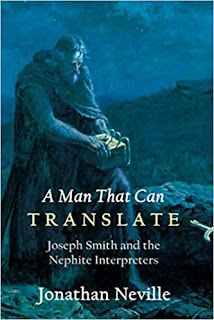
cover of A Man that Can Translate by Jonathan Neville Jonathan Neville’s 2019 book A Man that Can Translate: Joseph Smith and the Nephite Interpreters (which was revised and updated in 2021) argues that Joseph Smith did not use a seer stone to translate the Book of Mormon, that Joseph used exclusively the Nephite interpreters to accomplish the translation, and that the plethora of firsthand witnesses who saw Joseph using a seer stone to translate were mistaken because Joseph only did so as a “demonstration” of how the translation process worked.

Today, Interpreter: A Journal of Latter-day Saint Faith and Scholarship published Spencer Kraus’s sixty-two-page critical review of Neville’s book and his theories under the title “An Unfortunate Approach to Joseph Smith’s Translation of Ancient Scripture.” From the abstract:
[Jonathan] Neville has long argued that Joseph Smith did not use a seer stone during the translation of the Book of Mormon, and he has more recently expanded his historical revisionism to dismiss the multitude of historical sources that include the use of a seer stone. Neville’s “Demonstration Hypothesis” is explored in A Man That Can Translate, arguing that Joseph recited a memorized text from Isaiah rather than translate Isaiah from the Book of Mormon record. This hypothesis, meant to redefine how Joseph Smith used a seer stone during the translation of the Book of Mormon, however, fails to deal with the historical record seriously or faithfully. Neville, in a purported effort to save Joseph Smith’s character, ironically describes Joseph as a liar, reinvigorating old anti-Latter-day Saint claims that Joseph simply recited a memorized text, even to the point that Neville defends hostile sources while targeting Church-published histories and publications. He further attacks the witnesses of the translation in an effort to discredit their testimonies regarding the seer stone, and repeatedly misrepresents these sources. Coming from a Latter-day Saint, such claims are troubling and demand a response.
As someone who has long been disturbed by and disagreed with Neville’s “SITH” theories, I warmly recommend Kraus’s review to all my readers.

—Peter Pan
 

Wednesday, December 7, 2022

David Hocking’s claim about temples and steps

Yesterday I posted about Heartlander David Hocking’s claim that Church-approved Book of Mormon art is “visual pornography.” The quote I provided from Hocking included this claim:
If [the Church is] going to be truly neutral, they need to remove that kind of image and make it more Hebrew, not some other weird religion that has stone steps with a little square box [at the top]. I’ve never been to a Mormon temple or go to Hebrew [sic] when you go to the temple after the manner of Solomon that has multiple steps with a little square box at the top.
As it turns out, this is one of the primary arguments Heartlanders make to refute the Mesoamerican setting for the Book of Mormon: According to Hocking, a temple designed after the law of Moses cannot have steps or stairs due to the prohibition in Exodus 20:26.

Spencer Kraus saw my blog post and wrote a response to Hocking’s claim. Unlike Hocking, Kraus can read Hebrew, and he has some interesting insights into the meaning behind Exodus 20:26 and how some Mesoamerican structures fit the pattern for temples revealed to ancient prophets of Israel.
Read “A Note on Temples, Stairs, and Mesoamerica,” by Spencer Kraus.
—Peter Pan
 

Monday, October 17, 2022

Jonathan Neville’s unheard-of “faithful” explanation

The Interpreter Foundation gave Jonathan Neville the opportunity to respond to Spencer Kraus’s reviews of Neville’s two books, A Man that Can Translate and Infinite Goodness, that were published in Interpreter last June. Neville’s reply was published last week as “A Man That Can Translate and Infinite Goodness: A Response to Recent Reviews.”

Neville’s reply is interesting for what it says and what it doesn’t say. Kraus’s rebuttal—published in the same issue of Interpreter as “A Rejoinder to Jonathan Neville’s ‘Response to Recent Reviews’”—brings up most of the key issues, but there’s one thing Neville wrote in his response that struck me as particularly odd. Neville writes:
There are three basic explanations for the Book of Mormon. Proponents of each find support in historical documentation, which indicates the evidence is inconclusive and can support multiple working hypotheses.

  1. Joseph Smith translated the ancient engravings into English, using “translate” in the ordinary sense of the word of converting the meaning of a manuscript written in one language into another language.
  2. Joseph Smith (and/or confederates) composed the text and Joseph read it surreptitiously, recited it from memory, or performed it based on prompts or cues.
  3. Joseph Smith dictated words that supernaturally appeared on a seer stone he placed in a hat.

Until recently, explanation 1 was the “faithful” explanation, while explanations 2 and 3 were the critical or unbelieving explanations. Lately, explanation 3 has been embraced by many believers (including Kraus) as a faithful explanation that replaces explanation 1.
In the considerable time I’ve spent as an active member of the Church and student of Church history—not to betray too much about myself, but let’s just say that I’m older than 45 and younger than 70—I have never heard Neville’s explanation 1. Not even once. I have always been told or have read that Joseph Smith translated the Book of Mormon by miraculous means by seeing words in the Urim and Thummim—the Nephite interpreters—or in a seer stone (explanation 3). The claim that Joseph translated “in the ordinary sense of the word” is something I’ve never encountered until I began reading Jonathan Neville’s writings.

Anthony Sweat Urim and Thummim spectacles Neville’s claim that “Lately, explanation 3 has been embraced by many believers…as a faithful explanation that replaces explanation 1” is clearly and patently false. As I wrote in April 2021, “eyewitnesses to the translation process, early Latter-day Saint publications, Church leaders in the 19th through the 21st centuries, and official histories published by the Church have accepted and taught that Joseph Smith used a seer stone that he placed into a hat—along with the Nephite interpreters—to translate the Book of Mormon.”

This method of translating the Book of Mormon was taught by then-Elder Russell M. Nelson in 1992 and published in the Ensign in 1993.

This method of translating the Book of Mormon was included in the six-volume Comprehensive History of the Church, edited by Elder B.H. Roberts and published by the Church in 1930.

This method of translating the Book of Mormon was repeated by Apostle Orson F. Whitney in his 1921 book, Saturday Night Thoughts.

This method of translating the Book of Mormon was affirmed by Joseph Knight Sr., one of the Prophet’s closest friends and an eyewitness to the translation process.

This method of translating the Book of Mormon was corroborated by a Shaker in northern Ohio who heard Oliver Cowdery preach in 1830.

This method of translating the Book of Mormon was reiterated by Hugh Nibley, who wrote in 1975:
Nothing could be less like the normal ways of scholarship than the inspired mood and method in which the Prophet Joseph did his translation. “In the darkness the spiritual light would shine. A piece of something resembling parchment would appear, and under it was the interpretation in English. Brother Joseph would read off the English to Oliver Cowdery, who was his principal scribe, and when it was written down and repeated to Brother Joseph to see if it was correct, then it would disappear. Thus the Book of Mormon was translated by the gift and power of God and not by any power of man.” If all the Prophet had to do was to read off an English text, why did he need the original characters in front of him? He didn’t! “I frequently wrote day after day,” Emma Smith recalls, “often sitting at the table close by him, he sitting with his face buried in his hat, with the stone in it, and dictating hour after hour with nothing between us.… He had neither manuscript nor book to read from.… The plates often lay on the table without any attempt at concealment, wrapped in a small linen table cloth.” David Whitmer confirms this: “He did not use the plates in the translation, but would hold the interpreters to his eyes…and before his eyes would appear what seemed to be a parchment, on which would appear the characters of the plates…and immediately below would appear the translation in English.”

[Nibley, The Message of the Joseph Smith Papyri, 1975, p. 51 / 2005, p. 59; ellipses in the original]
The question of how much of what Joseph saw in those stones was directly revealed by God and how much of it was Joseph’s own language remains open. (As I explained in January 2020, Book of Mormon scholars Royal Skousen and Brant Gardner disagree on this matter.) But no one, to the best of my knowledge, has ever claimed that Joseph Smith translated “in the ordinary sense of the word,” as Jonathan Neville has asserted.

If there is any evidence of a Church leader or recognized scholar teaching what Neville is claiming, then I would be very interested to read what they said or wrote. Please leave a comment below.

—Peter Pan
 

Tuesday, October 26, 2021

Another excellent review from Spencer Kraus & recent finds in Mesoamerica

I’ve been preoccupied with some family matters recently, so this blog has been quiet for a few weeks. Here are two new developments my readers may be interested in:

The erudite Spencer Kraus writes:
You…may be interested in a recent review I did of Jonathan Neville’s latest interview with Mormon Book Reviews. In Part One I respond mostly to assertions made by the host, and focus more on claims made by Neville in Parts Two and Three. Neville, for instance, tries to discredit the seer stone translation [of the Book of Mormon] because the four authors of the Gospels of the New Testament didn’t use a seer stone—which is a ridiculous assertion for more than one reason. Or he claims it is a lost cause to expect to find any writing whatsoever in Book of Mormon lands—even though the Book of Mormon describes at least a semi-literate Lamanite nation.

Here are the links to all three parts for any [who are] interested:

Part One: https://latterdaylightandtruth.blogspot.com/2021/10/misrepresentation-and-miscellaneous.html

Part Two (Regarding Jonathan Edwards and the Book of Mormon): https://latterdaylightandtruth.blogspot.com/2021/10/jonathan-edwardss-purported-influence.html

Part Three (regarding baseless attacks, general misrepresentations, etc.): https://latterdaylightandtruth.blogspot.com/2021/10/misrepresenting-mesoamerica-book-of.html
Spencer’s three-part series is solid, and I recommend it to those interested in all things Neville.

In other news, the venerable publication Science posted a news article on their website on October 25, 2021, about a large number of Mesoamerican monuments that have been revealed by laser mapping:
Scientists have uncovered nearly 500 Mesoamerican monuments in southern Mexico using an airborne laser mapping technology called lidar. Dating as far back as 3000 years ago, the structures—still buried beneath vegetation—include huge artificial plateaus that may have been used for ceremonial gatherings and other religious events.…

The analysis resulted in the discovery of 478 formal complexes—many new to science—the team reports today in [the journal] Nature Human Behaviour. Several of these monuments had the same layout as Aguada Fénix, including an even more ancient Olmec site in San Lorenzo. Researchers continue to argue over whether the Olmec, which predate the Maya, are more of a mother or sister culture to them. The researchers estimate these Olmec and Maya complexes were built between 1100 and 400 B.C.E., and would have been used for ceremonial gatherings.
These findings are right in the middle of where most educated, competent Book of Mormon geographers place the events of the Book of Mormon. While the structures discovered by the lidar survey are too old to be connected to the peoples of the Book of Mormon, they are examples of the complex, developed societies that were found in ancient Mesoamerica—a striking difference from the simple Hopewell cultures in the American Midwest that had no written languages, large cities, or other features described by the Nephite authors.

After reading John L. Stephens’s 1841 book, Incidents of Travel in Central America, Chiapas, and Yucatan, Joseph Smith (with editorial assistance from John Taylor) wrote in 1842:
Mr. Stephens’ great developements of antiquities are made bare to the eyes of all the people by reading the history of the Nephites in the Book of Mormon. They lived about the narrow neck of land, which now embraces Central America, with all the cities that can be found.… Who could have dreamed that twelve years would have developed such incontrovertible testimony to the Book of Mormon? surely the Lord worketh and none can hinder.
These hundreds of new discoveries in Central America continue to show us how little we know of the ancient civilizations that inhabited that region. If twelve years (1830–1842) were enough for Joseph Smith to claim that “incontrovertible testimony” of the Book of Mormon had been found, how much more will its historicity be established as evidence continues to be uncoverered in Mesoamerica?

—Peter Pan
 

Sunday, November 27, 2022

Jonathan Neville’s claims eerily similar to those in a famous anti-Mormon book

Jonathan Neville continues undeterred in his claim that the language of the Book of Mormon was derived from the sermons of Jonathan Edwards. In a recent blog post, Neville repeated his argument that the famous phrase in King Benjamin’s sermon “the natural man is an enemy to God” was derived from Jonathan Edwards’s sermon on how “natural men are God’s enemies.” Since September 2019, he has maintained a blog devoted to proving that Joseph Smith copied much of the language in the Book of Mormon from the published writings of Jonathan Edwards. His response to Spencer Kraus’s thorough takedown of his hypothesis demonstrates that he has not read Kraus’s criticisms carefully and that he’s too personally invested in his view to admit that it has any flaws.

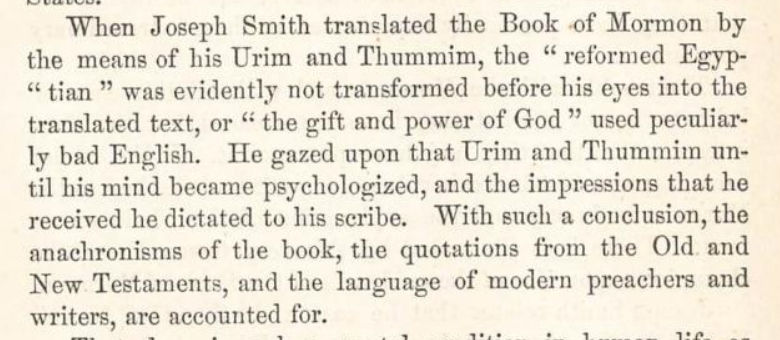
Dozens of times Neville has asserted that historical claims that Joseph Smith used a seer stone to translate the Book of Mormon are simply repeating the assertions made in the 1834 anti-Mormon book Mormonism Unvailed. In an ironic twist, Neville’s claims that Joseph didn’t see anything in the Urim and Thummim and that he copied the language of contemporary sermons repeats a similar explanation given by T.B.H. Stenhouse in his famous 1873 anti-Mormon book The Rocky Mountain Saints: Like Stenhouse, Neville believes that Joseph Smith didn’t “see” anything in the Urim and Thummim or seer stones—quite odd for a prophet who was called a “seer” (Mosiah 8:13; D&C 21:1)—and that “the language of modern preachers and writers” explains the origins of the language in the Book of Mormon.

Rather than demonstrating the miraculous origins of the Book of Mormon—the keystone scripture of the Restoration—Neville is providing ammunition to its critics who wish to find commonplace explanations for how it came to be.

—Peter Pan
 

Tuesday, July 19, 2022

Recommended watching: Spencer Kraus’s interview with Robert Boylan

Even though this interview goes into more detail about this blog than I’m comfortable with, I still warmly recommend it to my reader(s):
—Peter Pan
 

Sunday, September 4, 2022

It’s all so tiresome

When I started this blog, I legitimately hoped that, by pointing out the errors in Jonathan Neville’s arguments and methods, he would come to understand how misguided and offensive his manner is and perhaps moderate his approach.

Three-and-a-half years later, I am not so sanguine. He continues to misrepresent the arguments and the motivations those who disagree with him. He continues to call for mutual respect and to tolerate different points of view while simultaneously presuming the worst about his opponents.

One example of this is the terms that he uses to describe those on the other side. One of these is the acronym SITH, which stands for “stone in the hat,” referring to the (overwhelming) historical evidence that Joseph Smith translated the Book of Mormon by using a seer stone that he placed into a hat. The term “Sith” comes from the fictional Star Wars universe; it describes “an ancient order of Force-wielders devoted to the dark side [who] practice hate, deception, and greed…[and] look to amass power at all costs.”

This is not an innocent coincidence. Jonathan Neville knows the connection the word Sith has to great evil: In one of his earliest blog posts in which he used the term, he included photos of Star Wars-related media and used the phrase “the revenge of the SITH,” a reference to the title of the 2005 Star Wars movie. He’s deliberately using this acronym to describe those who disagree with him because it implies they are evil.

And yet Neville still protests his innocence and claims that all of this is just for convenience: “Some people don’t like these acronyms,” he writes, “and I’m happy to consider alternatives, but for now…SITH = stone-in-the-hat theory.” This is a lie. He is not going to “consider alternatives.” He knows exactly what he’s doing, and the evidence clearly shows that he’s doing it deliberately.

Amidst all of this, Neville continually—and hypocritically—pleads for disagreements to be “handled charitably.” That was the focus of two recent blog posts (here and here) in which he called for “respect [for] other perspectives, interpretations, beliefs, etc.,” while in the very same post calling the BYU Virtual Scriptures conceptual Book of Mormon map a “fantasy map,” claiming his opponents’ beliefs are “based on the premise that Joseph Smith and Oliver Cowdery were ignorant, naive, or deceitful,” and asserting that “the citation cartel”—(another derogatory term he uses frequently)—“obscures and censors sources so that people cannot make informed decisions.”

It requires either a massive amount of chutzpah or a total lack of self-awareness to plead for respect and charity while simultaneously resorting to name-calling and misrepresenting one’s ideological opponents.

Double down blackjack table The evidence sadly suggests that Jonathan Neville is not going to stop doing these things or even tone down his rhetoric. If anything, Neville’s recent appearance on Steven Pynakker’s Mormon Book Reviews YouTube channel shows that he’s doubling down on his approach in the wake of Spencer Kraus’s incisive reviews of his recent books.

My interpretation of all of this is that Jonathan Neville is allowing himself to become more and more convinced that Church leaders are going to come crawling to him, telling him that he’s been right about everything and pleading with him to come cast out the evil historians and save us all with his brilliance. But the phone keeps not ringing, so he has to keep ramping up the hyperbole to show the world how sincere and right he is. (See, for example, his recent blog post “Yet another SITH video!” in which he accuses the Church of the “suppression” of “what Joseph and Oliver taught.”) Neville’s latest interview with Pynakker doesn’t help, because Pynakker just feeds Neville’s sense of self-importance by telling him there is a time coming for him to shine, calling this approaching moment “the hour of Jonathan.” “the Jonathan Neville moment.”*

If my reading of these tea leaves is correct, then Jonathan Neville is following a well-trodden path that many would-be ark-steadiers` have walked before him. This road never leads to good ends.

—Peter Pan
 
* I inadvertantly misquoted Pynakker when I posted this blog. Pynakker pointed this out recently, and I’ve corrected the error. (Although, to be honest, I don’t see a qualitative difference between “the hour of Jonathan” and “the Jonathan Neville moment.”) —November 11, 2022.

Wednesday, December 9, 2020

An excellent review of Nevilleʼs recent posts

Iʼve been unusually busy and dealing with an illness, both of which have kept me from blogging as much as I would like to have.

Fortunately, Spencer Kraus—whom I do not know personally—has posted a wonderful review of and response to Nevilleʼs recent activity and claims.

A brief except:
Neville [has] made it clear: he would rather stand with known critics of the Church and defend them than he would defend the Church itself over a petty squabble of “not everyone agrees with me.”

Make no mistake: Jonathan Neville is a critic of the Church. His unorthodox views would be forgivable if he did not make them unofficial articles of faith for the Church and attack those who disagree with him incessantly while trying to claim he respects them.

—Peter Pan

Saturday, July 23, 2022

“Doctor Scratch,” perpetual gadfly and blowhard

We interrupt our regularly scheduled blog to bring you amusing developments over at DiscussMormonism.com.

An individual who calls himself “Doctor Scratch” has been criticizing Daniel Peterson and other Latter-day Saint apologists for over fifteen years now. Peterson refers to him as “my Malevolent Stalker,” and not without good reason.

Now, I have no problem with using a pseudonymous identity to make critical comments about well-known individuals. [ahem] In fact, I must give “Doctor Scratch” all the credit he is due for managing to keep his true identity a secret for a decade and half. That feat alone is impressive.

Scratch has recently set his sights on this humble blog, telling his followers:
“Neville-Neville Land” is a curious artifact of Mopologetics [“Mormon apologetics”]: one marvels at the sheer extent and obsessiveness of it. The blog began in February of 2019, and a new entry has been posted at least a couple of times per week since then, meaning that the total entries rivals the volume of [Daniel Peterson’s blog] “Sic et Non.” We are talking hundreds of entries—all devoted to one purpose: taking down Jonathan Neville, one of the chief proponents of the so-called “Heartland Theory.”
Doctor Scratch, B.H. Roberts Chair of Mopologetic Studies
“Doctor Scratch, B.H. Roberts Chair of Mopologetic Studies”
I won’t dispute “Doctor Scratch’s” description of this blog, but I can’t help but notice what may be the veritable Marianas Trench of irony that he would call me out for “the sheer extent and obsessiveness” of this blog. This, from a man from whom obsessiveness herself hides her face in shame! Uncounted masses can only stand silent, their mouths agape, at his utter and complete lack of self-awareness.

Perhaps just as amusing, though, is that “Doctor Scratch” has proclaimed to his trained minions that he has cracked the case regarding my identity. In his message board post that goes on for a rambling 3,400 words (!), he connects all the dots and triumphantly proclaims that I, Peter Pan, am in reality Stephen Smoot. (The title of his exposé is “Stephen Smoot’s Vendetta.”)

I hate to break to the good Doctor, but I’m not Stephen Smoot. I’m not Daniel Peterson either, but we’ve been over that many times on this blog. And, since we’re on this subject, I’ll freely admit that I’m also not Spencer Kraus.

For over a decade-and-a-half, “Doctor Scratch” has been posting to online message boards supposedly inside information about Latter-day Saint apologetics. That he would go through all the effort to reveal my true identity and yet get it completely wrong demonstrates how reliable his other claims must have been.

This is the first and last time I’ll mention “Doctor Scratch.” His pompous posts are worth less than the time I’ve already given them.

—Peter Pan
 

Tuesday, October 11, 2022

Another stake in the heart of Neville’s SITH hypothesis

Jonathan Neville insists that Joseph Smith used only the Nephite interpreters (the “Urim and Thummim”) to translate the Book of Mormon, that he did not use a seer stone to translate, and that he never placed either instrument into a hat. Instead, Neville insists that Joseph’s use of a stone in a hat was only a “demonstration” of the translation process to satisfy the curiosity of other people.

Neville’s claim is contradicted by the testimony of multiple eyewitnesses to the translation process, including Martin Harris and Emma Smith (who served as Joseph’s scribes during the translation), David Whitmer (one of the Three Witnesses), Joseph Knight Sr. (a close friend of Joseph Smith who supported the Prophet during the translation effort), Elizabeth Ann Whitmer (Oliver Cowdery’s wife), and others. Neville was forced to develop his “demonstration” hypothesis to account for the overwhelming number of witnesses who said Joseph translated by means of a stone that he placed into a hat.

Neville further claims that the “stone-in-the-hat” story was popularized by Eber D. Howe and set forth in Howe’s 1834 anti-Mormon book, Mormonism Unvailed. Neville tells us:
According to Mormonism Unvailed, one explanation was that Joseph Smith used a “peep” stone that he found in a well years before he obtained the plates from the hill in New York. Joseph placed the stone into a hat. Words appeared on the stone. He put his face in the hat to block the light and read the words to his scribes (primarily Martin Harris for the 116 pages and Oliver Cowdery for the Book of Mormon we have today).
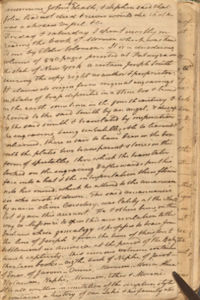
Some new evidence has recently come to light that destroys Neville’s claim that the “stone-in-the-hat” explanation was developed by anti-Mormons. The evidence comes from Richard McNemar (1770–1839), a Shaker who lived in Ohio and who encountered the Book of Mormon in late 1830. In November 1830, Oliver Cowdery, Peter Whitmer Jr., Parley P. Pratt, and Ziba Peterson spent four weeks in the area of Kirtland, Ohio, preaching and baptizing, before continuing on their mission to the Lamanites in the West. In his diary entry for Saturday, January 29, 1831, McNemar wrote:
Richard McNemar's January 29, 1831 diary entry about the Book of Mormon and Oliver Cowdery Friday & Saturday I spent mostly in reading the book of Mormon which was [handed?] to me by Elder Solomon. It is a duodecimo volume of 590 pages printed at Palmyra in the state of New York a certain Joseph Smith securing the copy right as author & proprietor. It claims its origin from original engravings on plates of brass deposited in a stone box & [buried?] in the earth sometime in the fourth century & showed to the said Smith by an angel & dug up by the said Smith & translated by inspiration the engraving being unintelligible to learned & unlearned. There is said to have been in the box with the plates two transparent stones in the form of spectacles thro[ugh] which the translator looked on the engraving & afterwards put his face into a hat & the interpretation then flowed into his mind, which he uttered to the amanuensis who wrote it down. The said amanuensis by name Oliver Cowdery, was lately at the North lot & gave this account. He & others being on their way Missouri to open this new revelation to the Indians whose genealogy it professes to trace from the line of Joseph & from the line of their first settlement in America at the period of the Babylonish captivity.… There being no intelligible correspondence between the marks on the plates, & the dictates of the pretended interpreter, all his ideas were acquired by looking into a hat, where in all probability the translation appeared quite plainly in our English language. We must therefore conclude that the confabulation was cunningly devised, whether by visibles or invisibles & whether those bright & unsullied plates had been deposited in ancient or modern times. [Emphasis added.]
McNemar spent the remainder of his diary entry explaining why he could not believe the Book of Mormon to be true. What is interesting, however, is the accuracy of his description of the book, how it was found, and how it was translated. Many early non-Mormon sources garble the story of the book’s translation and contents, but McNemar—with the exception of confusing the gold plates of Mormon for the brass plates of Laban—accurately summarized what he had heard Oliver Cowdery preach and what he himself had read in the Book of Mormon.

From McNemar’s contemporary account of what he heard Oliver Cowdery preach, it’s plainly evident that Oliver himself was teaching in late 1830 that Joseph Smith translated the Book of Mormon by placing the Nephite interpreters into a hat, and that Joseph received the translation by having it “flow into his mind” by “appear[ing] quite plainly in our English language,” as Martin Harris, David Whitmer, and Joseph Knight Sr. also later described.

This single, early account shatters Neville’s claims that (1) Joseph did not translate by using a stone in a hat, (2) that the stone-in-the-hat theory was created by anti-Mormon sources, and (3) that Joseph translated “in the ordinary sense of the word” and only used the Urim and Thummim to confirm that his translation was correct.

—Peter Pan

I am grateful to Dr. Gerrit Dirkmaat’s Standard of Truth podcast and Spencer Kraus’s Latter-day Light and Truth blog for bringing this historical item to my attention.
 

Popular Posts

Search This Blog