Examining the claims of Jonathan Neville and the Heartland movement

Showing posts sorted by date for query "dead prophets". Sort by relevance Show all posts

Monday, December 19, 2022

An open letter to Rian Nelson of the FIRM Foundation

Dear Rian,

I notice that you recently blogged about me. Thank you for opening a dialog; I hope this leads to further discussion.

I’ll respond to each of your points:
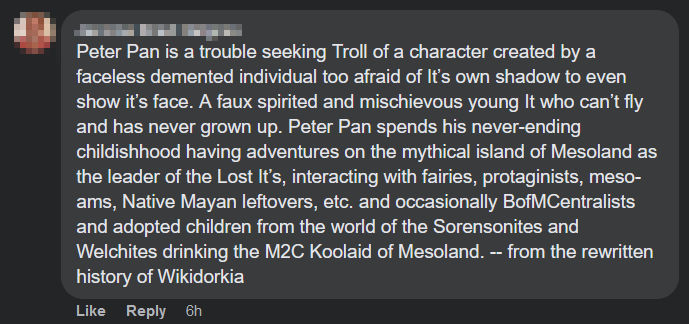
The blog below is from a a [sic] man who calls himself “Peter Pan.” I respect all peoples [sic] opinions, but it is very sad when they begin calling Heartlanders names.
This is a very interesting statement, since in your own blog you referred to the BYU Book of Mormon Conceptual Map by the derogatory name “Fantasy Map” (a term that Jonathan Neville has used in over 100 of his own blog posts) and also wrote that I “just seem like a very small person” to you. So, apparently, name-calling is not exclusive to my site.
He said we are an apostate sect, and hucksters, racists and other inflammatory things.
Allow me to examine those three terms in the context in which I used them:

  • Over the last four years, I have given many examples of statements from you, Jonathan Neville, and other Heartlanders that are apostate or lean in that direction. One of the most troubling features of Heartland movement is how its advocates continually imply that today’s Church and Church leaders are teaching falsehoods or withholding the truth about Joseph Smith, the Book of Mormon, and the hill Cumorah. (For example, see these statements by Jonathan Neville about how Church leaders have been purportedly suppressing the truth about the translation of the Book of Mormon in General Conference talks and Church magazines, and this claim he made that a general authority published anti-Mormon material in a Church magazine.) These things are very disturbing. You are leading your followers away from the teachings of living prophets while claiming to be faithful to dead prophets. You are also causing dissension and division among the Saints by repeatedly attacking mainstream Latter-day Saint scholars and implying that they are a “fifth column” within the Church. These things are despicable and dangerous. When confronted, you claim that you follow the Brethren and have faith in the Church, but your own statements contract that claim.
  • Yes, I called the leaders of the Heartland movement “hucksters.” A huckster is “a person who employs showy methods to effect a sale,” and the conferences and videos produced by the FIRM Foundation certainly fit that description.
  • Please read carefully: I have never once called you or anyone else a racist. I have said, however, that some of things you have written are racist: I’ve referred to “a disturbingly racist blog post,” “appeals to vaguely racist notions,” and “a disturbingly racist approach” to a specific matter. Occasionally using racist language does not make you a racist; it simply means that you should carefully consider what you write and how it could be interpreted by your readers before publishing.
He defends the “fantasy map” they use as you see it in the video below by John Lefgren.
There you go using the term “fantasy map” (in scare quotes, no less) instead of its actual name, the BYU Book of Mormon Conceptual Map. Using its real name would show respect for its creators, but it would prevent you from using derogatory labeling as a polemical weapon.
I support the following scriptures and quotes, that strengthen my faith and testimony, as I believe the Book of Mormon events began in North America:
1- D&C 128:20
2- D&C 125:3
3- Joseph’s letter to his wife Emma, on the Plains of the Nephites. JSP
4- Story of Zelph and Onondagus on the Illinois River JSP
5- Hundreds of quotes by Prophets, Apostles and Leaders HERE.
I’ve discussed each of these references and the problems with the Heartland interpretation of them. Feel free to use the search feature on my blog to find these discussions.

The problem with the Heartland approach is that you start with a conclusion (“the Book of Mormon events began in North America”) and then interpret these texts so that they fit into your predetermined belief, while also ignoring or hand-waving texts that contradict that belief. For example, Jonathan Neville doesn’t like the statements from Emma Smith, Martin Harris, David Whitmer, and many others that Joseph Smith used a seer stone in a hat to translate the Book of Mormon, so he dismisses those eyewitness testimonies and tells people, wrongly, that they should focus only on specific, cherry-picked statements of Joseph Smith and Oliver Cowdery, without interpreting those statements in the light of all the available evidence.

When you write:
Please read, pray and study these references above on your own, for validation of your own feelings.
…you’re doing the same thing Neville does—telling people to focus on only a limited number of specific sources that are the keystones of your belief.
I share this information with you for an awareness of the vitriol my friends Wayne, Rod, and Jonathan have endured for many years. They are entertained and just shrug it off as the good men they are.
The “vitriol” I have supposedly heaped upon your friends is no worse than what you and your friends have said about Daniel Peterson, Jack Welch, Richard Bushman, John Sorenson, and many other good men. You and your associates have repeatedly stated that these men—along with Church employees and Church leaders—have “rejected the teachings of the prophets,” are responsible for loss of faith and a decline in the growth of Church membership.

If you want respect for yourselves, then you need to start giving respect to others. This entire conflict began in 2008 with Rod Meldrum claiming that Church scholars are leading members astray; you, Jonathan Neville, and others have continued to promulgate that lie since then. If you want to know the source of the supposed “vitriol,” take a look in the mirror.
I love the gospel and the Savior and His Church. It saddens me to see good members put others down and don’t have the courage to openly debate in a positive way. We all love the Book of Mormon and it is my prayer we can all come together and not fight with each other. Our fight is against Satan not our fellow members.
I wholeheartedly agree! So please stop putting down and misconstruing the beliefs and statements of those who disagree with your interpretations about Book of Mormon geography, Book of Mormon translation, and other matters. Stop implying that the Brethren and Church employees are suppressing or distorting Church history. Stop peddling misguided “QAnon,” anti-vaxx, and other conspiracy theories. Start focusing on the truth of the teachings in the Book of Mormon and allow for different viewpoints on historical and geographic issues without asserting that those who disagree with you are “rejecting the teachings of the prophets.”
The anonymous Mesoamericanist supporter of the Book of Mormon won’t disclose his real name as he continually calls Heartlanders names.
Many authors throughout history have used pseudonyms for one reason or another. (There’s a long list of them on Wikipedia.)

I go by the pseudonym Peter Pan for a couple of reasons. The first is that I thought it was funny and that it tied in with the name of the blog (which was created first). The second is that, to be honest, there are some unstable people in the Heartland movement—Stephen Reed being just one prominent example—and I’d rather not expose myself or my family to being stalked or harassed by them.
Summary of Quotes from Peter Pan

1- “hucksters who are selling the Heartland hoax to gullible Latter-day Saints”
2- “advancing fraudulent pseudoarchaeology”
3- “May’s latest venture is a scheme”
4- “dubious interpretation of D&C 125:3 to find what he insists must be there.”
6- “must have a true and correct belief in Book of Mormon geography, otherwise their faith is misplaced”
7- “According to Wayne May, the Church is “under condemnation” for not believing in the correct geography of the Book of Mormon.”
8- “This is yet another example of the false god of the Heartland Book of Mormon movement:”
9- “with their own message of American Exceptionalism.”
10- “According to them, the United States is God’s promised land, and therefore the peoples of the Book of Mormon must have lived in the United States and the Book of Mormon’s promises must apply only to the United States and its inhabitants.”
11- “explains Neville’s disturbing views on nationalism and racial superiority
directly accuses the Church and its leaders of hypocrisy and teaching false doctrine. Wayne May once again claims that the Church is “under condemnation” for not accepting the Heartland Book of Mormon geography”
12- “He then asks viewers to give him money to help pay for the effort to find it.”
13- “As I’ve previously written, the Heartland movement is an apostate sect that is critical of living prophets and apostles.”
14- “Heterodox Teachings” [Not in agreement with accepted beliefs, especially in church doctrine or dogma.]
I stand by all of these statements as I made them in their original context. I invite anyone to search for these phrases on my blog and read what I wrote in full.
You can respond to Peter Pan at his blog below. Please, no derogatory remarks. I am sure he is a good member of the Church who loves the Book of Mormon. He just seems like a very small person to me.
And there’s the reference to me being “a very small person.” Who’s calling names now?

(For the record, I’m 5′ 10½″ tall, which is not “small.”)

It appears that some of your followers haven’t been heeding your advice. (“Please, no derogatory remarks about that very small person!”) Here are a couple of examples from your Facebook post about your blog: (The comment above—along with all of its replies—was deleted by its author or by Rian Nelson.) Respect is a two-way street, Rian.
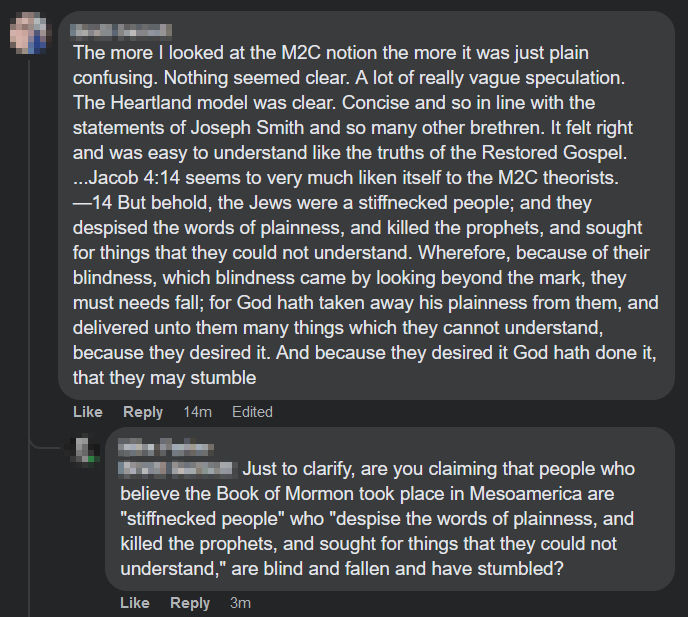
If you would like to engage in a dialog, I would be more than pleased to have that conversation. Please feel free to contact me in the comments below or at peter ᴀᴛ nevillenevilleland ᴅᴏᴛ com.

Sincerely,

—Peter Pan
 

Monday, April 26, 2021

Is the Church neutral or not, Jonathan Neville?

Jonathan Neville can’t seem to make up his mind on whether or not the Church is neutral about where the events of the Book of Mormon took place.

The Church of Jesus Christ of Latter-day Saints logo overlaid on Switzerland Back in 2019, I documented how Neville has been critical of Church leaders for not being neutral. He’s snarked that “this position of ‘neutrality’ really means nothing more than ‘neutrality’ about where in Central America the Book of Mormon took place,” and he’s criticized the Church for posting a video lecture of Dr. Mark Wright explaining how the Book of Mormon fits into a Mesoamerican setting.

Now he’s claiming that the Church does, in fact, have a position of neutrality that it upholds:
Most Latter-day Saints accept the Church’s position of neutrality regarding Book of Mormon geography, which recognizes multiple working hypotheses. We think that position best promotes harmony and unity in the Church.
I question whether “most Latter-day Saints” are even aware of the Church’s position on Book of Mormon geography, but one thing is certain: The Church is not neutral on Book of Mormon geography, nor does it recognize “multiple working hypotheses.” That is Neville’s tortured reading of the Gospel Topics Essay on Book of Mormon geography. As I pointed out in 2019:
Although “the Church does not take a position on the specific geographic locations of Book of Mormon events,” that does not mean that the Church may not or should not use representations of ancient structures found in the Americas, nor does it prevent individuals from expressing “their own opinions regarding Book of Mormon geography,” even in Church settings, as Dr. Wright did.

What the First Presidency and Quorum of the Twelve have actually said is that Church leaders and members should not “advocate those personal theories in any setting or manner that would imply either prophetic or Church support for those theories.” In other words, it’s perfectly fine to discuss different geographic theories in Church settings, only one should not state or imply that either revelation or the Church support one particular theory over another.

The real problem for Jonathan Neville, of course, is that “M2C* intellectuals” (as he calls them) are following the Brethren’s counsel while he and the Heartlanders are not. Dr. Wright, in his presentation, never claims that the prophets or the Church have declared that his Mesoamerican view of Book of Mormon geography is correct. For Neville and other Heartlanders, however, cherry-picked statements of dead prophets form the entire foundation of their claim that the Heartland hoax is the Lord’s revealed Book of Mormon geography.
One should also take note of Neville’s continued use of passive-aggressive language: In his latest blog post he claims that “We [i.e., Heartlanders] accept the teachings of the prophets that the hill Cumorah of Mormon 6:6 is in New York,” which he says is “only one working hypothesis.” Of course, by (mis-) characterizing his view as being the one held by prophets, he’s really implying that it’s the only acceptable hypothesis. Meanwhile, he informs us:
Other Latter-day Saints insist that the only possible setting for the Book of Mormon is in Mesoamerica. They teach that the prophets were wrong about the New York Cumorah because they have decided that the “real Cumorah” of Mormon 6:6 is in Mexico. This is the Mesoamerican/two-Cumorahs theory (M2C).

We recognize M2C as a working hypothesis and we are fine with people believing M2C if they want to. We hope they are engaged learners and not merely lazy learners whose beliefs are assigned to them by scholars.
Not only does Neville continue to straight-up lie when he claims his opponents “teach that the prophets were wrong,” he also continues to disingenuously assert that “we”—I assume by we he’s referring to other Heartlanders—“are fine with people believing M2C if they want to.”

So, Neville is “fine” with other Latter-day Saints “rejecting the teachings of the prophets” on what he believes is one of the most important doctrines of the Restoration, which he believes is leading to mass defection within the Church, especially among youth and new converts? Of course he’s not “fine” with that; he’s just playing a dishonest rhetorical trick to appear as if he’s fair and open-minded.

I’m honestly not sure which is worse: That Neville tries to hide his true beliefs behind amiable prose or that some of his readers actually believe what he writes.

—Peter Pan
 
* “M2C” is Jonathan Neville’s acronym for the theory that the Book of Mormon took place in Mesoamerica and that the hill Cumorah in the Book of Mormon is not the same hill in New York where Joseph Smith received the plates of Mormon.
 

Tuesday, February 23, 2021

Jonathan Neville has it completely backwards

In his February 22, 2021, blog post, “Oliver, Joseph, and scribes and Pharisees,” Jonathan Neville asserts:
The question of Cumorah boils down to whether people believe what Joseph and Oliver said, or whether people believe our latter-day scribes and Pharisees.

It’s a clear choice.

Once you decide whom to believe, you can confirm your choice with a corresponding interpretation of the scriptures and the relevant external evidence.
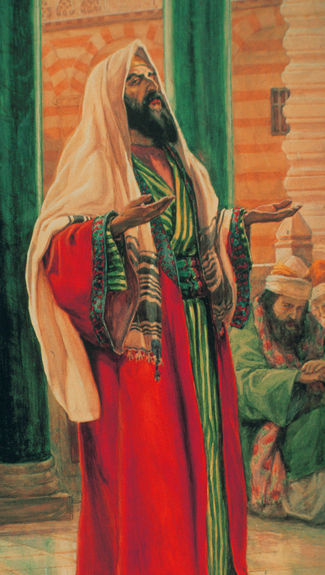
The proud Pharisee praying Luke 18According to Neville, scholars within The Church of Jesus Christ of Latter-day Saints who do not believe as Heartlanders do regarding Book of Mormon geography and translation are “scribes and Pharisees.” He does’t explain why this comparison is accurate and appropriate.
The reality, however, is exactly the opposite: It is Jonathan Neville and his Heartlander colleagues who are modern-day equivalents of the scribes and Pharisees of the New Testament:


Truly, if there are modern-day scribes and Pharisees, they are found among the advocates for the “Heartland” hoax who promote conspiracy theories and stir up dissension and contention through their false accusations against faithful Latter-day Saint scholars, Church employees, and Church leaders.

Jonathan Neville’s comparison is completely backwards.

—Peter Pan
 

Tuesday, February 2, 2021

More fan mail

I welcome all comments, especially ones that disagree with something I’ve written.

My only rule is that comments must be thoughtful. I don’t publish “drive-by” comments.

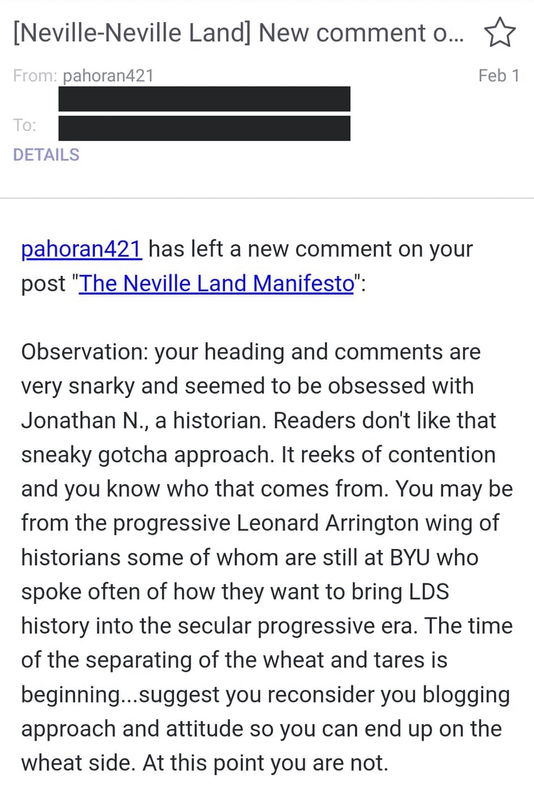
So, while I won’t be publishing the following comment, I do wish to demonstrate to “pahoran421” that I don’t censor, obviously or otherwise: Jonathan Neville insists that “those who accept the New York Cumorah are happy to discuss their reasoning and are confident, not defensive.”

pahoran421’s comment doesn’t seem to be a good representative of his assertion.
Observation: your heading and comments are very snarky and seemed to be obsessed with Jonathan N., a historian.
Well, snark is certainly preferrable to smarm. Some people’s views are so false and/or dangerous that they deserve some snark.

Also, calling Jonathan Neville “a historian” is bit of a stretch. He’s more of a propagandist.
Readers don’t like that sneaky gotcha approach.
My viewer stats indicate that my approach appeals to at least some of my readers.
It reeks of contention and you know who that comes from.
You’re referring to 3 Nephi 11:28–30. The Savior’s instruction to the Nephites was that there shall be no “disputations among you concerning the points of my doctrine.” Certainly he didn’t mean to imply that no one should ever contend for the truth—he and his apostles contended with those who spoke falsely. Not all contention is evil; sometimes contending is at least necessary. (See Jude 1:3; Words of Mormon 1:14; Mosiah 10:19; Alma 2:31; Alma 17:34; D&C 18:20; D&C 112:5; D&C 117:13.)

The sad fact is that I contend for President Russell M. Nelson’s teachings as the living prophet, while Neville contends for his heterodox reading of the words of dead prophets.
You may be from the progressive Leonard Arrington wing of historians some of whom are still at BYU who spoke often of how they want to bring LDS history into the secular progressive era.
I checked, and in my personal library of 597 books on religion—139 of which are on Mormon history—I found five that were authored or coauthored by the late Leonard J. Arrington. So, I wouldn’t exactly consider myself part of some sort of cult of Arrington.

This assertion—which has recently come into fashion thanks to a wretched book full of conspiracy theories by Hanna and James Stoddard—is deeply troubling. The Church History Department is overseen by a member of the First Quorum of the Seventy (currently that’s Elder LeGrand R. Curtis Jr.) who reports to the Quorum of the Twelve Apostles. Last year, Neville attacked an article written by Elder Curtis that was published in the Ensign. This kind of conspiracy-mindedness among Heartlanders is disturbing, to say the least.
The time of the separating of the wheat and tares is beginning…suggest you reconsider you[r] blogging approach and attitude so you can end up on the wheat side. At this point you are not.
Let me get this straight: “pahoran421” believes that my defense of the Church and its leaders against the scurrilous attacks against them being made by Jonathan Neville, perhaps along with my rejection of the false doctrines of “Heartlanders,” makes me a “tare” in the Savior’s famous parable—a tare that will be burned at the second coming of Jesus Christ.

I’m afraid we’re only now beginning to see how deep the psychosis of many Heartlanders really is.

—Peter Pan
 

Thursday, January 28, 2021

Heartland research director: “The Church is off course”

This post isn’t about Jonathan Neville, but it is about people in his sphere of belief—his theological circle, if you will.

The Joseph Smith Foundation is one of the more prominent organizations that promotes the “Heartland” theory of Book of Mormon geography and beliefs related to it, including denying that Joseph Smith used a seer stone to translate the Book of Mormon, emphasizing the United States as Lehi’s promised land, preferring the teachings of dead prophets and apostles over living ones, and other fundamentalist dogmas. (Despite what its name implies, the Joseph Smith Foundation is not a 501(c)(3) charitable organization; rather, it is a DBA for James Stoddard’s for-profit company, Integrivizion LLC.)

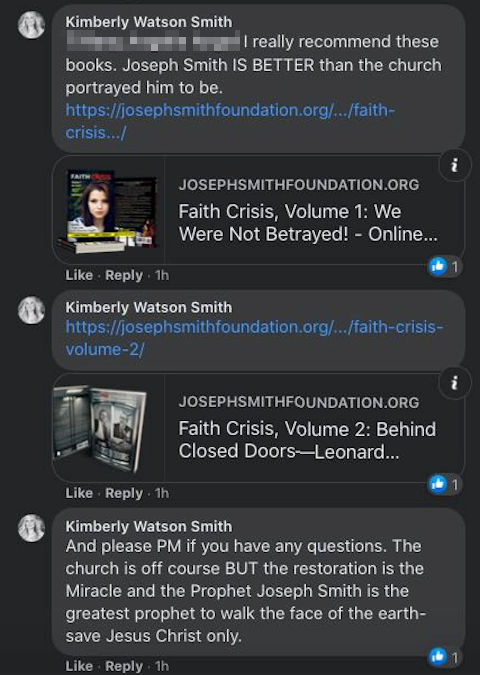
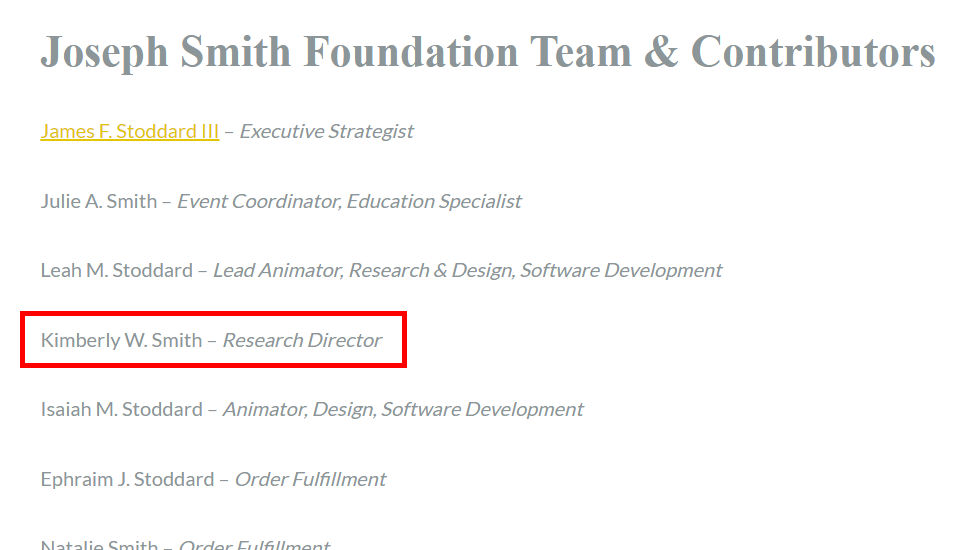
On the Joseph Smith Foundation website’s About page, Kimberly W. Smith is listed as the organization’s “Research Director.” That same page asserts:
Joseph Smith Foundation team and staff are active members of [T]he Church of Jesus Christ of Latter-day Saints[,] although the foundation is not sponsored by the Church.… The resources available on Joseph Smith Foundation sites are based upon and to our best knowledge in harmony with the scriptures and the writings of latter-day prophets.”
Keeping in mind that statement of belief, consider these recent comments made by Kimberly W. Smith:

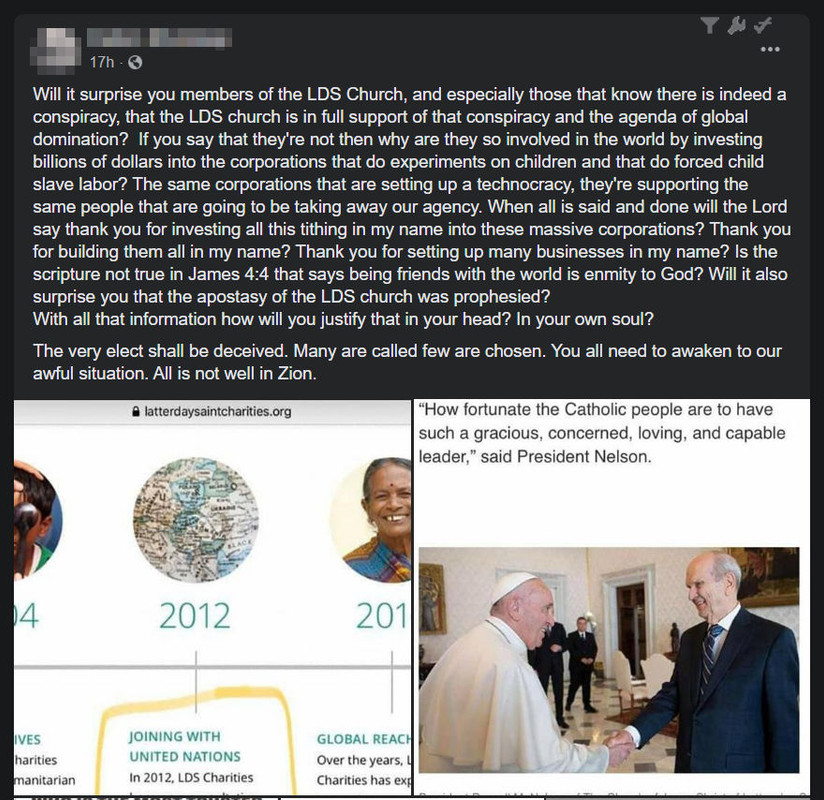
On January 27, 2021, a member of The Church of Jesus Christ of Latter-day Saints who is deeply mired in odious conspiracy theories—the very soil from which Heartlanderism has sprung—posted the following on his Facebook page. (I’ve redacted his name and profile picture out of respect for his privacy and because this post isn’t about him, per se.) In response to this loathsome attack on President Russell M. Nelson and Latter-day Saint Charities, one individual responded: Kimberly W. Smith, Research Director for the Joseph Smith Foundation, replied to the sister who expressed that she was in a faith crisis: After implying that the modern Church has denigrated the Prophet Joseph Smith, Kimberly W. Smith recommended two books published by the Joseph Smith Foundation and then declared, “The [C]hurch is off course.” A day or two later, Ms. Smith’s last comment was deleted, either by her or by the Facebook page’s owner.

I suppose there are several ways one could read Ms. Smith’s comment. I, for one, consider it to be a moment of transparent honesty—a sincere reflection of what those at the head of the “Heartland” movement really believe.

I’ve repeatedly predicted that it’s only a matter of time before Heartlanders declare The Church of Jesus Christ of Latter-day Saints and its current leaders to be in apostasy and break off to form their own church. Recent comments made by Kimberly W. Smith, Rian Nelson, and Jonathan Neville sadly reinforce that prediction.

—Peter Pan
 

Tuesday, October 13, 2020

He whose name shall not be mentioned

More than a week after October 2020 General Conference, Jonathan Neville has finally gotten around to acknowledging the matter of Elder Gerrit W. Gong’s comment in the Saturday afternoon session regarding “Mary Whitmer, the faithful sister to whom Moroni showed the Book of Mormon plates.”

I use the term acknowledging because Neville barely mentions it at all; instead, he brushes past it without dealing with any of its implications. His comments are limited to a mere 58 words in a 2,683-word blog post. (That’s a mere 2.2% by word count.)
The issue has resurfaced because in the October 2020 General Conference, one of the speakers repeated the story, citing Saints as authority. (I won’t mention the speaker’s name out of respect.)

Right in the same talk, the speaker described Moroni as “as a glorious messenger from God,” which is consistent with the description of Moroni in Letter IV.
Notice how Neville didn’t mention either the speaker’s name nor the office he holds; he didn’t even mention if the speaker was male or female. One could get the impression from his post that it was a newly-called Seventy or a counselor in an auxiliary presidency who made the offending remark. But the speaker was an apostle of the Lord Jesus Christ, one of fifteen men Neville supposedly sustains as a prophet, seer, and revelator.
Sustaining the leaders of The Church of Jesus Christ of Latter-day Saints in General Conference

It is proposed that we sustain one of the speakers, whose name we won’t mention.

By avoiding using Elder Gong’s name or mentioning his priesthood office, Neville less-than-deftly sidesteps all of the serious implications of his dogmatic insistence that the personage who appeared to Mary Whitmer was Nephi. For someone who insists that his ideological opponents teach that “the prophets were wrong,” Neville is awkwardly unwilling to admit that of himself. Instead, he just moves right along in his blog post to yet another rambling diatribe about the “M2C”* conspiracy, his assertion that Latter-day Saint scholars are denying what Joseph Smith and Oliver Cowdery taught, etc., without explicitly implicating Elder Gong in those heresies but clearly leaving the reader to infer exactly that.

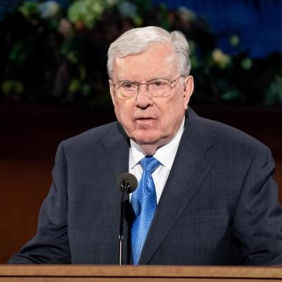
This is yet more evidence that Jonathan Neville, like his Heartlander comrades, clings to the selected teachings of dead prophets while rejecting the teachings of living prophets. Again and again this blog has demonstrated that Neville’s teachings are not in harmony with those of President Russell M. Nelson (1, 2, 3), President M. Russell Ballard (4), Elder Dieter F. Uchtdorf (5), Elder Quinten L. Cook (6), Elder LeGrand R. Curtis Jr. (7), and now Elder Gerrit W. Gong. He’s implied that Church leaders are withholding vital truths from Church members. He’s implied that the Brethren are ignorant of lies that are being fed to them by Church employees.

If this isn’t clear evidence that he’s on the road to apostasy, then I don’t know what is.

—Peter Pan

* “M2C” is Jonathan Neville’s acronym for the theory that the Book of Mormon took place in Mesoamerica and that the hill Cumorah in the Book of Mormon is not the same hill in New York where Joseph Smith received the plates of Mormon.

Saturday, October 3, 2020

Elder Gerrit W. Gong, M2C intellectual

Mary Whitmer was the wife of Peter Whitmer Sr., the mother of David Whitmer (one of the Three Witnesses of the Book of Mormon), and the mother of four of the Eight Witnesses. It was at her home in Fayette, New York, that the Prophet Joseph Smith completed the translation of the Book of Mormon in June 1829.

Mary herself was a witness of the Book of Mormon, being shown the gold plates by an angel who appeared to her as a elderly man. The identity of this angel has never been conclusively established, although most Latter-day Saint leaders and historians have concluded that it was Moroni. One account, recorded in 1878 by Mary’s grandson, John C. Whitmer, indicates that it was Nephi:
I have heard my grandmother (Mary Musselman Whitmer) say on several occasions that she was shown the plates of the Book of Mormon by a holy angel, whom she always called Brother Nephi. (She undoubtedly refers to Moroni, the angel who had the plates in charge.)
The parenthetical comments in that quote were written by Andrew Jenson, assistant historian of the Church, who interviewed Peter C. Whitmer.

The identity of the angel is of paramount importance to Jonathan Neville. As of this date, he’s written at least sixty-six blog posts on the matter, calling the identification of the angel as Moroni “a patently false story” cooked up by (who else?) “Book of Mormon Central, the Saints book, and our other M2C* intellectuals.”

Neville blogged about the identity of the angel as recently as yesterday (October 2, 2020).

For Neville, it’s not just that those who identify the angel as Moroni are wrong; they are malicious in their intent. It’s yet another piece of the grand conspiracy he’s dreamed up and that animates his years of blog posts, self-published books, YouTube videos, and presentations at Heartlander conferences.

At the same time, Neville continually insists that Latter-day Saints should follow “the teachings of the prophets and apostles”—a phrase he’s used in 210 separate blog posts as of this date—concerning the location of the hill Cumorah.

So my ears certainly pricked up this afternoon during the second session of the October 2020 General Conference of the Church, when Elder Gerrit W. Gong of the Quorum of the Twelve Apostles made this interesting statement (beginning at 7:51 in the video):
Our Church history is anchored in the lived testimony and gospel journey of each member, including Mary Whitmer, the faithful sister to whom Moroni showed the Book of Mormon plates.
Elder Garrit W. Gong of the Quorum of the Twelve Apostles, speaking in General Conference, October 2020

Elder Garrit W. Gong, the apostle who, according to Jonathan Neville, taught false doctrine at October 2020 General Conference.

I think this sets a record for the shortest shelf life for any of Neville’s blog posts.

Once again, we are confronted with an example of living prophets and apostles openly teaching something that Jonathan Neville has condemned as false and heretical. Neville claims that he and other Heartlanders are following “the teachings of the prophets and apostles,” but again we see that by that he really means they believe in selected teachings of selected (dead) prophets.

Perhaps Neville will chalk Elder Gong’s remark up to the Brethren being duped by conspiring Church employees, as he’s claimed before when official Church publications have disagreed with his pet theories.

Or perhaps, God willing, he’ll reconsider his passionately-held but eccentric views and bring them more in line with the teachings of living prophets and apostles.

—Peter Pan

* “M2C” is Jonathan Neville’s acronym for the theory that the Book of Mormon took place in Mesoamerica and that the hill Cumorah in the Book of Mormon is not the same hill in New York where Joseph Smith received the plates of Mormon.

Wednesday, June 24, 2020

Jonathan Neville and “the high road to apostacy”

Continuing his longstanding practice of criticizing magazines and Gospel Topics essays published by The Church of Jesus Christ of Latter-day Saints, Jonathan Neville has unloaded two new blog posts that attack these Church publications for not preaching his heterodox views: “The Restoration and the July 2020 Ensign” (June 23, 2020) and “Review of Gospel Topics Essay on Translation” (June 24, 2020).

This will not be an extensive review of why Neville’s specific criticisms are wrong; rather, I’d simply like to point out the clear marks of his growing apostasy.

road sign to apostasy
Joseph Smith warned the Twelve Apostles in 1839, “That man who rises up to condemn others & finding fault with the Church saying that they are out of the way while he himself is righteous, then know assuredly that that man is in the high road to apostacy & if he does not repent will apostatize as God live[s].” This statement applies at least as much to Jonathan Neville as it has to any other apostate before he or she broke from the Lord’s Church.

In his first blog post, Neville has created yet another table that compares his beliefs with inaccurate and oversimplified versions of the information published by the Church. Neville’s particular beef this time is with the July 2020 issue of the Ensign. He asks his readers:
We are left wondering what to do. Do we share the Ensign with our nonmember friends? Do we tell them the [Ensign’s] narrative in the left column above?

Or do we tell them the [Heartland] narrative in the right column above and encourage them to study the scriptures and the teachings of the prophets?
“We love our Ensign,” he professes, “but sometimes we wonder what’s going on.” The problem, he continues, is the July 2020 issue “discusses Church history in a manner that undermines the faith of many people and impedes missionary work.” Neville provides no evidence that either of his claims are true, of course, other than his usual vague assertion that current Church teachings undermine the historicity of the Book of Mormon and Joseph Smith’s status as a prophet (because “M2C”* and “SITH”).

Having examined the July 2020 Ensign and found it wanting, Neville concludes by repeating:
We ask again, do we share the Ensign with our nonmember friends? Do we tell them the narrative in the left column above?

Or do we tell them the narrative in the right column above and encourage them to study the scriptures and the teachings of the prophets?
It’s fairly clear that Neville would answer his rhetorical question by choosing the latter option—as long as people study through the lens of a Heartlander. He’d prefer that people not read the teachings and counsel of modern, living prophets (more on that in a moment) but instead stick with the interpretations of dead prophets that he and his associates make.

In summary, Jonathan Neville is literally suggesting that we steer investigators and interested nonmembers away from official Church publications because they supposedly teach falsehoods.

He begins his second blog post, by quoting—with no apparent sense of irony whatsoever—President Heber J. Grant’s warning, “If you get on a hobby horse it will ride you right out of the Church.”

Neville is, of course, a textbook example of a gospel hobbyist. He is obsessed with rooting out any teaching that the hill Cumorah of the Book of Mormon is not the hill as the one in western New York that goes by the same name. He’s recently adopted a second obsession with insisting that Joseph Smith only used the Nephite interpreters to translate the Book of Mormon and never used a seer stone (despite ample evidence of the latter from many eyewitnesses). That he would claim to having successfully “avoid[ed] getting on a hobby horse” is simply staggering.

In addition to comparing the teaching of Church history in the Gospel Topics essays to Soviet-era propaganda and the works of George Orwell—I am not making this up; read for yourself on his blog—Neville tells us:
In my view, [the Lord has said] plenty regarding the translation and historicity of the Book of Mormon, but certain scholars, along with their employees and their followers, have largely rejected those teachings in favor of their own theories.
Neville completely fails to note that it’s not just scholars and Church employees who believe that Joseph Smith translated the Book of Mormon with a seer stone, for modern, living prophets, apostles, and other leaders have also taught this very same thing. These prophets include:


To this list I would add Elder B.H. Roberts, member of the First Council of the Seventy (1888–1933) and Assistant Church Historian (1902–1933), as well as numerous Church publications in the nineteenth and twentieth centuries.

Jonathan Neville envisions a grand conspiracy of scholars and Church employees who are trying to undermine “the teachings of the prophets.” The only way his narrative can work, however, is if he completely ignores the inconvenient fact that living prophets and apostles are teaching the very things he claims are false and harmful to the Church.

“Know assuredly that that man is in the high road to apostacy.”

—Peter Pan

* “M2C” is Jonathan Neville’s acronym for the theory that the Book of Mormon took place in Mesoamerica and that the hill Cumorah in the Book of Mormon is not the same hill in New York where Joseph Smith received the plates of Mormon.

Tuesday, April 21, 2020

Elder Dieter F. Uchtdorf, SITH intellectual

It’s becoming more abundantly clear with each passing day that Jonathan Neville and other Heartlanders reject the teachings and beliefs of living prophets and apostles. Instead, they cling to a particular strain of conservative thinking represented in the writings of a select handful of dead prophets.

Jonathan Neville, James and Hannah Stoddard, and other prominent Heartlanders are actively trying to weaken the Saints’ trust in the leadership of the current First Presidency and Quorum of the Twelve Apostles by claiming that these leaders are allowing Church magazines and books to publish a false version of Church history. They are not just innocently disagreeing with this or that opinion of a prophet or an apostle; they are earnestly working to undermine the united efforts of the leading priesthood quorums of The Church of Jesus Christ.

For example, Neville strenuously denies that Joseph Smith translated the Book of Mormon by placing his seer stone into hat and using it to receive the revealed English text. He has published over fifty blog posts on this subject, as well as a 185-page book. He’s even coined the ominous-sounding acronym “SITH” (for “Stone In The Hat”) to describe that theory.

Neville also claims that rogue historians and intellectuals are to blame for the stone-in-the-hat showing up in Church publications. He’s even gone so far as to accuse a member of the First Quorum of the Seventy of teaching this supposed falsehood. So far, however, he hasn’t gone after President Russell M. Nelson and Elder Quinten L. Cook, who have also publicly taught about Joseph’s use of a seer stone.

And Neville has also, so far, completely ignored this testimony from (then-) President Dieter F. Uchtdorf, which he shared on social media in 2016:
So, what’s it going to be, Brother Neville? If you’re right, then the First Presidency is wrong and is teaching falsehoods about the origin of the Book of Mormon and the prophetic gifts of Joseph Smith. If the First Presidency is right, then you are wrong and are fighting against the Lord’s chosen prophets, seers, and revelators.

As the well-known hymn asks, “Who’s on the Lord’s side? Who? Now is the time to show. We ask it fearlessly: Who’s on the Lord’s side? Who?

Is it the First Presidency? Or Jonathan Neville? You be the judge.

—Peter Pan

Monday, April 20, 2020

President M. Russell Ballard, M2C/SITH intellectual

Jonathan Neville tries to strengthen the weak arguments of the Heartland hoax by claiming that his views align with “the teachings of the prophets,” while those who disagree with him are “rejecting” the prophets and adopting the theories of “M2C intellectuals.”*

(These supposedly false theories include the belief that Joseph Smith used a seer stone to translate the Book of Mormon, which Neville calls the “SITH” theory.)

For example, in a blog post he published on April 20, 2020, Neville wrote:
One reason why M2C persists is that Church members trust the M2C intellectuals’ interpretations and theories. The academic commentaries are replete with impressive rhetoric, interpretation, circular references, etc.

And that’s perfectly fine. We can all believe whatever we want. I don’t write these blogs for M2C proponents, who will never change their minds anyway. The psychology of bias confirmation is far too strong for that. But many people want to make informed choices, and to be informed, we need to know what the original sources say.
He then refers his readers to accounts of Moroni’s 1823 visit to Joseph Smith that were written by Joseph and by Oliver Cowdery.

(He continues to falsely assert that “Joseph assisted Oliver Cowdery in writing the eight Church history essays” that were published in Messenger and Advocate.)

He then claims:
You will see nothing in these original sources that states, implies, or even supports either M2C or SITH. Both of those theories come from other sources as amplified by our LDS M2C and SITH intellectuals today.

Instead, Moroni used the terms “this country,” “this continent” and “America” to describe where the events of the Book of Mormon took place.

In the work of modern intellectuals, you will see instead the term “the Americas” which does not appear in any of the original sources. That’s their spin to accommodate M2C.
President M. Russell Ballard, Acting President of the Quorum of the Twelve Apostles, speaking in April 2020 General Conference
Taking his words at face value, Neville apparently believes that President M. Russell Ballard, Acting President of the Quorum of the Twelve Apostles, is an “intellectual” who “spins” the original sources to “accommodate M2C.”

In his April 2020 General Conference address about the restoration of the gospel, President Ballard taught:
In 1823, the heavens opened again as part of the continuing Restoration of the gospel of Jesus Christ in the last days. Joseph noted that an angel named Moroni appeared to him and said “that God had a work for me to do…[and that] there was a book deposited, written upon gold plates” that contained “the fulness of the everlasting Gospel…as delivered by the Savior to the ancient inhabitants [of the Americas].”
The bracketed words in that quote were added by President Ballard. He used the term “the Americas” when quoting Joseph’s account of Moroni’s teachings, something that Neville asserts only “modern intellectuals” do as “spin to accommodate M2C” and to confirm their biases.

Jonathan Neville is a critic of The Church of Jesus Christ of Latter-day Saints and its leaders. He believes that his interpretation of Church history is correct, clings to the words of dead prophets, and rationalizes his disbelief in the teachings of living prophets.

How long will it be before Neville and his Heartlander associates declare that the leaders of the Church today are teaching false doctrines? When will they split off and form their own church, as so many other critics have done before? That day grows ever closer.

—Peter Pan

* “M2C” is Jonathan Neville’s acronym for the theory that the Book of Mormon took place in Mesoamerica and that the hill Cumorah in the Book of Mormon is not the same hill in New York where Joseph Smith received the plates of Mormon.

Saturday, December 28, 2019

January 2020 is a bad month to be Jonathan Neville

Jonathan Neville has three main gospel hobbyhorses that he rides:

  1. His insistence that the hill Cumorah of the Book of Mormon is the same hill as the one in New York state near Palmyra.
  2. His insistence that Joseph Smith received not one but two separate sets of plates from which he translated the Book of Mormon.
  3. His insistence that Joseph Smith used only the Nephite interpreters to translate the Book of Mormon of Mormon, that the interpreters were the only items called “Urim and Thummim,” and that Joseph did not also use a seer stone to translate.

All three of these claims run counter to what is taught by modern Church leaders and in modern Church publications. Neville instead relies on selected quotes from long-dead prophets and believes their statements were based on revelation, rather than on common belief and understanding.

The Book of Mormon is the Church’s Come, Follow Me course of study for 2020. In preparation for the coming year, the Ensign—the Church’s magazine for English-speaking adults—has published a series of resources on the Book of Mormon in the January 2020 issue. These resources directly contradict two of Neville’s pet theories.

The first is the infographic “Which Plates Did the Book of Mormon Come From?” (p. 34):
Which Plates Did the Book of Mormon Come From? Ensign January 2020 p. 34
According to the Church-published graphic, Mormon inserted the small plates of Nephi directly into his own plates of Mormon. This comports with Mormon’s comment in Words of Mormon 1:6, in which he declared that he would “take these plates,” refering to the small plates of Nephi, “and put them with the remainder of my record,” meaning the plates of Mormon.

There is no evidence from the scriptures, from Joseph Smith, or from the eyewitnesses to Joseph’s work that he had more than one set of plates. The Church’s infographic (and all the similar ones that it has previously produced, like this one) therefore show one set of plates. By insisting on the New York Cumorah, Jonathan Neville has painted himself into a corner and has been forced to come up with the singular, unconventional theory that Joseph had two sets of plates.

The second resource published in the January 2020 Ensign is the article “The Translation of the Book of Mormon: A Marvel and a Wonder,” by Elder LeGrand R. Curtis Jr.

Elder Curtis has been a member of the First Quorum of the Seventy since April 2011 and currently serves on the Scriptures Committee and as Church Historian and Recorder and as the Executive Director of the Church History Department. Jonathan Neville believes that the Church History Department is part of the “M2C* citation cartel” conspiracy that purposely acts to “deprive members of the Church of ‘good information’ solely to promote their particular agendas.” I’m not certain if Neville believes that Elder Curtis—whom Neville likely sustains as one of the general authorities of the Church—is part of the “M2C citation cartel,” but Elder Curtis directly repudiates Neville’s rejection of Joseph Smith’s use of a seer stone to translate the Book of Mormon on page 40 of his article:
The Translation of the Book of Mormon: A Marvel and a Wonder Ensign January 2020 p. 40
The “interpreters” used by Joseph during the translation process included the “two stones in silver bows” that were deposited by Moroni with the plates (see Joseph Smith—History 1:35). In addition to these two seer stones, Joseph used at least one other seer stone that the Lord had provided.

David Whitmer, whose family provided a place for Joseph and Oliver to complete the work of translation, provided this additional information: “Joseph Smith would put the seer stone into a hat, and put his face in the hat, drawing it closely around his face to exclude the light; and in the darkness the spiritual light would shine. A piece of something resembling parchment would appear, and on that appeared the writing. One character at a time would appear, and under it was the interpretation in English. Brother Joseph would read off the English to Oliver Cowdery, who was his principal scribe, and when it was written down and repeated to Brother Joseph to see if it was correct, then it would disappear, and another character with the interpretation would appear. Thus the Book of Mormon was translated by the gift and power of God, and not by any power of man.”

All of us who have tried to read illuminated words on a screen can understand why Joseph would have used a hat or something else to screen out extraneous light when he was reading the words on the seer stone.
LeGrand Curtis, Church Historian and Recorder and as the Executive Director of the Church History Department, accepts David Whitmer’s eyewitness testimony that Joseph Smith used a seer stone to translate the Book of Mormon.

Russell M. Nelson, president of The Church of Jesus Christ of Latter-day Saints and the living prophet, also accepts David Whitmer’s eyewitness testimony that Joseph Smith used a seer stone to translate the Book of Mormon.

David Whitmer’s testimony has been reprinted in numerous Church publications and used in Church visitors centers and museums to describe the translation process of the Book of Mormon.

Who doesn’t accept David Whitmer’s eyewitness testimony? Jonathan Neville, a retired attorney and author of numerous self-published books and blogs with offbeat and outlandish theories about Church history and doctrine.

Who’s the one who is out of step here?

—Peter Pan

* “M2C” is Jonathan Neville’s acronym for the theory that the Book of Mormon took place in Mesoamerica and that the hill Cumorah in the Book of Mormon is not the same hill in New York where Joseph Smith received the plates of Mormon.

Friday, August 23, 2019

A modern apostle repudiates the teachings of the prophets!

Elder Quinten L. Cook, General Conference, April 2017
Jonathan Neville has recently published a series of blog posts that explicitly reject the historical claim that Joseph Smith ever used a seer stone to translate the Book of Mormon. (These blog posts are, apparently, a prelude to a book that he plans to publish on the translation of the Book of Mormon.)

Neville claims that the idea that Joseph Smith used a seer stone, which he placed into a hat, in the translation process was a fabrication created by the 1834 anti-Mormon book Mormonism Unvailed and repeated by early Mormon apostate William McLellin. He rejects the testimonies of participants and eyewitnesses to the translation process—including Martin Harris, David Whitmer, and Emma Smith—as being confused by Joseph’s use of a stone “to demonstrate how the translation worked,” while he actually only translated with the Urim and Thummim (also called the Nephite Interpreters).

Neville goes even further to claim that Church historians, teachers, and employees who have written recent histories, magazine articles, and curriculum published by the Church have “embraced the old, discredited peep stone narrative over the accounts [of the translation process] by Joseph and Oliver” and “created a false historical narrative present to justify their interpretation.”

(Notice how, without a shred of awareness of his own hypocrisy, Neville refers to Joseph’s seer stone by the anti-Mormon pejorative “peep stone”?)

All of this, Neville argues, illegitimately “overrides the teachings of the prophets,” as he understands them. Neville alone stands against the tide by proclaiming these heretical teachings to be false and a betrayal of the testimonies of the Prophet Joseph Smith and Oliver Cowdery.

But I’m curious to know how Neville explains this statement from Elder Quinten L. Cook, whom I’m fairly certain he sustains as a “prophet, seer, and revelator”:
I recently viewed a first edition of the Book of Mormon. Joseph Smith completed the translation when he was 23 years old. We know something of the process and instruments he used in that translation. In that first 1830 printing, Joseph included a short preface and simply and clearly declared it was translated “by the gift and power of God.” What about the aids to translation—the Urim and Thummim, the seer stones? Were they essential, or were they like the training wheels on a bicycle until Joseph could exercise the faith necessary to receive more direct revelation? Just as repetition and consistent effort are required to gain physical or mental capacity, the same is true in spiritual matters.

(Quentin L. Cook, “Foundations of Faith,” April 2017 General Conference; emphasis added)
Has Elder Cook “embraced the old, discredited peep stone narrative” and accepted the “false historical narrative” of the “peep stone”? Has Elder Cook “overridden the teachings of the prophets”? Is Elder Cook falling into error and siding with discredited anti-Mormon sources?

Furthermore, how does Neville explain the teaching by modern apostles Russell M. Nelson (in 1992) and Neal A. Maxwell (in 1997) that Joseph used a seer stone to translate the Book of Mormon? Was Elder Maxwell led down the path into error? Has President Russell M. Nelson, president of The Church of Jesus Christ of Latter-day Saints, bought into the “false historical narrative”?

This is why I’m entirely serious when I claim that Jonathan Neville prefers the teachings of dead prophets over living prophets. He is doing exactly what then-Elder Dallin H. Oaks warned the students at BYU about in 1992:
A desire to follow a prophet is surely a great and appropriate strength, but even this has its potentially dangerous manifestations. I have heard of more than one group who are so intent on following the words of a dead prophet that they have rejected the teachings and counsel of the living ones.… Following the prophet is a great strength, but it needs to be consistent and current lest it lead to the spiritual downfall that comes from rejecting continuous revelation. Under that principle, the most important difference between dead prophets and living ones is that those who are dead are not here to receive and declare the Lord’s latest words to his people. If they were, there would be no differences among the messages of the prophets.

(emphasis added)
Jonathan Neville’s teachings result in confusion and, ultimately, rejection of the words of those whom the Lord has called to lead the Saints today. They should be renounced by all members of the Church.

—Peter Pan

Wednesday, August 7, 2019

Two answers for Heartlanders

This is a response to Jonathan Neville’s August 6, 2019, blog post “2 questions for the M2C citation cartel.”* (Neville persists in using the disparaging—and inaccurate—term “citation cartel” to refer to those scholars and writers who don’t agree with him and his comrades who advocate for the Heartlander Book of Mormon theory.)

Neville’s post wasn’t addressed to anyone in particular, but it appears to be based on material that has appeared on this humble blog, so your corespondent thought it would be appropriate to respond.

Neville writes:
Some of the M2C intellectuals complain when I observe that they are repudiating the teachings of the prophets.
Complain is too strong a word. I simply submit that his use of the term repudiate is loaded and inaccurate (as I’ll get into in a moment).
They say they don't care about "dead prophets" (an unbelievably disrespectful term they use often), but only about the living prophets, who (according to the intellectuals) agree with them.
I don’t know who the “they” are, but I’ve never claimed to “not care about ‘dead prophets.’” Rather, I’ve claimed that Neville and other Heartlanders cling to the words of dead prophets and rationalize their disbelief in the teachings of living prophets. (Neville himself does the latter in the very blog post I’m reviewing, as you’ll see below.)

Neville repeatedly cites the writings and sermons of Joseph Fielding Smith, Mark E. Petersen, Marion G. Romney, and other long-dead prophets and apostles who made statements that he agrees with and which he believes prove his beliefs to be correct. Rarely does he cite the statements and teachings of living prophets and apostles—probably because not one of them has made unequivocal statements about the location of the hill Cumorah. Spencer W. Kimball warned about that kind of behavior:
“Apostasy usually begins with question and doubt and criticism….

“They who garnish the sepulchres of the dead prophets begin now by stoning the living ones. They return to the pronouncements of the dead leaders and interpret them to be incompatible with present programs. They convince themselves that there are discrepancies between the practices of the deceased and the leaders of the present.… They allege love for the gospel and the Church but charge that leaders are a little ‘off the beam’! … Next they say that while the gospel and the Church are divine, the leaders are fallen. Up to this time it may be a passive thing, but now it becomes an active resistance, and frequently the blooming apostate begins to air his views and to crusade.… He now begins to expect persecution and adopts a martyr complex, and when finally excommunication comes he associates himself with other apostates to develop and strengthen cults. At this stage he is likely to claim revelation for himself, revelations from the Lord directing him in his interpretations and his actions. These manifestations are superior to anything from living leaders, he claims.” (The Teachings of Spencer W. Kimball [Salt Lake City: Bookcraft, 1982], 462.)
(I trust that Neville will forgive President Kimball for using the “unbelievably disrespectful” term dead prophets.)

The words in boldface type in President Kimball’s statement reflect where Neville is at this stage of his advocacy for the Heartland hoax. His (dozens of) blogs are filled his disparagement of the modern direction of the Church in its curriculum, its visitors centers, its missionary program, its published histories, and its website. He believes that, in not affirming that the hill Cumorah is the same hill in New York, the Church is “a little off the beam”, led by “M2C intellectuals” who (purportedly) withhold information deliberately from the Brethren. He justifies his criticisms of the modern Church by using selected teachings of long-dead leaders that have never been accepted as revealed doctrine of the Church.
In fact, they claim the living prophets have hired them, these intellectuals, to guide the Church.
Who are the “they” here, Brother Neville? You’ve repeatedly made this claim, and yet you never provide any citations to back up it up. The one person you have fingered, Daniel C. Peterson, has specifically denied that he has ever said or written any such thing, writing that your assertion “is flatly and unequivocally false. Neither I nor anybody I know has ever made such an arrogant and ridiculous claim.”

So, it’s time to “put up or shut up,” Brother Neville: Who said this, when, and in what context?
Here are two questions we'll keep in mind this week.

1. What is the correct term to use when an intellectual says the prophets are wrong?
I reject Neville’s question, based entirely on its loaded terminology. No believing Latter-day Saint “intellectual” asserts that “the prophets are wrong.” Rather, Church leaders, scholars, and (most) members understand that there is a difference between revelation and personal belief, between inspired declarations of doctrine and statements based on assumption and widespread interpretation. (Elder D. Todd Christofferson taught about this in April 2012 general conference.) Statements by previous church leaders—including Oliver Cowdery and other early saints—that the hill Cumorah is the same hill in New York where Joseph Smith received the plates are not based on revelation.
The M2C intellectuals try to frame their position nicely by claiming all the prophets who have taught the New York Cumorah were merely expressing their opinions. Unfortunately, they were wrong because they, the M2C intellectuals, know that the Cumorah of Mormon 6:6 is somewhere in Mesoamerica.
This is clearly an overstatement. I could just as easily claim that Heartlanders try to frame their position nicely by claiming all the prophets who have taught the New York Cumorah were speaking from inspired, authoritative revelation. They must have been right because they, the Heartlanders, know that the Cumorah of Mormon 6:6 is in New York.

No one who ascribes to a Mesoamerican geographical setting for the Book of Mormon “knows” that the hill Cumorah was there. It’s a theory based on the internal and external evidence. Lacking any revealed information on the location of Book of Mormon lands, the descriptions of the lands and cultures in the text appear to most closely match the lands and ancient civilizations found in southern Mexico and Guatemala. If a better candidate location presented itself, scholarly attention would turn to that location.
Here's the google [sic] definition of repudiate.

re·pu·di·ate
/rəˈpyo͞odēˌāt/

verb

refuse to accept or be associated with.
"she has repudiated policies associated with previous party leaders"
synonyms: reject, renounce, abandon, forswear, give up, turn one's back on, have nothing more to do with, wash one's hands of, have no more truck with, abjure, disavow, recant, desert, discard, disown, cast off, lay aside, cut off, rebuff; More

deny the truth or validity of.
"the minister repudiated allegations of human rights abuses"
synonyms: deny, refute, contradict, rebut, dispute, disclaim, disavow; More

The definition precisely fits the position of these M2C intellectuals. When it comes to the New York Cumorah, they reject, renounce, disavow, disown, deny, refute, contradict, and every other synonym.
Repudiate is another loaded term. The New York Cumorah is Jonathan Neville’s Fourteenth Article of Faith; therefore, anyone who disagrees with him is, from his point of view, “repudiating the prophets.”

I would assert, rather, that one cannot repudiate a belief that was never accepted as a revealed truth in the first place.
If there's another term that better reflects the position of the M2C intellectuals about the New York Cumorah, I'd like someone to tell me. If it makes sense, then I'll use that term instead of repudiate.

But until then, it seems obvious to me and everyone who reads their writings that the M2C intellectuals at FairMormon, Book of Mormon Central, etc., outright repudiate the teachings of the prophets about the New York Cumorah.
Respectfully disagree would be a better phrase, but Neville would likely still twist it to claim that “M2C intellectuals disagree with the prophets!” As I described above, there’s a larger issue here of discerning when the teachings of prophets are to be accepted as the will and mind of the Lord and when they’re speaking as men. In the absence of any revelation or official statement from the Brethren on the location of the hill Cumorah, it’s safe to respectfully hold a view that’s different than some of past prophets and apostles have held.

Next we get into Neville’s self-justification for rejecting the Church’s current position on Book of Mormon geography:
2. What is the significance of the anonymous Gospel Topics Essay on Book of Mormon Geography?

There are two features of the Gospel Topics Essays generally that put them in a strange category, but this particular one on geography is in a category of its own.

1. The essays are anonymous. This means no one takes responsibility for them. They were written by a committee, which is obvious (as I'll discuss below). Once approved, the essays are just posted on churchofjesuschrist.org and everyone is supposed to think they are authoritative, but in what sense?
Please note that Neville falsely claims that “no one takes responsibility” for the essays. Also note that he skirts right over the key point at issue here: Approved by whom?

The introduction to the Gospel Topics essays answers this question:
“Recognizing that today so much information about The Church of Jesus Christ of Latter-day Saints can be obtained from questionable and often inaccurate sources, officials of the Church began in 2013 to publish straightforward, in-depth essays on a number of topics. The purpose of these essays, which have been approved by the First Presidency and the Quorum of the Twelve Apostles, has been to gather accurate information from many different sources and publications and place it in the Gospel Topics section of LDS.org, where the material can more easily be accessed and studied by Church members and other interested parties.”
This is far from Neville’s claim that “no one takes responsibility for them”! It is certainly true that the essays were written by individuals or groups who were selected by Church leaders, and what they wrote went through a process of review and rewriting, but the final product, as published on the Church’s website, was approved by the First Presidency and the Quorum of the Twelve Apostles.
Presumably they fall somewhere short of the scriptures (although some contradict the scriptures in important ways). Are they more or less authoritative than General Conference addresses? What about General Conference addresses by members of the First Presidency? Do these essays override everything ever spoken or written prior to their undated posting on the Church's web page?
The First Presidency has never produced such a “ranking” of authoritative sources. Rather, the Church’s position has been that the teachings of modern prophets supersede anything written by previous prophets. Elder James E. Faust taught in October 1994 general conference:
“The scriptures and doctrines of the Church are not, as Peter warned, ‘of any private interpretation.’ Great temporal and spiritual strength flows from following those who have the keys of the kingdom of God in our time. Personal strength and power result from obedience to eternal principles taught by the living legates of the Lord. May the Spirit of God rest upon us as we follow the living oracles.”
There are literally no answers to these questions that I can find anywhere. If someone knows of an official framework that prioritizes these essays over the scriptures, over General Conference addresses, or puts them in any sort of category that we can make sense of them, I'd like to know about it.
The answers are there; Jonathan Neville just chooses to ignore them because they conflict with his deeply-held personal beliefs. His cognitive bias is preventing him from accepting new information.
This is important because our M2C intellectuals cite the geography essay for the purpose of overriding all prior teachings about the New York Cumorah--even though the essay doesn't even mention Cumorah. They specifically confer more authority on the essay than they do on General Conference addresses.
Do you see the self-justification that Neville has ginned up? The Gospel Topics essay on Book of Mormon geography flatly states, “The Church does not take a position on the specific geographic locations of Book of Mormon events in the ancient Americas.” It gives no exceptions or exemptions. Neville responds, “Well, the essay doesn’t mention Cumorah!” So what? It doesn’t mention the cities of Zarahemla, Nephi, or Bountiful either, nor the river Sidon, nor the narrow neck of land. Why should Neville get to carve out an exception to the blanket just because it’s important to his theology?
I frequently hear from readers who have questions about the essays generally, and about this one specifically. I respond that, from what I can gather, they are intended as guidance but have no priority over the scriptures or General Conference addresses. Hence, these essays are a framework for further discussion and analysis, with individuals reaching their own conclusions. They were never intended to enable certain intellectuals to claim official endorsement of their positions that contradict the teachings of the prophets.
But, since the essays are “approved by the First Presidency and the Quorum of the Twelve Apostles,” they are “the teachings of the prophets.” They have priority over Neville’s (and everyone else’s) interpretation of the scriptures and previous prophets. Certainly there can be “further discussion and analysis,” but that doesn’t mean that Neville can simply brush them aside with a wave of his hand and muttered complaints about committees.
But again, I could be wrong. Maybe these anonymous essays are the most official of all Church doctrine, with everything else subservient. I just can't tell from any official source.
This statement is a perfect example of the logical fallacy of the False Dilemma. “Either,” Neville tells us, “they’re for guidance only and have no priority or they are the most official of all Church doctrine.” There are, of course, other alternatives between those two extremes, but Neville is unwilling or unable to consider them.

My personal view is that the Gospel Topics essays represent the position of the Church, as approved by the First Presidency and the Quorum of the Twelve, in the absence of specific revelation on the subjects they cover. Without a specific revelation, they are, of course, subject to revision as new information becomes available. Which bring us to Neville’s next point:
2. The essays are subject to change at any time without notice. As I've shown in the links below, this geography essay has already been substantially changed once without notice and could be changed again at any moment. Other essays have also been modified without notice.

What does this say for the authority of the essay?

In my view, the susceptibility to change makes these essays useful only as a starting place for discussion. How could they be authoritative if they can be changed at any time, especially without explanation?
Nothing published by the Church is set in stone; everything is subject to revision as new truths are discovered, either by revelation through the Holy Spirit or by human learning (which is the result of the light of Christ). Joseph Smith even revised the Book of Mormon for the second (1837) and third (1840) editions, and he revised his published revelations between the 1833 Book of Commandments and the 1835 Doctrine and Covenants. Revision does not compromise authority.

The Church’s handbook for stake presidents and bishops (Handbook 1) is continually revised to deal with new issues and better handle old ones. Is the handbook “not authoritative” because it’s subject to change? Can bishops simply ignore it, considering it just “a starting place for discussion”? Of course not.
The change to the first version of the geography essay corrected some obvious mistakes and misleading information, but the revision retained some of the mistakes. Such a process is an inevitable result of an anonymous committee writing the essay with input from only one point-of-view, that of the M2C intellectuals who have long since repudiated the teachings of the prophets about the New York Cumorah.
And here we see Neville once again implying that the members First Presidency and the Quorum of the Twelve Apostles are easily-manipulated victims of conspirators operating inside Church Headquarters. If we take his statement above at face value, the Brethren must be uneducated, uninformed men who simply rubber-stamp whatever is put in front of them.

That is, of course, nonsense. The Brethren are quite well-informed and the Gospel Topics essays represent many hours of discussion and revision to strike the right balance.
The geography essay purports to establish an official position of neutrality. I've discussed how the so-called policy of "neutrality" is actually implemented and enforced to mean the Church is neutral about where in Mesoamerica the events took place. There is no evidence of any neutrality that even acknowledges, let alone accommodates, the consistent and persistent teachings of the prophets about the New York Cumorah.
FALSE. I’ve debunked Neville’s “neutrality” claim now several times, but he persists in telling this untruth because it suits his narrative.
We could discuss other essays as well. The original objective, as I understood it, was to set out some facts and arguments regarding topics that have been discussed for many years without any official acknowledgement of the issues. In that sense, the essays are useful.

The problem is, the essays have taken one point of view and presented it as the "correct" interpretation. That creates all kinds of problems.
Neville’s understanding of the Gospel Topics essays is completely at odds with the First Presidency’s description of what role they serve. If he would only take the time to read the introduction to the essays (quoted above), it would clear up his misunderstanding.

I suspect that he knows that he’s mistaken, but his cognitive bias is preventing him from accepting this fact because of the implications it would have for his assertion that the hill Cumorah of the Book of Mormon is in New York.

—Peter Pan

* “M2C” is Jonathan Neville’s acronym for the theory that the Book of Mormon took place in Mesoamerica and that the hill Cumorah in the Book of Mormon is not the same hill in New York where Joseph Smith received the plates of Mormon.

Popular Posts

Search This Blog