Examining the claims of Jonathan Neville and the Heartland movement

Showing posts with label Mormon’s Codex. Show all posts

Sunday, November 6, 2022

Jonathan Neville takes more swipes at John Sorenson and peer review

It’s been awfully quiet around here for a while. Jonathan Neville hasn’t been blogging much; when he does, it’s usually the same things he’s been saying for years, just with the words rearranged a bit.

Here are two brief comments on some of his recent posts:

First we have Neville (again) complaining about John Sorenson’s book Mormon’s Codex by (again) quoting Sorenson’s statement, “There remain Latter-day Saints who insist that the final destruction of the Nephites took place in New York, but any such idea is manifestly absurd.” This is, according to Google, the twenty-ninth time Neville has quoted that passage in a blog post. He also quotes Terryl Givens’ statement in the foreword that Sorenson’s book is “the high-water mark of scholarship on the Book of Mormon scholarship”; this would be the sixth time he’s repeated that.

At this point, I’m seriously wondering if Neville has actually read Mormon’s Codex. The book is a massive tome, with 714 pages of content and an 86-page bibliography, but Neville has never, to my knowledge, seriously addressed any of it. A few years back, he did a series of “reviews” of Sorenson’s book in which he utterly neglected to address a single claim or argument within it. He just keeps repeating the same “manifestly absurd” statement and taking repeated umbrage at it. It’s tiresome.

Second, here we see Neville once again attacking peer review in general and the peer review process at Interpreter in particular:
Peer approval serves to reinforce groupthink among like-minded academics and intellectuals. Students are enamored with their professors and mentors. They seek to please those who bestow credentials and can advance their careers.
I think Neville completely misunderstands what peer review is and how it works. The peer review at Interpreter is double-blind—the reviewers don’t know whose work they are reviewing, and the author doesn’t know the names of those who reviewed their work. That being the process, I’m not sure how the reviewers can seek to curry favor with anyone.

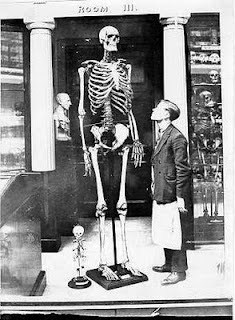
Giant human skeleton from Ireland I would be very interested to know if Digital Legend Press, which prints Neville’s books and much of the other content produced by Heartlanders, has anything like a peer review process or if they source-check the citations and references in their authors’ works (as Interpreter does). Based just on the fact that Digital Legend’s Annotated Edition of the Book of Mormon included a photograph of the skeleton of an eighteenth-century Irishman and implied that had a connection to ancient Jaredites, my guess is that they don’t do any peer review or source-checking.

Well, if they can’t be bothered to double-check the claims they publish, at least no one in the Heartland community is advancing their academic careers by pleasing professors and mentors. So they have that going for them, right?

—Peter Pan
 

Sunday, March 6, 2022

Peter’s hiatus and three brief notices

Things have been quite busy at the Pan household recently, and consequently this blog has suffered for want of attention. I can’t guarantee that will change any time soon, but I’ll do my best to continue exposing the distortions, misrepresentations, and fallacies of the Heartland movement.

Here are three recent examples of such from the keyboard of Jonathan Neville:

1. Correspondences


Neville recently visited Louvre Abu Dhabi where, he tells us, he “spent some time in the opening exhibit that celebrated similarities among cultures around the world and throughout time.”

His takeaway from this exhibit? “It reminded me of the futility of finding ‘correspondences’ as evidence of the Book of Mormon in Mesoamerica.” (Because everything for Neville is an allegory of “M2C” in some way.)

Neville again attacks John Sorenson’s, Mormon’s Codex, a book about which he complains much but never actually rebuts or even engages. Neville sums up:
The basic M2C logic works like this:

Nephites were farmers.

Mayans were farmers.

Therefore the Nephites were Mayans.

Neville’s laughably oversimplified version of Sorenson’s 714 pages of evidence and argumentation betrays that he either hasn’t read Mormon’s Codex or, if he has, he hasn’t understood it.

What’s worse, however, is that Neville considers it “futile” to find correspondences “as evidence of the Book of Mormon in Mesoamerica,” yet he’ll gladly accept such supposed correspondences as long as they’re found in North America and confirm his own biases. The Heartland Annotated Edition of the Book of Mormon is full of such parallels that are questionable at best and laughable at worst, so it’s more than a bit hypocritical of Neville to misrepresent Sorenson’s correspondences while offering up his own bogus ones.

2. Jonathan Neville on John Dehlin


John Dehlin has made a very comfortable living by accepting tax-deductible donations from people who dislike The Church of Jesus Christ for one reason or another. Jonathan Neville has a blog where he’s posted a handful of lackluster reviews of Dehlin’s claims. Seemingly, the worst he can say about Dehlin is:
Mormonstories provides a useful service for people to vent, form a community of like-minded people, and confirm their respective biases. That’s all fine. People can believe and do whatever they want.
Neville keeps his powder dry, as it were, for the real problem—believing, faithful Latter-day Saint scholars who haven’t fallen for the claims of the Heartland movement:
In a sense, Dehlin has an easy job. He just has to point people who have a faith crisis to the writings of LDS scholars in the citation cartels who have repudiated the teachings of the prophets. Then he asks, if Joseph and Oliver were wrong about the translation and historicity of the Book of Mormon, what’s left?
I honestly don’t know if John Dehlin has ever connected the dots in the way the Neville frames it. (Let’s just say I have my doubts that Neville is accurately describing Dehlin’s approach.) By a strange coincidence, however, Neville’s friend and fellow-traveler Rod Meldrum recently went on Dehlin’s MormonStories podcast. The entire podcast is seven hours long (!), and it’s a cringe-fest from start to finish. Here are just a few examples of how jaw-droppingly awful their conversation was. [Comments in italics are mine.]

  • Dehlin claimed that before FARMS was founded, there weren’t any theories about a limited Book of Mormon geography. [Limited geography theories have been around since the late 19th century, and John Sorenson developed his in 1955, over twenty years before FARMS came into existence.]
  • Regarding limited geography theories, Dehlin claimed it was Daniel Peterson, Lou Midgley, and “the apologist Egyptian guy…. I’m spacing his name…. [5 second pause] …oh, Hugh Nibley started the movement.” [This is a wonderful example of the level of Dehlin’s knowledge base. For someone who is arguably the best-known critic of the Church today, Dehlin’s handle on basic facts is shockingly low. Not only could he not recall the name of Hugh Nibley—the best-known Latter-day Saint scholar of the 20th century—but he also incorrectly believes that Nibley contributed to the development of Book of Mormon geography.]
  • Dehlin gave Meldrum this backhanded compliment: “If you read the scriptures, the Book of Mormon and the Bible, seriously, and take them literally, there’s little wiggle room for there having been a global flood, Adam and Eve being literal, etc. And there’s also little wiggle room for the prophets, seers, and revelators who have taught that these things are literally true for centuries.… [Because Heartlanders believe these things are literal] there’s a level of integrity that I think fundamentalist Mormons [i.e., Heartlanders] have, that I think apologists like FARMS and Maxwell Institute, and even neo-apologists like [Richard] Bushman, [Terryl] Givens, [Patrick Mason], they lose integrity because they massage words in ways that make words lose all their meaning. And in that sense I’m giving you and other ultra-orthodox Mormons credit. I’m tipping my hat because you’re saying that when prophets, seers, and revelators say something, they mean it.” [This exposes an important fact: John Dehlin and Rod Meldrum are not that far apart in their thinking. Both of them are hyper-literalists. Dehlin’s inability to use nuance and think below a surface-level reading led him out of the Church; Meldrum’s similar inability led him to double-down on fundamentalist, literalist readings and interpretations of history and scripture.]
  • [Meldrum explaining how the FIRM Foundation came into being]: “So I start doing these firesides [about the Heartland theory], and I’m running around, it’s costing me gas, it’s costing me time, it’s costing me money, I’m getting emails left and right, and I realize that there’s no way I can continue to work full time while doing this.”
    [Dehlin]: “Oh, I relate to this part.”
    [It’s amazing and wonderful to see two grifters empathizing with each other’s experiences.]

Who’s more on “team Dehlin”? Latter-day Saint apologists or Heartlanders? You be the judge.

3. Jonathan Neville on Jeremy Runnels


Speaking of grifters, Jeremy Runnels, author of the past-its-expiration-date anti-Mormon Letter to a CES Director was the subject of one of Neville’s recent blog posts. Neville wonders:
It has always seemed strange to me that CES [the Church Education System] never responded to Jeremy Runnels’ questions.

Jeremy was entitled to answers to his questions (at least, to his original, non-snarky questions).

Instead, he gets silence from CES and a torrent of sophistry from FAIRLDS and other apologists.
This statement pulls back the curtain and reveals how truly ignorant Neville is about Runnels. Neville actually believes Runnels’s fabricated history of how the CES Letter came to be! He accepts at face value Runnels’s lie that he was a sincere truth-seeker who took his questions to a real, honest-to-goodness CES director.

The truth is that, two years before he invented that fiction, Runnels was circulating a draft of his document on Reddit’s exmormon forum, claiming that he wanted input from others who were critical of the Church of Jesus Christ and that he wanted the document to “go viral.” (You can read the real history of the CES Letter in this Reddit post.)

The worst part of all of this is that Jonathan Neville believes that Jeremy Runnels is honest and sincere while Scott Gordon of FAIR and other faithful apologists are the real cause of lost testimonies. Neville truly lives in a bizzaro world where up is down, black is white, anti-Mormons are just misunderstood, and defenders of the gospel are conspiring to destroy faith. —Peter Pan
 

Tuesday, September 14, 2021

Please show us the receipts, Brother Neville

Jonathan Neville keeps telling us about anonymous “people” who ask him or tell him this or that. He never bothers to tell us who these people are or how they contact him.

Here’s the latest example:
I frequently hear from M2C and SITH scholars and their followers who say that we should accept the theories of the credentialed class because they are experts who have studied these things. They’ve reached a “consensus” about M2C and SITH and they expect all Latter-day Saints to agree with them.
I would like very much to know who these supposed “scholars and their followers” are. I’d also be interested to know how often “frequently” is (weekly? monthly? annually?). In other words, show us the receipts, Brother Neville.

I’ll wager real money that he can’t and won’t give us any examples of this because virtually no one who believes Cumorah was in Mesoamerica and that Joseph Smith translated the Book of Mormon using a seer stone would claim that anyone must believe them just because they said so. What we actually see from those people are arguments based on evidence from history, archaeology, anthropology, and the scriptures.

For example, John L. Sorenson, emeritus professor of anthropology at Brigham Young University, wrote Mormon’s Codex, an 826-page book setting forth his evidence-based arguments for a Mesoamerican setting for the Book of Mormon. Not once in his entire book did he state or even imply that anyone has to believe him simply because he’s an expert on archaeology and anthropology.

(Back in 2019, Jonathan Neville promised to review Mormon’s Codex and tell us where and why Sorenson’s arguments were incorrect. He wrote five blog posts about this, and not one of them actually engaged with any of Sorenson’s evidence. And I didn’t fail to point this out at the time.)

Until he feels inclined to tell us who these “people” are, Jonathan Neville’s claims about “scholars and their followers” who tell him things have just as much evidence for their existence as the rest of the claims made by advocates for the Heartland hoax.

—Peter Pan
 

Friday, November 15, 2019

Jonathan Neville, Master of the Double Standard

For Jonathan Neville, seemingly everything he encounters or experiences has some connection to the (supposed) vast conspiracy of Mesoamericanists who are (supposedly) trying to undermine the (supposedly) revealed geography of the Book of Mormon. Right now, for example, he’s reading cartoonist Scott Adams’s new book, Loserthink, and of course, finding all kinds of ways to apply it to “M2C.”*

In his November 15, 2019, blog post, “The Jailers of your Mental M2C Prison - Loserthink,” the latest in a series of blog entries on Adams’s book, he informs us:
The M2C jailers of mental prisons use patterns or analogies as arguments and rationales for M2C. The M2C intellectuals use the term “correspondences” to describe the patterns they cite to make people believe ancient Mayan culture has something to do with the Book of Mormon.

The argument goes like this:

The Nephites were farmers.
The Mayans were farmers.
Therefore the Nephites were Mayans.

When explained that way, the futility of a theory based on “correspondences” is apparent. Yet the entire M2C theory consists of little more than such “correspondences.”
Neville tells us that his hypothetical argument is “like” this, which allows him to weasel out of the inconvenient fact that no proponent of a Mesoamerican Book of Mormon settings has ever made such a facile, superficial claim.

Neville goes on to explain that “the entire M2C theory depends on such comparisons and patterns,” but that Scott Adams warns that human beings “can’t tell the difference between valid patterns that might predict something useful and something that simply reminds us of something else but means nothing.”

What’s so outrageous about this is that Neville and his Heartlander comrades do exactly what Neville is criticizing “M2C” proponents of doing—only they’re much, much worse at it.

The Annotated Edition of the Book of Mormon, a Heartlander publication of the Book of Mormon for which Neville served as a contributor, is chock full of attempts to draw correspondences between the Book of Mormon and ancient Native American societies of American Midwest. Many of these supposed correspondences are based on flawed research, old and outdated claims, or are just simply in error.

Here’s just one example from Stephen Smoot’s excellent review of the Annotated Book of Mormon:
A chart provided on p. 542 lists “words and phrases” that are shared by “Indians of America” and biblical Hebrew. The first problem with this chart is that it does not specify which “Indians of America” are being discussed, so it is impossible to verify which language to check to see if the parallels are valid. The short citations of two eighteenth and nineteenth sources to give some kind of credence to the chart are woefully inadequate, as they offer no genuine anthropological or linguistic insight, but rather reflect what is now widely considered to be thoroughly out of date speculation, at best, about Native American origins. Besides this problem, the chart also suffers from the fact that many of the Hebrew words listed aren’t actually Hebrew. “Jehovah,” for instance, the first word cited as parallel to the “Indian” word “Yohewah,” is not actually Hebrew, but the English mispronunciation of the German mispronunciation of the Latin mispronunciation of a deliberate Hebrew mispronunciation of the tetragrammaton (YHWH), which is believed to have originally been pronounced something like ya-weh. “It was never actually pronounced ‘Jehovah’ in antiquity.” Additional non-Hebrew words (or badly confused words) in the chart include, but are not limited to, those for Heavens (shamayim, not “Shemin”), Wife (ʾishah, not “Eweh, Eve”), His wife (ʾishto, not “Lihene”), nose (ʾaf, not “Neheri”), Winter (choref, not “Korah”), Do (ʿasah, not “Jannon”), and Assembly (qahal, not “Grabit”). The last phrase on the chart, Waiter of the high priest, has no known correspondence in Hebrew or Aramaic. It is obvious that [editors David] Hocking and [Rod] Meldrum are clueless to even the basics of Hebrew, and have merely passed on spurious parallels they uncritically accepted from thoroughly outdated sources.
I should point out that—unlike Hocking, Meldrum, and Neville—Stephen Smoot can actually read Biblical Hebrew. So when Neville repeatedly warns us in his blog post to beware of “experts,” what he’s really asking you to do is to trust amatuers and dilettantes like those who created the Annotated Edition of the Book of Mormon. (And we’ve clearly seen what happens when ignorant illiterates like Hocking, Meldrum, and Neville try to draw their own correspondences.)

By critizing “M2C” for doing what he himself does (and so poorly), Jonathan Neville again demonstrates that he’s completely lacking in self-awareness.

—Peter Pan

* “M2C” is Jonathan Neville’s acronym for the theory that the Book of Mormon took place in Mesoamerica and that the hill Cumorah in the Book of Mormon is not the same hill in New York where Joseph Smith received the plates of Mormon.

Tuesday, June 18, 2019

Claiming victory without engaging in battle

In a brief blog post published on June 18, 2019, Jonathan Neville tells us:
In April [2019] I did a series of posts on the M2C* hoax and the Illusion of Scholarship – Mormon’s Codex.
I feel compelled to mention that, in that series of posts, he also completely failed to address a single claim made by John L. Sorenson in his book. Instead, Neville’s five posts covered a single (misinterpreted) quote from the foreword, a blurb from the book jacket, an attack on Sorenson’s work in general, an attack on Book of Mormon Central, and an attack on an article published in Interpreter.

Neville was literally zero-for-five in his “review” of Mormon’s Codex, yet he seems to think that he actually accomplished something.

Disappointing, yet hardly unexpected.

—Peter Pan

* “M2C” is Jonathan Neville’s acronym for the theory that the Book of Mormon took place in Mesoamerica and that the hill Cumorah in the Book of Mormon is not the same hill in New York where Joseph Smith received the plates of Mormon.

Monday, May 13, 2019

If it’s so obvious, where is the evidence, Brother Neville?

Jonathan Neville has decided to take a break from not responding to John Sorenson’s scholarship and instead double down on his baseless claim that Latter-day Saint conversion rates are declining, in part, because of
…the influence of the intellectuals in the Church, including employees at CES, BYU, and COB, who are teaching the youth (and investigators) to disbelieve the prophets regarding such fundamental points as the translation of the Book of Mormon and the Hill Cumorah.
That claim is from his May 13, 2019, blog post, “Restatement of the obvious.”

This is not the first time Neville has made this kind of claim—on March 3, 2019, he literally invented evidence that New York-Cumorah acceptance rates among Latter-day Saints have been declining since 1920 (and, of course, blamed the decline on “M2C” intellectuals*).

Now he’s gone further than claiming loss of faith among Latter-day Saints into attributing declining conversion rates to the teaching of “M2C.” And what evidence does he have that this “serious problem that has real-world ramifications” is the case? He writes:
We do have statistics, and one of the biggest barriers [to accepting the gospel] is disbelief in the historicity and divine authenticity of the Book of Mormon.

We’ve seen that only 50% of Millennials in the Church believe the Book of Mormon is a real history, and that percentage is declining.
Neville links to his blog review of Jana Riess’ book The Next Mormons to back up his claim that half of Millennial saints disbelieve that the Book of Mormon is history. He seems unaware of criticisms Riess’ methodology, including her “question framings, answer options and sample demographics.” There are significant concerns that Riess’ pool of survey respondents wasn’t representative of typical Latter-day Saints and that she asked them leading questions that skewed the results.

In any case, let’s grant for the moment that half of LDS young adults don’t believe the Book of Mormon is historical. Does Neville have any evidence that this is because they’ve been taught “M2C”?

No. But that doesn’t stop him from considering itʼs “the entirely predictable result of”
1. Repudiating the consistent and persistent teachings of the prophets about the New York Cumorah and

2. Teaching the Book of Mormon to students in CES (Seminary, Institute, and BYU) by using a fantasy map.
Both of these points are utter nonsense, as the Captain and I have repeatedly pointed out on this blog. (See, for example, this post and this post.) But Brother Neville apparently doesn’t read this blog, otherwise one would expect him to respond to our claim that he’s employing logical fallacies and misrepresentations of his opponents’ claims to make his points.
As bad as this situation is for the youth of the Church, it is even worse for investigators, as I’ll discuss in upcoming posts.
We look forward to seeing Neville’s evidence. However, if it’s anything like the nonexistent arguments he’s promised but not delivered about John L. Sorenson’s work, we may be waiting a long time to see it.

—Peter Pan

* “M2C” is Jonathan Neville’s acronym for the theory that the Book of Mormon took place in Mesoamerica and that the hill Cumorah in the Book of Mormon is not the same hill in New York where Joseph Smith received the plates of Mormon.

Friday, May 10, 2019

Neville’s reviews of ‘Mormon’s Codex’ now zero for five

Jonathan Neville is now five posts into his “review” of John L. Sorenson’s magnum opus, Mormon’s Codex: An Ancient American Book. So far he has done…well, everything except review the claims Sorenson made in his book.

In part five of his series, “Illusion of scholarship – The Interpreter and Mormon’s Codex (part 5)” (posted May 8, 2019), Neville explains why he’s obsessing focusing on Sorenson’s book in particular: “One reason: Mormon’s Codex has imprinted M2C* on the minds of intellectuals throughout the Church.”

This is Neville-speak for “John Sorenson is taken seriously by educated, informed Church members and leaders while I am not, so I’m going to do everything I can to put his ideas down.”

But just when you expect Neville to actually review something—anything—Sorenson wrote, he switches tracks and instead attacks a recent article published by Interpreter: A Journal of Latter-day Saint Faith and Scholarship.

I expected Neville’s inability to stay on topic and actually discuss Sorenson’s arguments. What I didn’t expect is this head-scratchingly bizarre claim from him:
Ethan Smith published View of the Hebrews in 1823. Most readers here know the history of that book and its connection to the Book of Mormon. The issue of Book of Mormon geography boils down to the point that the M2C scholars follow Ethan Smith, not Joseph Smith. M2C is based on View of the Hebrews and the anonymous articles in the Times and Seasons.
This claim is so absurd and that I’m almost tempted to just let it stand, without comment, as a testament to the farce that is Jonathan Neville’s blog.

Almost.

You see, not one single proponent of “M2C”—not John Sorenson, not Mark Wright, not Brant Gardner, not Kerry Hull, not John Clark, not the Church History Department, not Book of Mormon Central, no one—has ever appealed to Ethan Smith’s View of the Hebrews to support their claims about Book of Mormon geography or Joseph Smith’s views on Book of Mormon geography. Not even once.

Can Neville cite a single “M2C intellectual” who has seriously entertained the theories of Ethan Smith? Of course he can’t. But that’s typical of Neville and other proponents of the Heartland hoax: Make broad, sweeping, generalized claims that don’t have a shred of evidence and move on, pretending they’ve won the argument.

But you know who does approvingly follow the theories of Ethan Smith?

Yep, that’s right: Heartlanders like Jonathan Neville.

Rodney Meldrum—the leading proponent of the Heartland hoax and friend of Jonathan Neville—uses the exact same kind of pseudo-science and parallelomania to make the exact same claims that Ethan Smith argued for in the 1820s—that the North American Indian tribes are descendants of ancient Hebrews, and that this is evident from the (supposed) similarities in Hebrew and American Indian customs, practices, lore, and artifacts.

The title page of Ethan Smith’s View of the Hebrews (1823), which is not the source of the Mesoamerican theory of Book of Mormon geography, but is strikingly like the claims made by Heartlanders.

It is unspeakably absurd for Neville to try to turn “M2C intellectuals” into fawning sycophants of Ethan Smith, but since he doesn’t have a single shred of evidence for his claims, “unspeakably absurd” is the best that Neville can hope to do.

At this point I’m expecting part 6 of Neville’s “review” of Mormon’s Codex to include his speculation about how M2C is teaming up with alien moon-men to hatch a plot to convince Church members that the Book of Mormon took place in the Sea of Tranquility.

Heck, that would make just as much sense as Neville’s current theories.

—Captain Hook

* “M2C” is Jonathan Neville’s acronym for the theory that the Book of Mormon took place in Mesoamerica and that the hill Cumorah in the Book of Mormon is not the same hill in New York where Joseph Smith received the plates of Mormon.

Wednesday, May 1, 2019

Jonathan Neville and the art of psychological projection

Jonathan Neville really doesn’t like Book of Mormon Central (BMC). Oh sure, he’ll pay insincere lip service to how wonderful BMC employees and researchers are, but he wants his readers to know that BMC is nothing more than a nest of censorious conspirators who are dedicated to getting people to, in his his words, “disbelieve the prophets.”

This is made clear in his April 30, 2019, blog post, “Illusion of scholarship – Mormon’s Codex part 4.” In it, Neville begins by responding to people who “from time to time” ask him what he thinks about BMC. Here is his take:
These are all fine young scholars, but they’re employees. Book of Mormon Central is the most sophisticated and best-funded advocate of M2C* the world has ever seen. They work hard to persuade their readers that the prophets are wrong about the New York Cumorah.
You’re not going to change their minds.

Think of it this way. If you’re interacting with an employee of the Republican National Committee, are you going to persuade him/her to support Speaker Nancy Pelosi? If you’re interacting with an employee of the Democratic National Committee, are you going to persuade him/her to support President Trump?

That’s the level of commitment and devotion you’ll find among employees of Book of Mormon Central. Don’t waste your time trying to change their minds. Facts are just as irrelevant to them as are the teachings of the prophets.

We love our M2C brothers and sisters. There is no need to contend about any of this. There no point to contending, anyway. From a purely intellectual perspective, we can all see that M2C is a hoax. They can’t. And we can’t expect them to. It’s basic psychology 101.
There are a number of things to unpack here:

1. Neville claims that “BMC work[s] hard to persuade their readers that the prophets are wrong about the New York Cumorah.” After analyzing BMC’s 512 published “KnoWhy” articles, I’ve discovered that only one of them has focused on the location of the Hill Cumorah. Others have touched on Book of Mormon geography and the Oliver Cowdery letters that Neville fetishizes, but only one KnoWhy has specifically been about the geography of the Hill Cumorah.

Does this sound like people “working hard” to “persuade” people that “the prophets are wrong”? Perhaps Neville could point me to a place where BMC has said “the prophets are wrong.” The KnoWhy on the location of the Hill Cumorah simply concludes, “The location of where Joseph Smith obtained the golden plates which he translated by the gift and power of God is well known. Whether that was the same location as the final destruction of the Nephites remains open to discussion.” Maybe in Neville-Neville Land this constitutes “working hard to persuade people that the prophets are wrong,” but in the real world this would seem to be doing responsible, nuanced scholarship.

2. Neville goes on to claim that, by virtue of being employees, the researchers at BMC are inherently biased, while insinuating that they’re just in it for the money. He compares BMC’s researchers to political hacks who are incapable of changing their minds or being reasoned with. “Don’t waste your time trying to change their minds,” Neville writes. “Facts are just as irrelevant to them as are the teachings of the prophets.”

One wonders if Neville would say this about his Heartlander colleagues at the FIRM Foundation, a for-profit business entity that fills the pockets of Rod Meldrum and other Heartlanders through conferences, publications, seminars, and tours. Because he makes money selling the Heartland hoax to the Saints, would Jonathan Neville also say that Rod Meldrum is a mercenary who can’t be reasoned with because he’s in it for the money?

3. “We love our M2C brothers and sisters,” Neville concludes. “There is no need to contend about any of this.”

Neville certainly has a funny way of showing “love” to his “M2C brothers and sisters.” This “love” includes mocking them with comics, graphics, and spiteful nicknames (including “M2C” and “Book of Mormon Central Censor”). It includes lying about them and repeatedly distorting what they actually believe and claim about Book of Mormon geography. It includes publicly saying they are part of a conspiracy to undermine the prophets, and claiming they are single-handedly responsible for people leaving the Church and abandoning faith in the Book of Mormon.

If this is what “love” is to Jonathan Neville, I shudder to think what he’d do if he hated his “M2C brothers and sisters”!

Neville finishes this part of his post with the loving and non-contentious line, “We can’t expect [M2C people to see their beliefs are a laughable hoax]. It’s basic psychology 101.”

Speaking of psychology, there’s this thing called psychological projection. As defined by Wikipedia,
Psychological projection is a defence mechanism in which the human ego defends itself against unconscious impulses or qualities (both positive and negative) by denying their existence in themselves while attributing them to others. For example, a person who is habitually rude may constantly accuse other people of being rude. It incorporates blame shifting.
Do we perhaps see any of that in Neville?

  • Neville accuses “M2C intellectuals” of being spiteful, contentious, and divisive while he himself has turned his brand into one of spitefully mocking and belittling “M2C intellectuals.”
  • Neville calls “M2C” a conspiracy while he himself spins so much conspiracy yarn about the “M2C citation cartel censoring information” that you could make a sweater out of it.
  • Neville accuses “M2C” of perpetuating a hoax while he works closely with Rod Meldrum and Wayne May, who routinely use forged artifacts, pseudoscience, and fraudulent history to prop up the Heartland hoax.
  • Neville says “M2C employees” can’t be reasoned with because they get paid for their work while attending and speaking at paid conferences and publishing multiple books.
  • Neville says “M2C intellectuals” are incapable of recognizing their own psychological biases while he himself goes about, blissfully unaware of his own biases.

And these are just the tip of the iceberg. Brother Neville is practically the poster child for psychological projection. That he lashes out at “M2C intellectuals” (including the Church History Department and Brigham Young University) for not accepting his bizarre conspiracy theories and impossible geography model demonstrates that he’s projecting the very psychological infirmities he suffers from onto his perceived enemies.

It’s okay, Brother Neville. We can all disagree peaceably here without resorting to armchair psychologizing each other. But the first step is to recognize it in yourself and ask for help.

—Captain Hook

* “M2C” is Jonathan Neville’s acronym for the theory that the Book of Mormon took place in Mesoamerica and that the hill Cumorah in the Book of Mormon is not the same hill in New York where Joseph Smith received the plates of Mormon.

Thursday, April 25, 2019

The illusion of a book review

Recently, Jonathan Neville has taken up the challenge of reviewing John L. Sorenson’s magnum opus, Mormon’s Codex: An Ancient American Book.

I’ve already taken Neville to task for his first review, in which he misinterpreted a single statement from the foreword and proceeded to attack a straw man. Since then, Neville has posted the second and third installments in his series, and they’re just as awful.

His second installment, posted April 23, 2019, starts off with a conciliatory note:
First, I re-emphasize that I have great respect and admiration for Brother John L. Sorenson, the author of Mormon’s Codex: An Ancient American Book. As I mentioned in my own book, Moroni’s America, Brother Sorenson has helped me and many other members of the Church think of the Book of Mormon people and events in a real-world context. That is an important and invaluable contribution that I hope everyone recognizes.
While this statement appears to offer an olive branch to the “M2C intellectuals”* Neville continually rails against, it completely contradicts Neville’s own claim—repeated in a significant number of his blog posts—that Mesoamericanists teach that “the best way to understand the Book of Mormon setting is by putting it an imaginary, fantasy world of mythology,” and that way of reading the Book of Mormon “will inevitably lead those youth to disbelieve in [its] divine authenticity.”

So, does Sorenson’s work, as the chief proponent of the “M2C” theory, help people see the Book of Mormon as a real-world text or as a mythological fantasy text? And does Neville even read his own blog? I am honestly left to wonder.

Next, after insisting that “M2C intellectuals” do not lack scholarship, Neville tells his readers that they really do lack scholarship, because
Scholarship involves citations and analysis of data. It involves interpretation of source materials. It involves source-checking and peer review.

But scholarship also requires careful, respectful consideration of alternative viewpoints, and this is where Mormon’s Codex, as all of M2C publications, falls way short.
This is a fallacious claim in two ways: (1) Book of Mormon scholars who prefer a Mesoamerican context have, in fact, given the claims of the Heartland hoax “careful, respectful consideration,” (as Captain Hook noted in a recent post on this site), and (2) not all “alternative viewpoints” require such consideration, as some of them—and I would include the Heartland hoax in this category—are so manifestly fraudulent that they can (and should) be simply dismissed out of hand. Respected physicists do not, for example, give “careful consideration” to the flat-earth theory, and the Heartland hoax comes pretty close to being the flat-eartherism of Book of Mormon studies.

Neville continues by claiming, for what feels like the millionth time, that “M2C intellectuals” believe they are correct and the prophets are in error. (Seriously, he makes this point in nearly every blog post. Repeating a lie over and over doesn’t make it true, Brother Neville.) He then proceeds to defend his own unscholarly book, Moroni’s America, and dismiss the Church’s recent Gospel Topics essay on Book of Mormon geography. Again, standard stuff for a Jonathan Neville blog post.

Only after all that—824 words of cut-and-paste Nevilleblogging—does he finally get to reviewing Sorenson’s book…jacket.

No joke: This is Neville’s second review of Mormon’s Codex and he still hasn’t examined a single claim in the book itself. Instead, we’re treated to snarky quips, like this zinger:
[Mormon’s Codex book jacket:] Leading scholar and author John L. Sorenson brilliantly synthesizes in this volume his work from 60 years of academic study of ancient Mesoamerica and its relationship to the Book of Mormon.

[Neville’s analysis:] IOW, the book synthesizes 60 years of bias confirmation.
Ladies and gentlemen, I bring you book reviews from the “I-know-you-are-but-what-am-I” school of playground taunts.

Neville’s third “review” of Mormon’s Codex, posted April 25, 2019, is just as painful as the second, if not more. No kind words for Professor Sorenson, this time—Neville calls his book “a long-winded academic justification for repudiating the teachings of the prophets,” filled with “logical fallacies and circular reasoning throughout the book.” He goes on to call Mormon’s Codex “propaganda,” and “the illusion of scholarship.”

Most of Neville’s post is dedicated to, yet again, repeating the same stuff we get from him day after day:
Fact: The Hill Cumorah is in New York.¹ This was established as a fact in Letter VII,² written by President Oliver Cowdery who was an eye-witness to the depository of Nephite records in that hill (Mormon 6:6).³ Joseph Smith helped write these letters, had them copied into his personal history, and endorsed their republication for the rest of his life.⁴ The fact that Cumorah is in New York has been repeated many times by Church leaders, including by members of the First Presidency speaking in General Conference.⁵ No member of the First Presidency or Quorum of the Twelve has ever repudiated this teaching of his predecessors.⁶
  1. Fact: There is a hill in New York that is called Cumorah. That it is the hill called Cumorah in the Book of Mormon has never been established by revelation, and its location, geographical setting, and archaeological history do not indicate that it is the hill described in the book.
  2. Letter VII is not the “silver bullet” that purveyors of the Heartland hoax claim that it is, as Stephen Smoot explained in 2018.
  3. There are no first-hand or second-hand accounts of the story of the depository of Nephite records in the New York hill. It has all the marks of being a Latter-day Saint “urban legend.”
  4. Heartlanders exaggerate Joseph Smith’s involvement in Oliver Cowdery’s Messenger and Advocate letters. And, as Stephen Smoot pointed out, the letters “contain factual errors and embellishments (which Heartlanders conveniently ignore).”
  5. Repeating a popular belief doesn’t make it true. Neville, once again, has fallen for the logical fallacy of Appeal to Common Belief.
  6. It’s exceptionally rare for Church leaders to “repudiate” misinterpretations and disproven beliefs expressed by previous leaders. Neville’s statement tells us nothing about the truth or falsity of the New York hill Cumorah claim.

I’m honestly not sure what’s worse: Neville’s seeming inability to interact with the actual claims in Sorenson’s book, or his annoying practice of writing the same thing over and over again, only (sometimes) using different words.

—Peter

* “M2C” is Jonathan Neville’s acronym for the theory that the Book of Mormon took place in Mesoamerica and that the hill Cumorah in the Book of Mormon is not the same hill in New York where Joseph Smith received the plates of Mormon.

Saturday, April 20, 2019

The illusion of scholarly engagement

Jonathan Neville is incredibly adept at repackaging the same simplistic argument into an infinite number of blog posts, but can he actually engage the published scholarship of “M2C intellectuals”?*

In his April 19, 2019, blog post, “Illusion of scholarship – Mormon’s Codex part 1,” he teases his readers with the possibility that he might actually give us something of substance. He begins:
After my [April 17th] post on the illusion of scholarship, people wanted specific examples.

Let’s start with Mormon’s Codex, which Professor Terryl Givens claims is “the high-water mark of scholarship on the Book of Mormon.” Foreword, Mormon’s Codex, p. xvi.
Despite his childish inability to resist including an image of the cover of Mormon’s Codex without overlaying it with an “M2C approved” stamp, this is a promising start. At last, perhaps we’ll finally get the takedown of the magnum opus of John L. Sorenson—Ph.D., University of California, Los Angeles, and Professor Emeritus of Anthropology at Brigham Young University—that we’ve been waiting for!

Neville continues:
Well, let’s start with Brother Givens. In the Foreword, he writes,

“Whether or not God spoke to Moses on Sinai, Jesus resurrected from the dead, or Paul wrote words given him by inspiration, no one doubts the Old World setting and ancient origins of the Old and New Testaments. Until such time as a preponderance of evidence provides comparable historical plausibility for the Book of Mormon’s ancient origin, no one can expect scholars to consider the book as anything other than a nineteenth-century cultural artifact. If such a time is to come, it will arrive in large measure through the efforts of John Sorenson, who has done more than any Latter-day Saint scholar to shift the terms of the Book of Mormon debates.”

This is the M2C or bust approach; i.e., you have to believe the Book of Mormon took place in Mesoamerica, and that the prophets are wrong about the New York Cumorah, or else you have to believe the Book of Mormon is fiction.
That’s Neville’s sole quotation from Mormon’s Codex.

Oh, Jonathan, you started with such promise and then you blew it! We were expecting some response to Sorenson’s claims, but instead all you did was give us a quote from the foreword and then proceed to misinterpret the only quote you gave us!

By claiming that Sorenson “has done more than any Latter-day Saint scholar to shift the terms of the Book of Mormon debates,” Givens clearly didn’t mean “shift it toward an ‘M2C or bust’ approach”; rather—as is clear from the context of the very paragraph you quoted—he shifted the debate from one of the Book of MOrmon being “a nineteenth-century cultural artifact” to it being an ancient document grounded in historical reality.

Now, that historical reality just so happens to be rooted in Mesoamerica, which is the reason Mormon’s Codex exists in the first place. Yes, we know that you disagree with that theory, and we can see from your blog post that you go on to repeat, for the umpteenth time, your unproven claims that believing that theory means “repudiat[ing] the teachings of the prophets” and causing loss of testimony among young Latter-day Saints, blah, blah, blah. But surely even you must admit that Professor Sorenson’s decades of research and publications—through actual, reputable publishers, not self-published outfits like CreateSpace {cough}—have all pointed toward his goal of grounding the Book of Mormon in historical reality.

Brother Neville, once again you’ve let us down.

Ah, well. At least you spelled “foreword” correctly in your blog post…unlike you did the book you edited, Moroni’s America – Maps Edition:

Moroni's America - Maps Edition: Forward & Acknowledgements

—Peter Pan

* “M2C” is Jonathan Neville’s acronym for the theory that the Book of Mormon took place in Mesoamerica and that the hill Cumorah in the Book of Mormon is not the same hill in New York where Joseph Smith received the plates of Mormon.

Popular Posts

Search This Blog