Examining the claims of Jonathan Neville and the Heartland movement

Showing posts sorted by relevance for query confirmation bias. Sort by date Show all posts

Monday, June 3, 2019

Jonathan Neville’s fatuousness continues to astonish

In what may be Jonathan Neville’s most stunning example of a total lack of self-awareness, he published a blog post on June 3, 2019, that he called “one of the most important I’ve made because it addresses a fundamental issue that affects all of us throughout our lives.”

Informing us that “researchers have conducted neurological experiments to understand how political partisans respond to information” (something he read about here), he then proceeds to tell us why he believes this research “explains why the teachings of the prophets about the Hill Cumorah are being systematically censored and removed from the historical record.” He explains:
When people are contending over something such as M2C,* they usually think they are using facts and logic, but they are actually just responding to biochemistry.

When our brains detect an unpleasant conflict between data and what we want to believe, they use biochemistry and faulty reasoning to reduce distress. This is a biological description of bias confirmation.
This statement is not incorrect. It’s well-known and understood in academic studies that virtually all people look for evidence that reinforces their preexisting beliefs. It’s why it’s so hard for people who have different views to convince each other of their positions—or even have a discussion that doesn’t result in an argument.

He continues:
People believe they are thinking rationally, based on facts, but their brains are simply engaged in self-defense. Their brains perceive confirmation of the M2C bias as pleasurable, while criticism of M2C is painful.
Nowhere does he express any belief in or awareness of the possibility that, while he believes he is thinking rationally, his brain is “simply engaged in self-defense,” that he receives pleasurable stimuli when he thinks of Heartland bias and pain when he encounters criticisms of it. (He does admit to neurochemical stimuli affecting Heartlanders, but he twists it to support his beliefs; we’ll get to that in a moment.)
Having believed M2C for decades, but now realizing it’s a hoax, it’s easier for me to recognize the biochemistry involved than it is for those still within the M2C bubble.
It’s hard not to notice Neville’s self-ascribed intellectual superiority when he smacks you across the face with it. He understands the biochemistry because he’s moved on from the false beliefs he used to hold, while others are still trapped in a “bubble” of false faith.

This is identical to the claim made by ex-Mormon atheists. They’re smart. They’ve seen through the lies of “Mormonism.” They’ve managed to escape the Church and now observe it dispassionately from the outside. Smugly arrogant and self-satisfied, Neville now knows “the truth” that the rest of us are too blinded by brain chemistry to see.
It’s also why none of this is personal or upsetting to me. I really don’t care what anyone else believes, and I’m not trying to persuade anyone. I just want people to make informed decisions, and understanding neurochemistry is part of that.
If Neville truly didn’t care what others believe and wasn’t trying to persuade anyone, he wouldn’t be blogging daily (on just one of over sixty blogs) and working on what will be his tenth book on the same narrow subject. If it wasn’t personal to him, he wouldn’t be engaging in childish name-calling of his opponents—calling Book of Mormon Central “Book of Mormon Central Censor,” calling FairMormon “FairlyMormon,” referring to scholars who disagree with him as a “cartel,” calling BMC’s KnoWhy articles “No-Wise,” and praising scholars who disagree with him for their great work and then, in the very next sentence, accusing them of “rejecting the prophets,” deceiving the Brethren, and leading members of the Church astray.

The fact that Jonathan Neville is unable to see how bizarre his claims are to others is evidence that he himself is steeped in confirmation bias.
Every time an M2C follower sees a map of Mesoamerica with Cumorah in southern Mexico, his/her brain generates a positive response.

Every time an M2C follower sees a map of Cumorah in New York, his/her brain generates a negative response.

The psychological problem for M2C followers is that their brain normally generates positive responses to the teachings of the prophets. For example, they accept almost everything President Oliver Cowdery taught. Same with the other prophets who have reaffirmed the New York Cumorah.

But they can’t accept what President Cowdery and the other prophets have said about the New York Cumorah.
This is patently absurd. It has nothing to do with “accepting” what Oliver Cowdery or Marion G. Romney or any other prophet or apostle has said; it has everything to do with the fact that not one of their statements on the New York location of Cumorah has been submitted to and accepted by the Church as a revelation. Neville believes that the Cumorah of the Book of Mormon is the hill in New York, so he accepts these statements as inspired and authoritative, but that’s not how revelation works or has ever worked in The Church of Jesus Christ of Latter-day Saints.

Now, observe Neville’s incredible sleight-of-hand when he explains what happens in Heartlander brains:
We see the exact opposite brain chemistry among those Church members who still believe the teachings of the prophets about the New York Cumorah. They get positive rewards when they read those teachings, just as they get positive rewards from reading all the teachings of the prophets. They get a similar positive reward from seeing proposed geographies that affirm the New York Cumorah.

They get negative rewards when they see material that repudiates the teachings of the prophets.
Notice what he does here? Heartlanders get positive and negative rewards, not when they see things they agree or disagree with, but when they read “the teachings of the prophets.” And which teachings are those? The ones they agree with! The ones that they believe are revealed and inspired—despite not being declared and submitted and accepted as revelations.

In other words: “New York Cumorah good, ‘M2C’ bad.”

But it gets even worse:
It also explains why the M2C citation cartel continues to censor material that contradicts M2C. It’s not so much that they want to keep members of the Church ignorant. It’s more that they want to avoid giving their readers the psychological pain they feel whenever they see something that contradicts M2C or supports the New York Cumorah.
Upon reading this preposterous statement, my jaw simply fell slack. I can guarantee you that neither I, nor Captain Hook, nor anyone else who rejects the Heartland hoax feels any “pain,” psychological or otherwise, when we read Heartlander arguments. The strongest emotional reaction we feel is stunned incredulity that any rational individual could make such mindless, irresponsible claims, let alone be gullible enough to accept them.
This also explain[s] why the Gospel Topics Essay [on Book of Mormon geography] doesn’t want anyone talking about this at Church. Because there is such a stark difference of opinion, no matter which side is represented, someone will feel pain while someone else will feel happiness.
No, Brother Neville, the Gospel Topics Essay doesn’t tell anyone not to talk about Book of Mormon geography at church. That’s not what the essay says at all; rather, it informs us:
The First Presidency and Quorum of the Twelve Apostles urge leaders and members not to advocate those personal theories in any setting or manner that would imply either prophetic or Church support for those theories. All parties should strive to avoid contention on these matters.>
Do you see the difference? The First Presidency and Quorum of the Twelve Apostles have asked leaders and members to not “advocate those personal theories” about Book of Mormon geography that “imply either prophetic or Church support.” The essay is directly addressed to Heartlanders like you, Brother Neville, who claim that the prophets support their views. So when Neville writes…
That’s why it is essential that the Gospel Topics Essay be actually implemented, starting by getting rid of the M2C materials in the curriculum and media.
…he’s completing missing the real point and intent of the Gospel Topics Essay: To implement the essay would require Heartlanders to stop making their false claims of prophetic support for their views in church settings.

—Peter Pan

* “M2C” is Jonathan Neville’s acronym for the theory that the Book of Mormon took place in Mesoamerica and that the hill Cumorah in the Book of Mormon is not the same hill in New York where Joseph Smith received the plates of Mormon.

Saturday, May 23, 2020

Jonathan Neville, volcanologist

In his second blog post in what appears to be a series criticizing Mesoamericanist Book of Mormon scholar Kirk Magleby, Jonathan Neville commented on Magleby’s arguments concerning the meaning of the word Cumorah.

Of course, Neville being Neville, he couldn’t help but start off by taking an assertion-without-evidence swipe at the entire Mesoamerican viewpoint, which he claims is not just wrong but heretical:
[Magleby’s] article “Ramah/Cumorah” is a fascinating example of bias confirmation for those interested in the psychology of M2C. Our M2C friends have a variety of techniques to justify their repudiation of the teachings of the prophets about the New York Cumorah. In this article, the 30 “textual criteria” are outcome-driven interpretations of the text, designed to explain the “2C” part of M2C.
Neville’s comment falls right in line with his primary thesis that the Mesoamerican view of the Book of Mormon (“M2C” in Neville-speak), is simply “confirmation bias” designed to “repudiate the teachings of the prophets”—even though prophets and apostles (including President Russell M. Nelson) have spoken of the Book of Mormon taking place in Mesoamerica and a Mesoamerican setting for the Book of Mormon has been included in copies of scripture published by the Church (like this 1962 edition) and in the Church’s official magazines (like this two part series in the Ensign). No, all of that is just a Church-wide conspiracy, according to Neville.

But back to the main point of this post, which is to call attention to one of the most astonishing hand-waving assertions Neville has ever committed to print. Magleby approvingly cited some theories of linguist David Richins regarding the meaning of the name Cumorah, about which Neville commented:
Richins then explains why he thinks the [Mesoamerican] pyramids represent volcanoes. He thinks the “original” Cumorah of Mormon 6:6 was a Central American volcano. That doesn’t make sense to me; I’ve visited lots of volcanoes and I wouldn’t describe any of them as a “hill.”
And there you have it, folks: Neville’s never seen a volcano that was small enough to be called a “hill,” therefore the hill Cumorah couldn’t have been a volcanic mound.

What’s most astounding about this is that Neville could—but didn’t—double-check his belief with a simple Google search. Had he done this, he may have come across this article on the syndicated news service Live Science. (I’ve added boldface to key portions.)
Cinder cone volcanoes (also called scoria cones) are the most common type of volcano, according to San Diego State University, and are the symmetrical cone-shaped volcanoes we typically think of. They may occur as single volcanoes or as secondary volcanoes known as “parasitic cones” on the sides of stratovolcanoes or shield volcanoes. Airborne fragments of lava, called tephra, are ejected from a single vent. The lava cools rapidly and fall as cinders that build up around the vent, forming a crater at the summit, according to the U.S. Geological Survey. Cinder cone volcanoes are fairly small, generally only about 300 feet (91 meters) tall and not rising more than 1,200 feet (366 meters). They can build up over short periods of a few months or years.
Small cinder cone volcanos exist around the world. Latter-day Saints who live in southwestern Utah and northern Arizona are probably familiar with this type of prominence, as there are perhaps thousands of them in that area. Here are just two examples:
Sunset Crater near Flagstaff, Arizona
Sunset Crater (999 ft./304 m) cinder cone, near Flagstaff, Arizona

Sullivan's Knoll, Hurricane, Utah Sullivan’s Knoll (648 ft./198 m) cinder cone, Hurricane, Utah
Neville’s personal experience notwithstanding, there are many cinder cone volcanoes small enough to be called “hills.”

I’ve pulled that particular quote out of his longer blog post because it’s yet another example of Neville doing exactly what he criticizes his “M2C” opponents of doing, namely offering up bias confirmation instead of actual evidence. He’s never seen a volcano that could be described as a “hill”; therefore, no such thing exists and his opponents are wrong. When he thinks of the hill Cumorah, he envisions the drumlin in western New York, which isn’t a volcano; therefore, he rejects the suggestion that the hill Cumorah of the Book of Mormon may have been a volcano.

Neville’s personal biases are at least as strong as those who believe in a Mesoamerican Book of Mormon setting. Those who argue for Mesoamerica, however, just happen to have more behind their views than tradition, pseudoscience, and conspiracy theories.

—Peter Pan

* “M2C” is Jonathan Neville’s acronym for the theory that the Book of Mormon took place in Mesoamerica and that the hill Cumorah in the Book of Mormon is not the same hill in New York where Joseph Smith received the plates of Mormon.
Saturday, September 21, 2019

Picking cherries with Jonathan Neville

On September 21, 2019, Jonathan Neville published an updated version of an older blog post about David Whitmer. He begins:
Some people still dismiss David Whitmer’s account of the messenger taking the plates from Harmony to Cumorah before arriving in Fayette with the plates of Nephi.
Later in his post he tells us:
The rationale [some have] for rejecting David Whitmer’s testimony is that he supposedly never talked about it until 50 years after the fact, in interviews he gave to Edward Stevenson in 1877 and to Joseph F. Smith and Orson Pratt in 1878.
And:
It’s not a 50-year-old story related from a feeble and tainted memory. It’s a retelling of an account related by a missionary to his investigators just a few years after the event.

Other than to defend the M2C* ideology, there’s no reason to cast doubt on the testimony of the Three Witnesses.
Here we see Jonathan Neville (falsely) accusing believers in “M2C” of “cast[ing] doubt” on the statements of the Three Witnesses (Oliver Cowdery, David Whitmer, and Martin Harris) because, supposedly, it contradicts their “ideology.”

Neville’s level of hypocrisy here is positively staggering. Less than two months ago, he wrote an entire series of blog posts (pt. 1, pt. 2, pt. 3) explaining why the eyewitness testimonies of David Whitmer, Martin Harris, and Emma Smith of Joseph Smith using a seer stone to translate the Book of Mormon were untrustworthy or mistaken. Yet here we read Neville wholeheartedly accepting David Whitmer’s testimony of seeing an angel because Whitmer’s testimony supports Neville’s views on Book of Mormon geography.

Neville constantly accuses those who disagree with him of being the victims of confirmation bias. Yet here we see perhaps the gold standard for confirmation bias (a.k.a. cherry-picking): Selectively using evidence that supports one’s preferred theory and ignoring, dismissing, or explaining away anything that contradicts it.

Jonathan Neville is a hypocrite. Full stop.

—Peter Pan

* “M2C” is Jonathan Neville’s acronym for the theory that the Book of Mormon took place in Mesoamerica and that the hill Cumorah in the Book of Mormon is not the same hill in New York where Joseph Smith received the plates of Mormon.

Thursday, October 22, 2020

Jonathan Neville at the summit of confirmation bias

It requires a breathtaking lack of self-awareness for Jonathan Neville to write:
Once you realize that M2C* advocates think of themselves as priests policing heresy rather than investigators seeking truth, the M2C logo and the censorship by the M2C citation cartel will make a lot more sense.
Priests policing heresy. This, coming from the very man who has claimed hundreds of times that his intellectual opponents are “repudiating the teachings of the prophets.”

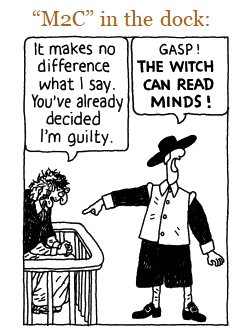
M2C in the dock at the Salem witch trialsThe simple fact that Neville is unwilling or unable to comprehend is that Latter-day Saint scholars and other Church members who believe that the Book of Mormon took place mostly in Mesoamerica could not care less if anyone has a difference of opinion about that matter. Everyone is free to express his or her own beliefs and put forth evidence in support of those beliefs. There will be (and should be and has been) vigorous debate over these evidences. Since there is no revelation on this matter, it is open for discussion.

So why does Neville perceive that there is a conflict? This goes back nearly thirteen years to Rodney Meldrum’s presentation at the inception of the “Heartland” movement. In his presentation, Meldrum used a quote from President Gordon B. Hinckley about anti-Mormons and twisted its meaning to assert that Latter-day Saint scholars “disdain” the Prophet Joseph Smith by teaching a Mesoamerican setting for the Book of Mormon.

Since that time, Heartlanders like Meldrum and Neville have been self-appointed heretic hunters, calling out “M2C” for being opposed to “the teachings of the prophets” and asserting that the Heartland theory is the only view that is supported by prophetic teaching (and making quite a bit of money at it along the way). Their claims have received widespread attention and not a small number of followers. Their accusations have become so strident that the First Presidency was motivated to issue the following counsel:
Individuals may have their own opinions regarding Book of Mormon geography and other such matters about which the Lord has not spoken. However, the First Presidency and Quorum of the Twelve Apostles urge leaders and members not to advocate those personal theories in any setting or manner that would imply either prophetic or Church support for those theories. All parties should strive to avoid contention on these matters.
And yet, because he is firmly entrapped in his own web of confirmation bias, Jonathan Neville continues to insist that it is Mesoamericanists who are “policing heresy.” (And he’s spilled no small amount of ink disparaging the First Presidency’s counsel, above, in an attempt to justify his shameful behavior.)

Neville doesn’t like that I’ve claimed his actions place him on the road to eventual apostasy. The Book of Mormon prophet Nephi responded to such objections in 1 Nephi 16:2.

—Peter Pan

* “M2C” is Jonathan Neville’s acronym for the theory that the Book of Mormon took place in Mesoamerica and that the hill Cumorah in the Book of Mormon is not the same hill in New York where Joseph Smith received the plates of Mormon.

Saturday, August 24, 2019

Jonathan Neville’s list of “M2C” hoaxes: creatio ex nihilo

On August 21, 2019, Jonathan Neville and his prodigious imagination set forth “a partial list of the hoaxes our intellectuals say you have to believe in, because otherwise, M2C* implodes.”

His list of ten supposed hoaxes is full of misinterpretations and misrepresentations of what other people actually believe and say. Let’s break it down:
1. Oliver Cowdery and David Whitmer were unreliable witnesses because they taught that the Cumorah of Mormon 6:6 was in New York.
I challenge Neville to quote a single “M2C intellectual” who has ever claimed that Cowdery and Whitmer were “unreliable witnesses.” Neville’s oft-repeated use of this phrase comes completely from his own twisted, distorted version of what he thinks his ideological opponents believe.

The deep, deep irony here—an irony that Neville completely fails to notice due to his usual lack of self-awareness—is that he just wrote a blog post in which he claimed that David Whitmer is an unreliable witness to the translation of the Book of Mormon. (Whitmer was, according to Neville, a “disaffected member of the Church who [had] potential for bias.”)

So, for Neville, David Whitmer is a reliable witness when Whitmer’s testimony confirms Neville’s bias about the location of Cumorah, but Whitmer is an unreliable witness when Whitmer’s testimony conflicts with Neville’s bias about the method of translating the Book of Mormon. Neville’s double standard here is simply appalling, if not sadly unexpected.
2. Joseph Smith passively adopted the false tradition that the Hill Cumorah of Mormon 6:6 is in New York and thereby misled the Church.
Note Neville’s use of loaded terms like passively and misled that frame the argument in a way that benefits his point of view. He wants to (falsely) present the “M2C” position as being one of “Joseph was ignorant” (more on that in a moment); therefore, in Neville’s version of “M2C” beliefs, Joseph must be “passive,” not the take-charge prophet of the Heartlanders who was certain of everything because everything he knew, he knew by revelation.

The truth, of course, is Joseph was neither passive nor omniscient. He received great revelations and much inspiration, but he also had personal beliefs and interpretations. With regard to Book of Mormon geography, Joseph believed that the book’s events took place across North and South America, the same hemispheric view held by all other Latter-day Saints in Joseph’s time. Ironically, Jonathan Neville disagrees with Joseph about this; Neville confines the action of the Book of Mormon to the American Midwest and Northeast. So it seems that even Neville believes that Joseph “misled the Church” about Book of Mormon geography—that, or Neville “rejects the teachings of the prophets.”

This is Neville’s second double standard in a row.
3. It was Moroni who showed the plates to Mary Whitmer in Fayette. We know this because she was wrong when she said the messenger told her his name was Nephi, and David Whitmer was wrong when he said it was the same messenger who took the Harmony plates to Cumorah, a messenger Joseph wrongly identified as one of the Nephites.
Neville has a weird fixation on the identity of the angelic being who appeared to Mary Whitmer and showed her the plates. As Daniel C. Peterson noted yesterday, “[Mary’s] account has only arrived to us via three separate informants at second hand, so I’m prepared to be agnostic on the matter” of the angel’s identity. (Peterson was responding to yet another one of Neville’s bizarre misrepresentations of what Peterson actually said.)

The writers of Saints, volume 1, chose to identify the angelic being as Moroni and not Nephi. As Peterson noted, the documentation for Mary’s experience is late and secondhand. The evidence for it being Nephi comes entirely from Mary’s grandson, John C. Whitmer, who told Church historian Andrew Jenson in 1888 that Mary “was shown the plates of the Book of Mormon by an holy angel,whom she always called Brother Nephi.” But John himself immediately followed that statement by noting, parenthetically, “(She undoubtedly refers to Moroni,the angel who had the plates in charge.)” So, even John C. Whitmer, the source of the identification of the angel as Nephi, believed it was actually Moroni. Why does Neville insist that it must, then, be Nephi? Because it confirms his bias about the location of the hill Cumorah.

What any of this has to do with “M2C” is beyond me. To the best of my knowledge, no one who has argued for a Mesoamerican geography of the Book of Mormon has used Mary Whitmer’s experience as evidence of where the book’s events took place. Neville is simply lumping Mary Whitmer’s experience into his M2C Grand Conspiracy Theory.
4. Every Prophet/Apostle who has taught the New York Cumorah misled the Church, including members of the First Presidency speaking in General Conference.
Once again, Neville deploys the loaded term “misled.” I’ve addressed this claim on this blog; see this post.
5. Anonymous articles in the 1842 Times and Seasons that didn’t mention Cumorah nevertheless prove that Cumorah cannot be in New York.
The solid scholarly work by Matthew Roper, Paul J. Fields, and Atul Nepal has demonstrated that “the evidence is more supportive of a collaborative effort within the Times and Seasons office between Joseph Smith and John Taylor” on the five Central America editorials published in 1842. Neville refuses to accept or engage their research because it conflicts with his biases.

I’ve already refuted Neville’s claim that Mesoamericanists believe those articles have anything to do with Joseph’s belief in the location of Cumorah here.
6. Joseph Smith was an ignorant farm boy who couldn’t possibly translate the ancient Nephite plates, even with the gift and power of God, so he had to read words that appeared on a seer stone in a hat, put there by an “intermediary translator,” creating a “metaphysical teleprompter.”
This is such a gross distortion of what anyone who has published on Joseph’s translation process has written that it’s hard to give Neville the benefit of the doubt that he’s arguing in good faith. (In other words, Neville is straight-up lying here.)

First, he uses loaded terms again; this time it’s “ignorant.” Joseph Smith clearly did not have an advanced education in 1828. Public schools were just getting started in America; Joseph himself was educated in his home with minimal resources. In 1832, only two years after the Book of Mormon was published, Joseph himself wrote that he “was mearly instructtid in reading writing and the ground rules of Arithmatic.” While Joseph was clearly uneducated, no believing Latter-day Saint would call him ignorant.

Neville then claims that “M2C intellectuals” believe that Joseph “couldn’t possibly translate the ancient Nephite plates, even with the gift and power of God.” This is a lie. He cites no evidence that anyone, anywhere who believes the Book of Mormon took place in Mesoamerica has claimed this. He doesn’t cite anyone because he can’t.

Neville believes that Joseph used only the Urim and Thummim (the Nephite Interpreters) to translate the Book of Mormon. Joseph never explained how the Urim and Thummim worked, yet Neville is confident somehow that they didn’t work the way the eyewitnesses to the translation described the translation process. The terms “intermediary translator” and “metaphysical teleprompter” are, from the investigation I’ve done, invented by Neville himself—he put them in quotes, but he wasn’t quoting anyone who used those terms. He made them up himself to disparage his opponents’ views. They don’t accurately reflect the views of those with whom he disagrees. It’s despicable.
7. The Book of Mormon events took place within a limited geography of Mesoamerica.
Neville’s just being lazy with this one. Clearly he doesn’t believe it, but that doesn’t make it a hoax. No points awarded by judges, I’m afraid.
8. The Book of Mormon describes Mesoamerica, but Joseph didn’t know that so he (and/or the teleprompter) used terms that fit North America to describe Mesoamerican (Mayan) structures, animals, and culture.
Without knowing which “structures, animals, and culture” Neville is referring to, I’m left to assume that he means the ancient burial mounds in the Midwest that Heartlanders falsely claim were defensive fortifications, animals like bighorn sheep that lived nowhere near the Midwest (and still don’t), and the loose trading culture of the Hopewell that in no way resembles the complex societies described in the Book of Mormon.

What Joseph knew or didn’t know about Book of Mormon geography during the translation has nothing to do with anything that the text actually says.
9. Oliver Cowdery misled Brigham Young, Heber C. Kimball, Wilford Woodruff and others when he said he and Joseph entered the Nephite repository on multiple occasions. At most, Oliver was relating visions of a repository in the “real” hill Cumorah in an unknown location in southern Mexico.
I’ve already demonstrated (twice, actually) that there’s no evidence whatsoever that Brigham Young learned about the account of the cave of plates experience or vision from Joseph Smith or Oliver Cowdery; rather, the evidence seems to indicate that he received his account from Heber C. Kimball, who received it from W. W. Phelps.

We can’t know if Oliver Cowdery “misled” (there’s that loaded language again!) anyone about this story, because there’s no account of Oliver relating the story to anyone. Neville believes there’s a cave full of plates under the New York hill Cumorah, so he believes that Oliver said there was one, in spite of the total lack of evidence.

What’s ironic about this is that Jonathan Neville continually preaches about the dangers of “confirmation bias, and yet he himself is constantly confirming his own biases by distorting or even making up evidence to support what he already believes. The “cave of plates” story is only one example of this behavior.
10. The modern prophets have hired the intellectuals to guide the Church in all these matters, so criticizing the intellectuals constitutes criticism of the Brethren.
This is a lie. No less than Daniel Peterson himself has refuted Neville’s claim “M2C intellectuals” are telling the Brethren what to think and that they cannot be criticized. (He’s done so at least twice.)
Jonathan Neville persists in telling lies about those he disagrees with, even after he’s been corrected.

Why he does this, I don’t know.

How he can claim, biannually, to be “honest in all his dealings,” I don’t know.

Perhaps one day he’ll examine himself and make some much-needed changes in his approach to how he engages in dialogues with those who don’t accept all of his views and opinions.

God speed that day.

—Peter Pan

* “M2C” is Jonathan Neville’s acronym for the theory that the Book of Mormon took place in Mesoamerica and that the hill Cumorah in the Book of Mormon is not the same hill in New York where Joseph Smith received the plates of Mormon.

Monday, June 24, 2019

Jonathan Neville (finally) responds to the Neville Land blog

Today I was pleased to discover that Jonathan Neville has at last taken the opportunity to respond to two criticisms we’ve made on this humble blog. In his new web page, “Answers to common M2C* claims” (which he announced on June 24, 2019), he informs his audience:
People often ask me why I don't respond to all the M2C arguments floating around the Internet. My answer: I've responded to all the legitimate arguments I know of. I ignore some of the poor arguments because I trust people to see through them. And yet, some of these poor arguments continue to find expression on the Internet, so I decided to address a few in this post.
“Poor” or not, I’m grateful that Brother Neville has finally decided to engage with the holes we’ve poked in his theories. Sadly, unlike the approach we’ve taken from day one, he’s chosen not to “provide the sources” of the arguments to which he’s responded ”because none of this is personal and because the authors could change their minds.” (We agree on the former and disagree on the latter, but we’d appreciate a link nonetheless.)

He begins by providing some “background” on the “M2C.” Unfortunately, his very first sentence is erroneous:
People promote M2C because they think that, if the Book of Mormon is a real history, it can only have taken place in Mesoamerica.
No, that’s not true. Those of us who believe the Book of Mormon took place in Mesoamerica believe it because that’s where the strongest evidence currently points. If stronger evidence of an advanced ancient culture in the Americas that fits the time period and cultural marks of the Book of Mormon peoples were to arise, the focus would shift there. The Book of Mormon couldn’t “only” have taken place in Mesoamerica, but a more convincing location has yet to be proposed. (It certainly isn’t the Hopewell Culture that the Heartlanders point to, which had no written language, cement structures, or any other matching characteristics of the Nephite/Lamanite societies.)

In his “claims” section, Neville explains:
Some of the quotations…below are taken from social media, others from various book and articles.
That’s not a true statement, at least not as June 24, 2019. As of this date he has two quotations, and they’re both taken directly from this very blog:


The first quotation is from my April 25, 2019, blog post, “The illusion of a book review.” The second is from my May 28, 2019, post, “Jonathan Neville and the logical fallacy of Appeal to Authority.”

So, while we appreciate knowing Brother Neville actually reads our blog, can’t he at least be truthful even in these inconsequential details?

The Cumorah cave

We’ve written several blog posts about the story of Joseph Smith and Oliver Cowdery and others (the persons named vary in the accounts; not a good indication of solid documentary historicity) having an experience or seeing a vision of a cave full of plates in the hill Cumorah. To become familiar with the recorded statements about this story, I strongly recommend reading Cameron J. Packer’s 2004 article published in the Journal of Book of Mormon Studies.

It’s vitally important to note that there are no first- or second-hand contemporary sources that document this story. Joseph Smith never mentioned it in any of the Church histories he dictated or any recorded sermons that he gave. Oliver Cowdery never mentioned it in any of his correspondence, including in the series of letters he wrote for the Latter Day Saints’ Messenger and Advocate, which Heartlanders have elevated to near-scriptural status.

The accounts of the cave story that we do have are late and (at best) second-hand. As I’ve noted previously:
The earliest written account we have of the cave story comes from the diary of William Horne Dame, in an entry dated 14 January 1855, in which he recalled the elements of the story as he heard them earlier that evening in a discourse given by W.W. Phelps. Phelps himself did not see the cave, but said he heard about it from Hyrum Smith.
In his response, Neville doesn’t address the lateness problem. He simply ignores this giant, gaping hole. Instead, he makes a rather garrulous argument in defense of Brigham Young’s June 17, 1877, version of the story:
Brigham Young reported Oliver's statement; i.e., he heard it from Oliver. That makes Brigham a first-hand witness of what Oliver said.
Actually, Brother Neville, if you’ll read Brigham’s sermon carefully, he never actually says that he heard it directly from Oliver Cowdery. Instead, he uses rather vague language:
Oliver Cowdery went with the Prophet Joseph when he deposited these plates. Joseph did not translate all of the plates; there was a portion of them sealed, which you can learn from the Book of Doctrine and Covenants. When Joseph got the plates, the angel instructed him to carry them back to the hill Cumorah, which he did. Oliver says that when Joseph and Oliver went there, the hill opened, and they walked into a cave, in which there was a large and spacious room. He says he did not think, at the time, whether they had the light of the sun or artificial light; but that it was just as light as day. They laid the plates on a table; it was a large table that stood in the room. Under this table there was a pile of plates as much as two feet high, and there were altogether in this room more plates than probably many wagon loads; they were piled up in the corners and along the walls. The first time they went there the sword of Laban hung upon the wall; but when they went again it had been taken down and laid upon the table across the gold plates; it was unsheathed, and on it was written these words: “This sword will never be sheathed again until the kingdoms of this world become the kingdom of our God and his Christ.” I tell you this as coming not only from Oliver Cowdery, but others who were familiar with it, and who understood it just as well as we understand coming to this meeting.… [Don] Carlos Smith was a young man of as much veracity as any young man we had, and he was a witness to these things. Samuel Smith saw some things, Hyrum saw a good many things, but Joseph was the leader. [emphasis added]
Oliver says.” “I tell you this as coming not only from Oliver Cowdery, but others.” Did Brigham hear Oliver tell him this story himself? Or was Brigham repeating what others had told him they heard Oliver say? If it’s the latter, when did these people tell Brigham the story? Brigham was not at all clear on these points.

Neville asserts that, because Brigham “was well acquainted with Oliver” and “both men were ordained apostles and prophets” and “both were motivated to teach the truth,” that therefore Oliver must have “conveyed the information in private.” To use his courtroom analogy, I respond, “Objection, your honor: Speculative.

If Oliver Cowdery told this story to Brigham Young—or anyone else—while he was still associated with the Church (i.e., prior to the spring of 1838), why is there not a single record of it at the time—a written history, a journal entry, a newspaper article, a mention in a sermon, anything? Why does it only start circulating in the 1850s?

And please note that the earliest version of this story that was told by a general authority—Heber C. Kimball, in a sermon he gave on September 28, 1856—calls the cave experience “a vision”:
How does [the handcart pioneers crossing the Plains] compare with the vision that Joseph and others had, when they went into a cave in the hill Cumorah, and saw more records than ten men could carry? [emphasis added]
Neville insists that the “cave full of plates” must have been an actual, physical experience, because that’s one of a precious few evidences he has that the New York hill is the hill Cumorah of the Book of Mormon. But there’s not much to back his claim here; rather, it appears much more likely that the cave was seen in a vision and the story got bigger in the telling.

(And, yes, even prophets and apostles are not immune to sometimes telling stories that go beyond the facts.)

Is the New York hill called Cumorah by revelation?

My assertion was: “Neville has never offered any persuasive evidence that Church leaders—including Joseph Smith and Oliver Cowdery—have received a revelation declaring the hill in New York to be the same hill Cumorah described in the Book of Mormon.” Neville incorrectly (and ridiculously) calls my statement “word salad,” but it is neither incoherent nor incomprehensible; it is, rather, a direct and fundamental challenge to his core claim. Can he provide any statement that can credibly be considered a revealed statement about the New York hill?

The answer is, of course, no.
First, absence of evidence is not evidence of absence. Joseph and Oliver never detailed all the revelations they had, such as the things they prophesied when they were baptized. They didn't even detail the visit of Peter, James and John. They just declared it had happened.

Likewise, President Cowdery just declared it was a fact that the final battles took place in the mile-wide valley west of the Hill Cumorah in New York, and that the depository of Nephite records was in that same hill.
I’ve never claimed that there is “evidence of absence” of a revelation. The onus is not on me to prove that a revelation doesn’t exist (one can’t prove a negative); it’s Neville’s responsibility to demonstrate that the identification of the New York hill as the hill Cumorah is a revealed, inspired statement. (Neville is skirting dangerously close to committing the logical fallacy of demanding that I Prove Non-Existence.)

Also, by claiming that Joseph and Oliver “just declared [things] happened,” Neville is confusing direct assertions by the Prophet and Oliver of spiritual manifestations with statements that don’t claim any prophetic or inspired cause. Apples and oranges, Brother Neville. Let’s look at Oliver Cowdery’s statement from Letter VII:
At about one mile west rises another ridge of less height, running parallel with the former, leaving a beautiful vale between. The soil is of the first quality for the country, and under a state of cultivation, which gives a prospect at once imposing, when one reflects on the fact, that here, between these hills, the entire power and national strength of both the Jaredites and Nephites were destroyed.
Is there any hint in Oliver’s statement that he was speaking from revealed knowledge? Quite the rather, he wasn’t even asserting as a “fact” that the New York hill is the scriptural hill; rather, his use of the word “fact” was clearly rhetorical to underscore the “imposing” nature of a great final battle in such a humble place. (Heartlanders are wont to do this sort of thing—take innocuous statements and turn them into pseudo-evidence. Compare how they similarly mistreat D&C 125:3.)

Neville’s first argument, above, doesn’t provide any evidence that the location of the hill has been revealed. It’s just a rhetorical trick to distract his readers from the uncomfortable truth that he has no evidence.

Neville continues:
Second, "persuasive" is in the eye of the beholder. Because of bias confirmation, people readily accept false accounts if they confirm their biases, and readily reject objectively verifiable facts if they contradict their biases. Whether the prophets explain their statements of fact to the satisfaction of any particular reader is up to that reader. The vast majority of the people in the world don't believe even the published revelations.
Neville’s argument is just as easily turned against his own views: Because of his bias confirmation, he readily believes that the location of the hill Cumorah has been revealed and readily rejects any request that he provide evidence of his belief. Modern prophets and apostles have declared, “The Church does not take a position on the specific geographic locations of Book of Mormon events in the ancient Americas,” but Neville chooses to put an asterisk at the end of that statement because of his confirmation bias.

And his second argument, above, still doesn’t provide any evidence that the location of the hill has been revealed. It’s just a rhetorical trick to distract his readers from the uncomfortable truth that he has no evidence.
Joseph did not claim a "revelation" about the dimensions of the plates; he learned that by physically holding them. He didn't claim a revelation that the Title Page was a literal translation of the last leaf of the Harmony plates; he learned that by translating the plates.
Ah, but the dimensions of the plates of Mormon and the authorship of the Book of Mormon’s title page aren’t matters around which the Church (or any of its members, at least that I’m aware of) has built an entire doctrinal apparatus, as Jonathan Neville and the other merchants of the Heartland hoax have. There’s a lot at stake for them if the hill in New York hasn’t been revealed to be the hill Cumorah of the Book of Mormon: The Heartland conferences, the Heartland book sales, the Heartland bus tours, the Heartland DVDs—all of these things depend on the core Heartlander claim that the Book of Mormon took place in the American Midwest and the New York area.

If it turns out that Joseph’s description of the dimensions of the plates was off by several inches or that it was actually Mormon, not Moroni, who wrote the title page, the truthfulness of the restored gospel remains comfortably intact. But if it turns out that the New York hill is not the hill described in Mormon 6:6, then the Heartland hoax takes a serious blow—possibly a fatal one.

And Neville’s third argument, above, still doesn’t provide any evidence that the location of the hill has been revealed. It’s just a rhetorical trick to distract his readers from the uncomfortable truth that he has no evidence.

Finally, Neville tells us:
Oliver [Cowdery] was present when the divine messenger said he was taking the Harmony plates to Cumorah. He visited the hill Cumorah with Joseph Smith to observe Moroni's stone box. He told the Indians that it was Moroni who called the hill Cumorah anciently.
To which I can only respond by offering Neville a little red pill:


Of course, I have no more evidence that Moroni named the New York hill after the actual hill Cumorah in Mesoamerica than Neville has evidence that the hill in New York has been declared to be the Book of Mormon hill by revelation.

Neville calls my challenge “merely a pretext for rejecting the teachings of the prophets because the M2C advocate disagrees with what the prophets have taught.” I hope it’s abundantly clear that his claim is false.

—Peter Pan

* “M2C” is Jonathan Neville’s acronym for the theory that the Book of Mormon took place in Mesoamerica and that the hill Cumorah in the Book of Mormon is not the same hill in New York where Joseph Smith received the plates of Mormon.

Saturday, November 23, 2019

Those who live in glass houses, pt. 4

(Part four of an ad hoc series. See Part 1, Part 2, and Part 3.)

Jonathan Neville clearly loves the Book of Mormon and its message. What’s puzzling to me is that, with all the time and effort he commits to blogging, he spends virtually none of it advocating for what he finds positive about the Book of Mormon and almost all of his time disputing what he claims are the arguments of “M2C.”*

In other words, he could use his 67 blogs to promote what is good and beautiful and interesting about the Book of Mormon. Instead he uses his time to tilt at windmills and slay imaginary giants.

This week Neville blogged about “M2C sophistry,” taking potshots at Brant Gardner and Gardner’s forthcoming book, Labor Diligently to Write: The Ancient Making of a Modern Scripture, without mentioning either of them by name. Gardner’s book isn’t about Book of Mormon geography, but Neville took the opportunity to criticize Gardner for the merest mention of connections between Book of Mormon and Mesoamerican cultures:
Today’s topic…involves yet another Interpreter article, this one an excerpt from a book.

The author is a well-known M2C proponent, as you will see. I like much of his work, but his obsession with M2C undermines his objectivity and even credibility, IMO [in my opinion].
Neville’s opinion that Gardner has an “obsession with M2C” gave me a good chuckle. If anyone is obsessed with “M2C,” it’s Neville, who, as I previously mentioned, spends all his blogging time stating and restating the same shallow objections to the Mesoamerican theory of Book of Mormon geography.

Likewise, it’s stunning to see Neville criticize Gardner’s “objectivity and credibility,” when Neville possesses neither of those traits. Regarding objectivity, Neville’s constant, repeated misrepresentations of views he disagrees with have been cataloged on this blog. And if credibility is measured by how and where one’s arguments have been published, then Neville and his catalog of CreateSpace self-published books (which include the intriguingly titled Goop Calder and the Haunted Cowboy Robots) hasn’t got a leg to stand on compared to Gardner’s extensive list of publications on many Book of Mormon subjects, including the over 4,600 pages he’s written and published through Gred Kofford Books, which have received awards from the Association for Mormon Letters.

But Neville doesn’t measure credibility by how robust an author’s arguments are; rather, he judges them credible if they accept Neville’s views on the Book of Mormon and Church history (which Neville, of course, claims align with the prophets’ views).

Neville continues:
For example, in this chapter, the author [i.e., Gardner] writes, “Books have been written to examine the geography and history described in the Book of Mormon. This isn’t one of those books.” But as a dedicated M2C advocate, he inserts M2C anyway. In fact, starting on page 39 he delves into one of the “correspondences” that, IMO, are pure bias confirmation; i.e., “it is important to note that this method of recording annalistic history was part of the cultures of Mesoamerica, which I consider the most plausible location of the Book of Mormon events. Perhaps the change to the way time was recorded was influenced by the introduction of the long count among the Maya.” He spends a few pages comparing Mayan annals to the Book of Mormon text.

My reaction to such “correspondences” is to consider whether they have any relevance or are merely examples of Loserthink bias confirmation and pattern recognition.
Neville being Neville, he can’t help but shove anything he disagrees with into the paradigm of his new favorite book, Scott Adams’s Loserthink. The title is so pejoratively delicious that he’s taken to using it as a cudgel with which to beat “M2C” and its proponents.

It’s at this point that Neville falls into a bottomless pit of the double standard:
Annals are ubiquitous on human history. The history of China includes “The Basic Annals” dating to around 2853 B.C. Ancient Roman and Christian annals were well known by the time Joseph translated the Book of Mormon, as were the Chaldean annals, the Phoenician annals, and others. Josephus discussed the annals of the Tyrians.

It may be more difficult to find an ancient civilization that did not keep annals than to find one that did. The Nephites and the Mayans were no exception, but that doesn’t make the Nephites Mayans.
Here we see Neville again misrepresenting his opponents: Gardner didn’t claim that the keeping of annals proves that the Nephites were Mayans. Rather, he claimed that “annalistic history was part of the cultures of Mesoamerica,” which means it was compatible with Nephite culture.

Do you know which civilization didn’t keep annals, Brother Neville? The Hopewell Indians—the people you and your Heartlander colleagues claim were the Nephites of the Book of Mormon.

Neville criticizes Gardner for what Neville considers to be a meaningless correspondence, yet Neville’s own views don’t even have such a correspondence, meaningless or not. The peoples of the Book of Mormon were diligent in keeping records, as they had been commanded to by the Lord; meanwhile, the Hopewell culture left no written works of any kind or even evidence that they had writing. In fact, the only pre-Columbian cultures in the Americas that left behind any known writings were in Mesoamerica.

—Peter Pan

* “M2C” is Jonathan Neville’s acronym for the theory that the Book of Mormon took place in Mesoamerica and that the hill Cumorah in the Book of Mormon is not the same hill in New York where Joseph Smith received the plates of Mormon.

Tuesday, September 22, 2020

“Oliver said it. I believe it. That settles it.”

Jonathan Neville’s blog posts are like Mexican food: The same handful of ingredients, just prepared in different forms. He continually repeats the same talking points over and over (and over) again, perhaps in the belief that repetition will convince his readers that what he writes is true.

The most recent example of this is his 1,367-word blog post “It’s not my theory,” in which he yet again defends his postion that the hill Cumorah must be the hill in New York where Joseph Smith received the plates of Mormon. This time, he garnishes his combo meal with the claim that what he believes is fact, while what other people believe are theories.

He could have saved himself 1,358 words and a couple of hours if he’d simply written, “Oliver said it. I believe it. That settles it.

Like other fundamentalists, Neville thinks that there is only one legitimate way to read source documents—his way. For him, the writings of prophets and apostles have plain meaning that don’t require context or interpretation; interpretation is what other people do:
Our current revisionist LDS historians have done everything they can to accommodate their M2C* colleagues, but facts are facts. We can all read Letter VII, Lucy Mack Smith’s history, David Whitmer’s statements, Brigham Young’s explanations, etc. Every one of Joseph [Smith]’s contemporaries and successors in Church leadership who has addressed the issue publicly has reaffirmed what Joseph and Oliver taught about the New York Cumorah.…

It’s funny to me that some of my critics resort to falsely representing my position to criticize me. They miss the basic point that as far as I’m concerned, everything other than Cumorah is a theory. Such theories are open for further study, discussion, and even revelation. Settings other than Cumorah involve probabilities and interpretations, but mostly bias confirmation.

[Emphasis in Neville’s original blog post.]
Neville’s beliefs are facts. “M2C” and other views are theories.

(Latter-day Saint scholar Ben Spackman has recently written about how apostle Joseph Fielding Smith displayed this sort of thinking in his disagreements with other apostles and church leaders about the age of the earth and biological evolution.)

What Neville fails to perceive—or to admit—is that texts don’t interpret themselves. When Oliver Cowdery wrote in 1834, referring to the landscape between Palmyra and Manchester, New York, “When one reflects on the fact, that here, between these hills, the entire power and national strength of both the Jaredites and Nephites were destroyed,” the reader must ask himself why Oliver wrote it was a “fact” and how he knew it to be a fact.

Jonathan Neville—who is ever wont to accuse others of falling victim to “bias confirmation” but rarely willing to admit his own biases—refuses to ask the important why and how questions. For him, Oliver Cowdery’s Letter VII is simply to be taken as theopneustos (“God-breathed”) and therefore unquestionable.

The bitter pill that Heartlanders like Neville refuse to swallow is that Oliver Cowdery’s series of historical letters (of which Letter VII is just one) contain factual errors. As Stephen Smoot has explained:
A problem with the Cowdery letters that Heartlanders routinely ignore or downplay is the fact that they contain glaring errors and embellishments. The most obvious example of this is that Oliver was completely silent about the First Vision. The way Oliver tells the story in Letters III and IV, in the year 1823 (!) Joseph Smith was confused by the religious sects and denominations fighting for converts around him and so retired to his bedroom, prayed, and was visited by the angel Moroni, which event kicked off the Restoration. This version of events contradicts Joseph Smith’s own official history, his 1832 journal entry (written in his own hand), and his private retellings of the First Vision, in which he placed the religious excitement in the years 1818–1820 and was visited by God the Father, Jesus Christ, and a host of angels—not a solitary visit from Moroni. The reason Cowdery didn’t mention of the First Vision is unknown.
Letter VII, written by Oliver CowderyIf Neville is going to assert that it’s a “fact” that the hill in New York is the hill Cumorah of the Book of Mormon because Oliver Cowdery called it a “fact” in Letter VII, then consistency demands that he also affirm that Joseph Smith’s confusion about religious disagreements in the 15th or 17th year of his life led, not to the First Vision, but to the visit of Moroni in 1823, as Oliver claimed in Letter III and Letter IV.

The extent of Neville’s biases are revealed in his further claim that Joseph Smith’s 1838 history, “was not written by, and probably not dictated by, Joseph Smith. Instead, it was compiled by his scribes.” So, according to him, Oliver Cowdery’s error-prone 1834 history is the authoritative source for the location of the hill Cumorah, but Joseph Smith’s canonized 1838 history—the primary source for our understanding of the First Vision—is untrustworthy.

Witness the folly that Heartlanderism hath wrought.

—Peter Pan

* “M2C” is Jonathan Neville’s acronym for the theory that the Book of Mormon took place in Mesoamerica and that the hill Cumorah in the Book of Mormon is not the same hill in New York where Joseph Smith received the plates of Mormon.

Monday, June 24, 2019

Taking Jonathan Neville up on his offer

In a blog post published on June 24, 2019, Jonathan Neville made the following offer with regard to his various blogs:
As always, I welcome feedback, especially corrections if I’ve misstated any facts or misunderstood anyone’s arguments or positions. We promptly revise whenever we’re made aware of errors. We want to be clear, objective and fair in all things all the time. We want everyone to make informed decisions about these topics.
Brother Neville, this is the seventy-third post in less than five months here on the Neville-Neville Land blog. On this site, Captain Hook and I have documented scores of examples of when you’ve misstated facts and misunderstood arguments and positions. We would be thrilled if you would revise anything you’ve written in response to our critiques.

So far, unfortunately, your only response has been to call us “anonymous juveniles on the Internet…who write nonsense.” This doesn’t inspire much confidence that you’re serious about receiving feedback. You seem to prefer to dwell in a bubble of confirmation bias.

Please—prove me wrong.

—Peter Pan

Wednesday, April 3, 2019

The Neville Formula

I’ve wanted to respond to the particulars of Jonathan Neville’s last two posts (“The M2C Hoax – Part 7 – when science replaced the prophets” and “The M2C hoax – Part 8 – impact on Church history”), since they are worth responding to in detail, but as I read and re-read them, I saw a pattern emerge. This pattern I am going to call the Neville Formula. It goes like this:
[Unsubstantiated claim that prophets have known by revelation the location of the Hill Cumorah]

[Accusation that “M2C* intellectuals” dismiss the prophets]

[Accusation that “M2C intellectuals” are censorious and/or conspiratorial]

[LETTER VII LETTER VII LETTER VII and/or PLAINS OF THE NEPHITES PLAINS OF THE NEPHITES PLAINS OF THE NEPHITES]

[Kids today don’t believe the Book of Mormon is history because of M2C and/or BYU fantasy map and/or CES indoctrination]

[Accusation that “M2C intellectuals” suffer from confirmation bias and other cognitive biases]

[Moral grandstanding and broad, sweeping claims about how he is right and M2C is wrong and all the problems and hangups people have with the Book of Mormon would go away if people could just see beyond the M2C conspiracy and believe Cumorah is in New York]
That’s it—I just summarized virtually all of Neville’s blog posts.

Seriously, go read his two blog posts (linked above) with this formula in mind and you’ll see what I’m talking about. All Neville is doing is repackaging the same talking points in a formulaic manner. He has nothing original or insightful to say. He doesn’t always use the formulaic points in the same order, but, almost without fail, he employs them in every single one of his blog posts.

Neville has turn continually misleading his readers into believing a false narrative by repeating the same misinformation over and over again into a quasi-scientific formula.

It is almost impressive how well he’s gotten away with it this long.

Almost.

—Captain Hook

* “M2C” is Jonathan Neville’s acronym for the theory that the Book of Mormon took place in Mesoamerica and that the hill Cumorah in the Book of Mormon is not the same hill in New York where Joseph Smith received the plates of Mormon.

Friday, March 22, 2019

The Heartland hoax, or Neville through the looking-glass

Every once in a while, Jonathan Neville manages to set the “lack of self awareness” bar just a little higher.

The latest example of this is his March 21, 2019, blog post “The M2C hoax – Part 2 – Power of psychology,” in which he goes after the Mesoamerican theory of Book of Mormon geography. He claims the widespread belief in this theory is the driving force behind a massive conspiracy by Church employees to avoid “psychological pain to Church members” who haven’t learned about the New York location of the hill Cumorah:
We ask ourselves, why are they doing this? These employees are good people with worthy motives: they want to bring people to Christ. They think promoting M2C* is the best way to do this, even if it means censoring the teachings of the prophets, revising Church history narratives, and insisting on one interpretation of the text of the Book of Mormon.
Neville here ascribes worthy motives to these censoring, revisionist Church employees (although his assessment of them has’t always been so kind), claiming—with a straight face, supposedly—that they think the best way to “bring people to Christ” is to falsify the record and lie to millions of Latter-day Saints. It doesn’t seem to cross Neville’s mind that those who believe in a Mesoamerican Book of Mormon geography can do so both with honest intentions and with good, legitimate reasons for doing so.

In something resembling a frenzied fever-dream, Neville asks his readers, rhetorically, “On what topic other than M2C does the Church condone outright censorship of historical documents?” As Captain Hook has demonstrated on this blog, responsible historians (of which Jonathan Neville is not one) critically analyze sources and rely on their strengths while admitting their weaknesses. What Neville calls “censorship” is actually responsible scholarship that disagrees with his fringe theories.

The Church has made available a wealth of source documents—including the very documents Neville claims that they’re censoring—and even linked to them in their online version of Saints, their new Church history series. Anyone can, with the click of a mouse or a tap of a screen, see and read the original documents for themselves. Actual censorship would be suppressing the originals—not providing access to them at all. But since “Church historians disagree with me” isn’t a compelling argument, Neville naturally turns to the conspiracy theories that are at the very core of the “Heartland” hoax. (More on that in a moment.)

He goes on to claim that the New York location of Cumorah isn’t believed more widely by Latter-day Saints due to confirmation bias, the human tendency to disregard evidence that contradicts what we already believe. Neville presents his readers with a scenario (which he claims “many readers of this blog have tried”) in which a believer in the Heartland hoax shows an unsuspecting friend a copy of Oliver Cowdery’s Letter VII—the supposed “silver bullet” for Heartlanders—after which the friend becomes confused and turns to unreliable online sources (the dastardly “M2C citation cartel”!) to disprove what he’s just read confirm what he already believes.

Next, he says, the Heartlander shows his friend statements by Church leaders about the hill Cumorah. When that, too, fails, Neville goes through the looking-glass:
Next, you get into the sciences: archaeology, anthropology, geology, geography, etc., and show them things they’ve never known before. You’ll get the same M2C responses.

No matter what evidence you provide, you will not change the mind of an M2C intellectual or follower. Change is too psychologically painful.
Neville’s claim is so bizarre that it’s hard to know whether to laugh to simply stand in stunned silence. According to him, Latter-day Saints don’t believe in “evidence” for the Heartland hoax, not because it is pseudoscientific garbage, but because “change is too psychologically painful.”

The Heartland theory of Book of Mormon geography makes many claims that cannot be supported by responsible science and scholarship, including that the small agrarian Hopewell communities in Ohio were the great Nephite civilizations and the Michigan Relics (which geologist and apostle James E. Talmage declared to be “forgeries…made and buried to be dug up on demand”) are authentic evidence of ancient Hebrew in America. Proposed Heartland Book of Mormon maps have to so dramatically distort the descriptions of the Nephite and Lamanite lands in the book itself that it’s hard to believe that anyone can take them seriously.

If change is too “psychologically painful” for anyone, it’s for Jonathan Neville himself, who, from the very start of his interest in Heartlanderism, has received repeated challenges and responses to his questionable understanding of the Book of Mormon but has refused to recant or reconsider anything he’s claimed.

—Peter Pan

* “M2C” is Jonathan Neville’s acronym for the theory that the Book of Mormon took place in Mesoamerica and that the hill Cumorah in the Book of Mormon is not the same hill in New York where Joseph Smith received the plates of Mormon.

Friday, June 26, 2020

The Church is Big Brother, or something

It’s plainly evident that Jonathan Neville is a conspiracy theorist of the first order. He believes that “Church employees and departments are censoring information at various levels,” and “they are even depriving Church leaders and members of important information and perspectives.”

What’s surprising to me, though, is the levels to which he takes his rhetoric. By his choice of words and use of quotations, he not-so-subtly implies that Church employees are not simply mistaken but are willfully malicious in they way they use their positions to distort the truth.

Here’s just the latest example from Neville’s BookOfMormonCentralAmerica.com blog:
“The most effective way to destroy people is to deny and obliterate their own understanding of their history.”

— George Orwell

Despite the Gospel Topics Essay on Translation and the Ensign, there is still at least one page on the Church’s [web] site that claims Joseph [Smith] translated the plates with the Urim and Thummim.

https://history.churchofjesuschrist.org/content/joseph-smith-translates-the-gold-plates?lang=eng

Let’s see how long that stays up.
Good heavens. Let’s break this down, shall we?

1. Neville begins with a quote from George Orwell about the suppression and control of history for propaganda purposes.

Orwell is, of course, best-known as author of the novel Nineteen Eighty-Four, whose protagonist, Winston Smith, lives in a dystopian, totalitarian state where every individual’s actions are closely monitored and the general populace is fed a steady stream of propaganda and lies from a ruling elite.

Neville’s use of that specific quote from that specific author implies that the same thing is going on today at the headquarters of the Lord’s Church: According to him, Church employees are doing their very best to conceal, cover up, and distort the true history of The Church of Jesus Christ of Latter-day Saints and the teachings of its prophets.

Winston Smith revises Church history in the Ministry of Truth, Salt Lake City, Utah. B&W; 1984.
(Photo courtesy of Jonathan Neville’s imagination.)
2. Neville next claims, by use of a negative, that the Gospel Topics essay on the translation of the Book of Mormon and the the Ensign (the Church’s official English-language magazine) do not teach that “Joseph translated the plates with the Urim and Thummim.”

Now, perhaps Neville was just not being careful with his wording; if so, I invite him to clarify his statement, for, as it now stands, it’s blatantly false.

The Gospel Topics essay most definitely teaches that Joseph used the Urim and Thummim to translate the Book of Mormon:
Joseph Smith and his scribes wrote of two instruments used in translating the Book of Mormon. According to witnesses of the translation, when Joseph looked into the instruments, the words of scripture appeared in English. One instrument, called in the Book of Mormon the “interpreters,” is better known to Latter-day Saints today as the “Urim and Thummim.” Joseph found the interpreters buried in the hill with the plates. Those who saw the interpreters described them as a clear pair of stones bound together with a metal rim. The Book of Mormon referred to this instrument, together with its breastplate, as a device “kept and preserved by the hand of the Lord” and “handed down from generation to generation, for the purpose of interpreting languages.”
And, in an Ensign article from January of this year—an article that Neville heavily criticized—Elder LeGrand Curtis Jr. wrote:
Joseph [Smith] himself did not elaborate about the process of translation, but Oliver [Cowdery], David [Whitmer], and Emma [Smith] provided some additional information. Oliver said: “These were days never to be forgotten—to sit under the sound of a voice dictated by the inspiration of heaven, awakened the utmost gratitude of this bosom! Day after day I continued, uninterrupted, to write from [Joseph’s] mouth, as he translated with the Urim and Thummim, or, as the Nephites would have said, ‘Interpreters,’ the history or record called ‘The Book of Mormon.’”

The “interpreters” used by Joseph during the translation process included the “two stones in silver bows” that were deposited by Moroni with the plates. In addition to these two seer stones, Joseph used at least one other seer stone that the Lord had provided.
These two articles, along with other resources published by the Church (like here, here, and here), are clear that Joseph used the Nephite interpreters to translate the Book of Mormon.

Why, then, does Jonathan Neville feel the need to lie by implying that there is just “one page on the Church’s site that claims Joseph translated the plates with the Urim and Thummim”?

3. The concluding statement of Neville’s introduction—“Let’s see how long that stays up”—again directly implies that Church history is in the process of being changed right before our eyes, and that the “one page” to which he referred could be taken down at any moment because it doesn’t mention Joseph using a seer stone to translate. And so we’re back, once again, to Neville’s grand conspiracy theory.
Why do Jonathan Neville and many other leading figures in the “Heartland” Book of Mormon movement lean so heavily on conspiracy theories? There’s no one reason, but psychologists have pointed to confirmation bias, belief perseverance, and the human desire to be uniquely knowledgeable as factors that motivate conspiracy theorists. Being an outsider and shouting at the masses to “wake up!” brings one a sense of comfort, certainty, and authority.

What Neville and his Heartlander comrades don’t seem to realize, though, is that their continual appeals to conspiracies to boost their own presumed authority can only impair the authority of called, sustained, and ordained leaders of the Church and the publications they oversee and authorize. Ironically, Neville’s actions will cause those who follow him to lose trust in the teachings of the prophets that he claims to uphold.

For that reason (among many others), Jonathan Neville’s theories should be rejected by believing Latter-day Saints.

—Peter Pan

* “M2C” is Jonathan Neville’s acronym for the theory that the Book of Mormon took place in Mesoamerica and that the hill Cumorah in the Book of Mormon is not the same hill in New York where Joseph Smith received the plates of Mormon.

Thursday, May 14, 2020

Jonathan Neville and the Hofmann saga

Jonathan Neville has published another hit piece on “M2C* scholars,” this time linking them to Church historians who accepted Mark Hofmann’s forgeries as authentic:
Church members and leaders who relied on the experts were misled by faithful, well-meaning experts who, for various reasons, developed a groupthink around the forged documents. Bias confirmation strengthened the groupthink to the point where it could be overcome only by outside experts and irrefutable evidence.
Or by bombs. But, I know—details, shmetails.

(If you’re not familiar with the events behind the Hofmann forgeries, I highly recommend Richard E. Turley Jr.’s excellent book, Victims: The LDS Church and the Mark Hofmann Case.)

There are at least five glaring problems with Neville exhuming the corpses of Hofmann’s victims to attack his dreaded “M2C” foes:
Jonathan Neville misspelled Mark Hofmann's name 14 times in his May 14, 2020, blog post

1. Mark Hofmann’s last name is spelled with one f and two ns. Neville misspells it Hoffman in the title of his blog post and throughout the article—fourteen times, in all. He even misspells it when it was spelled correctly in the source he quoted verbatim. When you’re criticizing scholars for their supposed sloppy work, make sure that you at least look up the subject you’re writing about on Wikipedia to check that you’re spelling his name correctly, okay Brother Neville?

2. Neville complains that Church scholars accepted the Salamander Letter as authentic, even though Hofmann got the idea for it from the 1834 anti-Mormon book Mormonism Unvailed. Yet Neville himself accepts the common anti-Mormon argument that Church leaders and Church members were “misled” by experts, a claim critics of the Church use to supposedly demonstrate that the leaders of the Church were not inspired enough to see through Hofmann’s lies.

In 1987, then-Elder Dallin H. Oaks of the Quorum of the Twelve Apostles explained:
In order to perform their personal ministries, Church leaders cannot be suspicious and questioning of each of the hundreds of people they meet each year. Ministers of the gospel function best in an atmosphere of trust and love. In that kind of atmosphere, they fail to detect a few deceivers, but that is the price they pay to increase their effectiveness in counseling, comforting, and blessing the hundreds of honest and sincere people they see. It is better for a Church leader to be occasionally disappointed than to be constantly suspicious.

The Church is not unique in preferring to deal with people on the basis of trust. This principle of trust rather than suspicion even applies to professional archives. During my recent visit to the Huntington Library in Pasadena, California, I was interested to learn that they have no formal procedures to authenticate the many documents they acquire each year. They say they consider it best to function in an atmosphere of trust and to assume the risk of the loss that may be imposed by the occasional deceiver.
Which brings me to my next point:

3. Hofmann fooled everyone, not just Church scholars. He was one of the greatest forgerers in modern history. Wikipedia explains:
In addition to documents from Mormon history, Hofmann also forged and sold signatures of many famous non-Mormons, including George Washington, John Adams, John Quincy Adams, Daniel Boone, John Brown, Andrew Jackson, Mark Twain, Nathan Hale, John Hancock, Francis Scott Key, Abraham Lincoln, John Milton, Paul Revere, Myles Standish, and Button Gwinnett, whose signature was the rarest, and therefore the most valuable, of any signer of the Declaration of Independence.

Hofmann also forged a previously unknown poem in the hand of Emily Dickinson.

But his grandest scheme was to forge what was perhaps the most famous missing document in American colonial history, the Oath of a Freeman. The one-page Oath had been printed in 1639, the first document to be printed in Britain’s American colonies; but only about fifty copies had been made, and none of these were extant. A genuine example was probably worth over one million dollars in 1985, and Hofmann’s agents began to negotiate a sale to the Library of Congress
Church historians did their best at the time, but Hofmann fooled not just them but some of the world’s greatest handwriting experts. Criticizing Church scholars for accepting Hofmann’s forgeries and doing their best to give them context within Church history is a low blow, even by Neville’s standards.

4. Despite the tragic failures of the Hofmann affair, members of the First Presidency and the Quorum of the Twelve still trust historians and scholars to help them and to inform Church members. Neville admits this in his blog post, but he goes on claim that the experts who were guilty of “groupthink” at the time are still under “the influence of the Hoffman forgeries,” which continue “through the present in the way Church historians are interpreting Church history.” If that is truly the case, then why do the Church’s highest leaders still trust the experts and rely on them? (Does Neville actually think about the implications of any of the arguments he makes? The long trail of evidence collected on this blog indicates no, he doesn’t.)

President M. Russell Ballard recently told Church educators:
When something has the potential to threaten our spiritual life, our most precious family relationships, and our membership in the kingdom, we should find thoughtful and faithful Church leaders to help us. And, if necessary, we should ask those with appropriate academic training, experience, and expertise for help.

This is exactly what I do when I need an answer to my own questions that I cannot answer myself. I seek help from my Brethren in the Quorum of the Twelve and from others with expertise in fields of Church history and doctrine.
President Ballard turns to the very experts that Neville claims have been compromised by “groupthink.” What does Neville know that President Ballard doesn’t?

5. Finally—and ironically—somewhat like the experts who were fooled by Mark Hofmann, Heartlanders accept forged artifacts as authentic.

The Annotated Edition of the Book of Mormon, a Heartlander publication of the Book of Mormon for which Neville served as a contributor, accepts as genuine numerous items that mainstream scholars have clearly demonstrated to be forgeries, including the Los Lunas Decalogue Stone, the Bat Creek Stone, the Newark Holy Stones, and the Tucson Lead Artifacts. (See Stephen Smoot’s review of the AEBOM for more about this.) Heartlanders are also borderline obsessive about the fraudulent Michigan Relics, which James E. Talmage declared over one hundred years ago to be fraudulent.

So it’s deeply ironic that Neville is critical of “faithful, well-meaning experts who, for various reasons, developed a groupthink around…forged documents” and succumbed to “bias confirmation,” when the rank amateurs who pose as experts within the Heartland movement are literally doing exactly that.

These are yet more examples of Jonathan Neville’s near-total lack of self-awareness. Almost every criticism he levels at his “M2C” opponents applies as much, if not more, to him and his Heartlander colleagues. Just change a few of the words around, and anything he writes can be turned against him and his beliefs.

—Peter Pan

* “M2C” is Jonathan Neville’s acronym for the theory that the Book of Mormon took place in Mesoamerica and that the hill Cumorah in the Book of Mormon is not the same hill in New York where Joseph Smith received the plates of Mormon.

Popular Posts

Search This Blog